

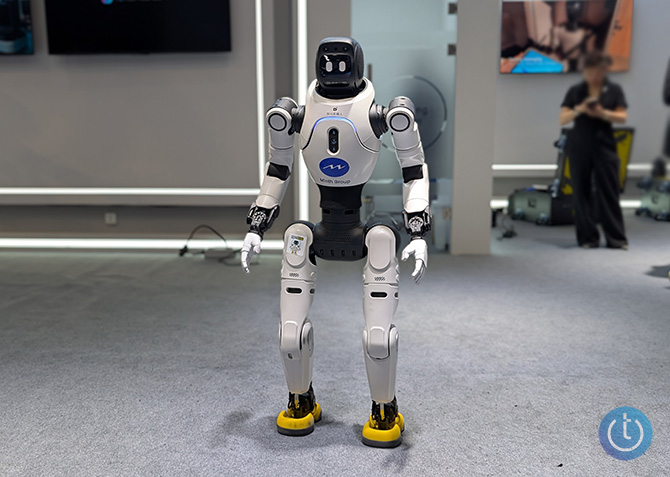
Humanoid robots have long been a staple of science fiction, but the industry is beginning to shift from laboratory prototypes to machines designed for real-world environments. At Mobile World Congress 2026, I had the chance to see one of the latest examples up close: the AGIBOT X2, a compact humanoid robot built for commercial interaction and entertainment.
AGIBOT is part of a growing wave of robotics companies working to combine advanced mechanics with increasingly capable AI systems. During MWC, I spoke with three company executives – William Shi, President of AGIBOT Europe, Patrick Gao, the company’s general manager for North America, and Howard Qiu, AGIBOT’s Chief Operating Officer of AGIBOT D1 – about where humanoid robotics stands today and where it may be heading.
While the long-term vision for humanoid robots includes industrial work, logistics, and household assistance, many of the first real-world deployments are happening in places where robots interact directly with people. That’s exactly the environment the X2 was designed for.
A Compact Robot Designed for Human Interaction
The AGIBOT X2 is a half-size humanoid robot standing about 131 cm (just over 4 feet) tall and weighing 35 kg. The robot’s mechanical system includes 25 degrees of freedom, allowing it to move fluidly and perform a wide range of gestures and full-body motions. It can walk at speeds up to 2 meters per second and runs on a 500 Wh battery that provides about two hours of operation.
Where the X2 differs from many robotics systems is its focus on interaction rather than heavy-duty physical work. The robot includes an interactive RGB camera system and a variety of sensors that allow it to recognize faces, track body movement, respond to voice commands, and react to touch. The robot can even display animated facial expressions that help convey emotion or status during conversations.
Those features may sound simple, but they’re critical for environments like retail stores, exhibitions, or tourism venues where robots are expected to engage with visitors in a natural way.
Motion That Shows How Far Robotics Has Come
Seeing the X2 in person at MWC was a proof-point for how quickly humanoid robotics has progressed. The robot’s balance, agility, and expressive movements were noticeably more fluid than what we saw from many earlier humanoid platforms just a few years ago.
The X2 supports more than 20 preset motion skills and can perform complex sequences of gestures and movement. It can transition between different body positions and even recover from a fall using self-righting capabilities. That level of physical control makes it possible for the robot to do things like greet visitors, demonstrate products, or even perform choreographed routines at events.
Early Use Cases for Humanoid Robots
Despite the impressive demonstrations, AGIBOT’s leadership emphasized that humanoid robotics remains in a very early stage of development.
On an expert panel at MWC, Shi said that one of the biggest challenges facing the industry today is data. Unlike language models trained on vast quantities of internet text, robots need enormous amounts of real-world physical data to learn how to interact safely and reliably with their environment.
That’s one reason companies like AGIBOT are focused on getting robots into real environments as quickly as possible. According to Qiu, the robots improve as they operate. Data collected from real-world deployments feeds back into the training process, allowing future versions of the systems to become smarter and more capable. It’s a feedback loop similar to what we’ve seen in other areas of AI: the more systems that are deployed, the faster the technology improves.
A Glimpse of the Future
Today there are still relatively few humanoid robots operating in the world. Shi estimated that the total number across all companies remains surprisingly small, though production is expected to scale rapidly in the coming years.
Over time, the range of applications could expand significantly. Gao noted that many industries are already facing shortages of skilled workers, particularly for repetitive or physically demanding jobs. In those cases, robotics could help fill gaps rather than simply replace human workers. Factories, logistics centers, and service businesses are increasingly exploring automation to maintain productivity as labor shortages grow.
For now, the AGIBOT X2 represents an early step in that direction – a glimpse of how humanoid robots may soon move from show floors and demonstrations into everyday environments where they work alongside people to enhance productivity and convenience.

