

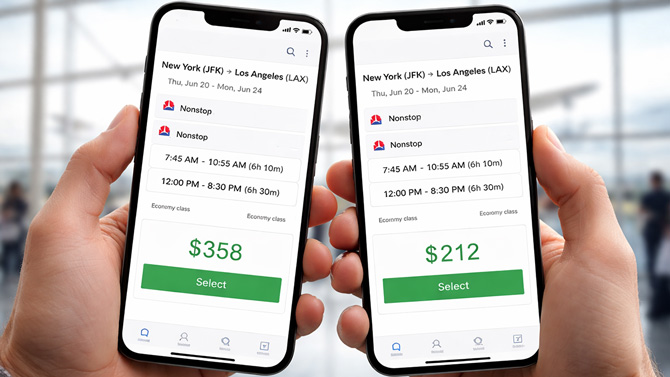
You and a friend search for the same flight at the same time on the same travel site. Yet somehow, your ticket costs more. It sounds unfair – but it’s exactly the scenario lawmakers are now investigating as artificial intelligence becomes more involved in setting prices.
Chairman of the House Oversight Committee James Comer (R-KY) recently asked several major companies – including Uber, Lyft, Expedia, Booking.com, and Instacart – to explain whether they use AI systems that adjust prices based on personal data about customers.
The concern centers on a practice known as “surveillance pricing.” Instead of offering everyone the same price, companies could use algorithms that analyze information about you – such as your browsing history, location, shopping behavior, and even how urgently you seem to want something – to determine the highest price you might be willing to pay.
What AI surveillance pricing actually means
Pricing algorithms themselves are not new. Airlines, hotels, and ride-sharing companies have used dynamic pricing for decades. Prices go up when demand rises and drop when demand falls. Think of airline tickets during the holidays or ride-share fares during a rainstorm. That’s traditional dynamic pricing at work.
According to Comer, the worry is: “Companies utilizing surveillance pricing deploy algorithms in conjunction with ‘harvested’ personal data to determine a consumer’s emotional state, purchase intent, maximum willingness to pay...and an individualized price is tailored accordingly." Further, Comer claims, "Surveillance pricing can be difficult to detect because consumers rarely have a view into what information a company has about them, what the prices they see are based on, or what prices other customers may be seeing for the same goods or services—making it difficult for consumers to make informed purchasing decisions."
A few companies contacted by Comer say they are not using personal data to set individualized prices. Uber said fares are based on factors like time, location, and demand rather than personal characteristics or browsing behavior, according to a Reuters report. Expedia and Instacart also denied using customer data to increase prices for individuals. Still, lawmakers want more transparency about how modern pricing algorithms work and what data they rely on.
Could this actually happen?
Artificial intelligence is rapidly expanding the capabilities of pricing software. AI systems can analyze massive amounts of behavioral data and make real-time adjustments to prices in ways that older systems couldn’t. That raises concerns among regulators that companies could eventually move toward hyper-personalized pricing without customers realizing it.
However, the technology to do it exists. Northeastern University reported that Delta President Glen Hauenstein described the company’s AI-assisted pricing tool to investors as “a super analyst” that could determine “a price that’s available on that flight, on that time, to you, the individual.” Delta denies using personal data for pricing. However, Christo Wilson, a Northeastern professor of computer science and founding member of the university’s Cybersecurity and Privacy Institute, said that “It very much sounded like this was being used for personalized, individual pricing.”
Right now, there is no clear evidence that major travel companies are widely using AI to set individualized prices based on personal data. However, lawmakers have passed or are considering rules that would require companies to disclose when algorithms influence prices or prohibit pricing based on sensitive personal data. New York's Algorithmic Pricing Disclosure Act, which took effect on November 10, 2025, requires conspicuous disclosure of personalized AI pricing with the statement, “This price was set by an algorithm using your personal data.” The Ohio Senate is considering similar measures (SB 79 and SB 328) and California's Fair Online Pricing Act is under consideration this year.
Read more: Flying Soon? Airlines Are Quietly Cracking Down on Li-Ion Batteries
What travelers should watch for
Even without personalized pricing, the travel industry already uses complex algorithms that can change prices quickly. If you’re booking flights or hotels, a few habits can help you avoid paying more than necessary. Compare prices across multiple sites and avoid repeatedly refreshing the same search. Check fares on different devices or use your browser's incognito mode. And if you have time, set up a price-tracking tool to receive an alert when the price drops. These steps won’t guarantee a lower price, but they can help you spot sudden price swings.
For now, the bigger question isn’t whether AI can set personalized prices – it’s whether travel providers will in the future. And that’s exactly what lawmakers want to get a handle on before it becomes the norm.
Read next: Zenni Blocks Facial Recognition with Rose Colored Glasses
[Image credit: Suzanne Kantra/Techlicious via ChatGPT]

