

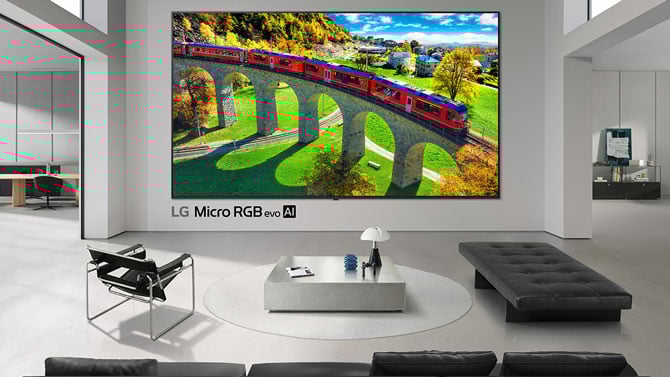
LG’s new Micro RGB evo TV (model MRGB95) is its most advanced LCD television to date, and it arrives at a moment when display terminology has become misleading. In recent years, Samsung, Sony, and Hisense have all been talking up MicroLED – essentially a more durable replacement for “organic” LED (OLED). So it’s easy to assume LG is chasing the same technology. It isn’t. And that’s precisely why this TV is worth paying attention to.
When companies like Samsung, Sony, and Hisense talk about MicroLED TVs, they are generally referring to true self-emissive displays, like OLEDs. Each pixel is its own light source, built from microscopic red, green, and blue LEDs. There is no LCD layer, no backlight, and no color filter for the backlight. They behave like OLEDs, just with inorganic LEDs that can get brighter and avoid burn-in – a slight, ghostly image remaining permanently on the screen.
LG’s new evo TV works differently. It has a Mini-LED LCD screen, like those found in mainstream TVs these days, but it uses MicroLED technology to provide a more color-precise backlight behind the LCD. That distinction may sound technical, but it’s the entire story. You get a much better LCD TV that's more likely to fall to an affordable price.
MicroLED TVs, in contrast, come with a ridiculously high price tag for a “consumer” product. Samsung’s MicroLED MS1B series starts at $109,999 for an 89-inch screen. Hisense’s 136-inch 136MX MicroLED debuted at $99,999 at CES 2025. Sony’s Crystal LED displays live in the same rarefied, custom-installation world. These are technological marvels, but they are also massive, expensive, and often require professional installation. They’re aspirational showpieces, not televisions that most people can reasonably consider for their homes.
Read more:Streaming Video Ads Too Loud? Here’s How to Quiet Them Right Now
Micro RGB TVs take a different path. They keep the LCD structure intact but dramatically upgrade the backlight. Instead of sending white or blue LED light through color filters to produce red, green, and blue light, LG uses separate red, green, and blue micro-sized LEDs behind the LCD panel. The pixels themselves are still in the LCD layer, but the light feeding them is far more precise and far more efficient.
Traditional LCDs lose efficiency and accuracy because the color filters block a lot of light. By generating red, green, and blue light directly in the backlight, Micro RGB TVs preserve color intensity even at extreme brightness levels. That’s not just marketing language. LG says its Micro RGB evo is certified by quality-assurance company Intertek for 100 percent coverage of the three richest color standards – BT.2020, DCI-P3, and Adobe RGB – essentially the full “triple crown” of today’s color spaces.
LG isn’t alone in this new category. Samsung launched 115-inch Micro RGB TV this fall, priced at $29,999. That’s a high price, but it's also for a very big TV using cutting-edge technology. LG’s Micro RGB evo, which will be available in 100-inch, 86-inch, and 75-inch sizes, is compelling because it’s positioned to deliver many of the benefits of MicroLED TVs at a much lower cost. Yes, pricing will still land in the ultra-premium category, but the technology can realistically trickle down into future high-end and eventually mainstream LCD TVs.
Read more: Portable CD Players Make a Comeback, with These 4 Models Out Front
[Image credit: LG]

