
We may earn commissions when you buy from links on our site. Why you can trust us.

Samsung Music Studio 7 Review: Rich, Powerful Sound, Zero Setup
by Sherri L. Smith on April 08, 2026

I’ve owned a number of televisions over the years. And I have to tell you, there have been more than a few moments when I’ve gnashed my teeth because the audio is nowhere near the visual quality. The result? Researching and investing in a soundbar or speaker setup to achieve some audio-visual parity. However, when it comes to home theater setups, no matter how simple the company says it will be, there will be some kind of calibration as you work to bring the different channels into alignment to create an optimal audio experience in the room. And as much as I like to tinker, sometimes I want to just unbox, plug it in, and go.
Samsung is offering such a solution with its Music Studio Wi-Fi smart speakers. Designed to work independently or with other audio components such as a soundbar, Music Studio 7 delivers warm, balanced audio and a bunch of features designed to enhance your listening experience. I recently had the opportunity to test the Music Studio 7. Here are my thoughts.
| + Pros | – Cons | |
|
|
|
|
||
Pricing and availability
The Music Studio speakers are currently available in two varieties. I demoed the Music Studio 7, which costs $499.99 per speaker. Each speaker features a 3.1.1 channel setup consisting of three main channels – left, front/center, and right channels – plus an up-firing driver and a built-in subwoofer. The Studio 7 offers a more immersive audio experience than its counterpart, the Music Studio 5 speaker. Priced at $299.99, the Music Studio 5 has a 2.0 channel setup of two tweeters and an integrated subwoofer.
Design
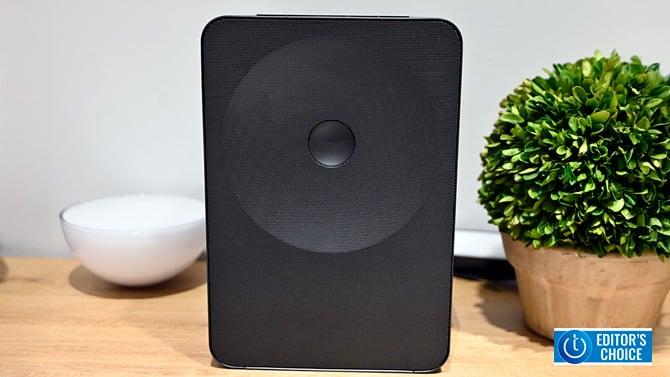
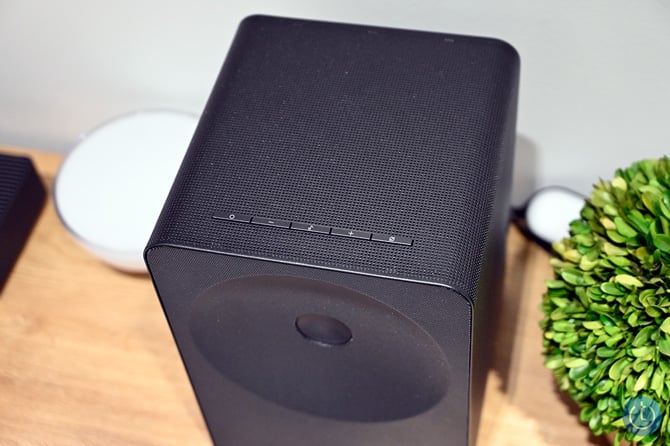
The Music Studio 7 makes for a fine-looking pair of speakers. The charcoal black rectangular housing is minimalist and stately, toeing the line between art and furniture. The result of a collaboration with renowned artist and designer Erwan Bourollec, the Dot Design focuses on the titular circular dot on the front of the device. They’re not the centerpiece of the room, but they add a touch of elegance to just about any decor, nonetheless.
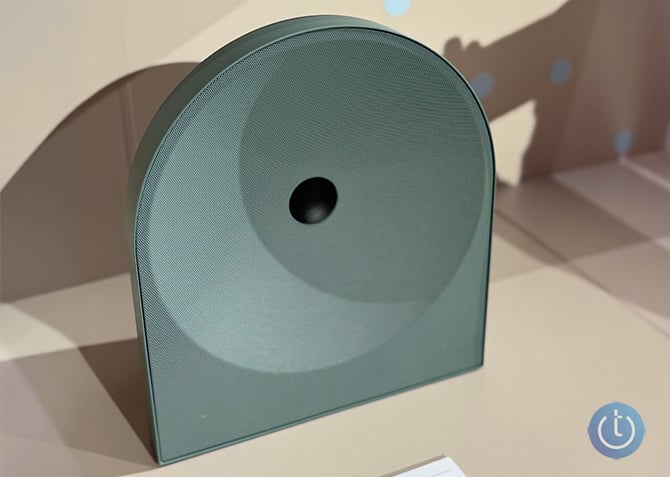
Nine out of ten, when it comes to audio, I’m going to choose the speaker with the best performance and features. However, I have to say, I prefer the Studio 5 as it eschews the rectangular shape, going all in on the circular motif. They offer a more visually striking presentation that speaks to me.
In terms of dimensions, neither pair of speakers takes up much real estate. The Music Studio 5 weighs 5.29 pounds and measures 9.88 x 11.18 x 5.39 inches. The Music Studio 7 has a more substantial footprint of 7.28 x 10.59 x 7.5 inches and weighs 12.35 pounds. Either can fit comfortably in an entertainment system or on a TV stand.
Features
The Studio 7 comes packed with features. My favorite is SpaceFit Sound Pro, which utilizes integrated mics to examine audio reflections in whatever room you’re planning to use the speakers in, using test acoustics. From there, the software calibrates the audio to best match the room. In addition to optimizing audio for every channel plus the subwoofer, the Sound Pro also keeps track of content engagement and automatically adapts the sound according to circumstance. So, whether you’re watching a breathy romance, an action movie bursting with explosions, or slaying a dragon in a game, Sound Pro will adjust without you lifting a finger.
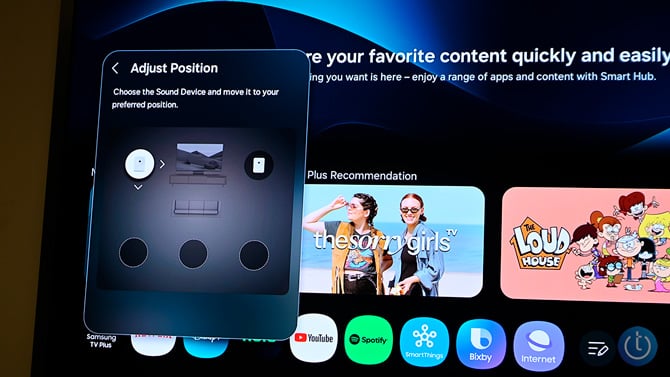
Q-Symphony is another cool feature. It allows for wireless syncing between the Studio 7, your Samsung TV, and up to three additional Samsung audio devices. Want even more audio power? Throw a soundbar in for good measure. Samsung has also launched a new app called Samsung Sound that acts as an aggregator of all your connected Samsung audio devices, allowing you to create custom audio groups for multi-room or single-room experiences. You can also tailor your listening preferences with equalizers and sound mods.
For the bass lovers, there’s AI Dynamic Bass Control, a patented Samsung technology that uses AI to monitor your audio, adjusting the lows in real time. The result is powerful bass that isn’t diffused or distorted. The Studio 7 also has Waveguide Technology, another patent that helps the speakers create immersive audio with a wider soundstage and better clarity. That means instead of having to sit in the very center of the speakers to snag that coveted sweet spot, I got a stellar performance even though I was sitting left of center.
Finally, to further improve audio clarity, you have the company’s Pattern Control Technology. It uses algorithms to manage audio signals and works to cut down on signal overlap between different audio channels, for a cleaner result when Dolby Atmos 3D audio is enabled. In short, the technology prevents audio bleed between the three channels (left, front/center, right), ensuring that finer details like a whisper or the flicker of a flame instead aren’t buried under a weighty explosion or loud soundtrack music.
Performance
The Music Studio 7 sounds pretty gosh darn good. I listened to several tracks as well as watched a few movie clips. And no matter what I watched or listened to, the Studio 7 delivered warm, balanced audio with a generous soundstage and clean detail.
I started my testing with a scene from “The Old Guard”. Andy (actor Charlize Theron) and her team infiltrate what’s supposed to be an enemy base, only to discover the entire operation is a setup. The scene opens with a helicopter dropping the team off at their destination; the steady pulse of the blades spinning punctuates the heavy strings of the background music. The gentle bleating of goats and the soft crunch of footsteps as the team made their way to their destination were crisp. The same can be said for the blunt, meaty sound as a bullet hit an unsuspecting guard. A satisfying metallic clink from the spent bullet casing isn’t buried under the pulsating drumline as the team infiltrates the base.
The scene culminates as Andy lets out a tight, frustrated expletive that’s cut off by an explosive volley of gunfire. The team goes down in a hail of bullets punctuated by the sound of numerous shell casings hitting the concrete floor. I was impressed at how well the speakers handled the finer details of the scene, particularly the dialogue. It’s been my experience that on certain speakers and soundbars, dialogue comes in lower than music, explosions, or other background noise. It was nice to hear that Theron’s swear word wasn’t lost in the midst of the action.
I also streamed a few songs from Spotify. To test the speakers’ Hi-Fi chops, I set the stream quality to Lossless (up to 24-bit/44.1kHz). Speaking of which, the Studio 7 has Spotify Tap, so you can start listening to your playlist with the tap of a button. But back to the testing. I started with Van Morrison’s “Moondance”. My ears were immediately buffeted with warm piano, complete with a tinkling trill. I clearly heard the strumming of the bass as the artist’s dulcet tenor drove the song, while a clean flute, a brassy horn, and crisp percussion completed the composition. The generous soundstage allowed me to focus on individual parts of the track without much effort. And although I wasn’t sitting in the center of the Studio 7 speakers, I didn’t notice any deficits.
Next, I listened to one of my favorite songs, Santana’s “Europa (Earth’s Cry Heaven’s Smile)”. And as expected, Santana's electric guitar was front and center. But it didn't overwhelm the organ, warm bass, or synthesized strings. The sound was so clean, I could hear the brassiness of the cymbals right along with hits to the snare, kick, and high-hat.
Verdict
Set it and forget it never looked or sounded this good. The Samsung Music Studio 7 speakers are made for those of us who just want to turn a gadget on and have it just work. The 3.1.1 channel system, combined with Samsung’s proprietary technologies, ensures a great listening experience regardless of where you are in the space and what you’re watching or listening to. They’re stylish, even if they sport a more traditional design, and can synchronize with up to four additional Samsung audio sources. They’re a little pricey compared to some competing systems, but for the number of features and ease of use, it’s worth spending a little more.
[Image credit: Sherri L. Smith/Techlicious, Jonathan Takiff/Techlicious]

