

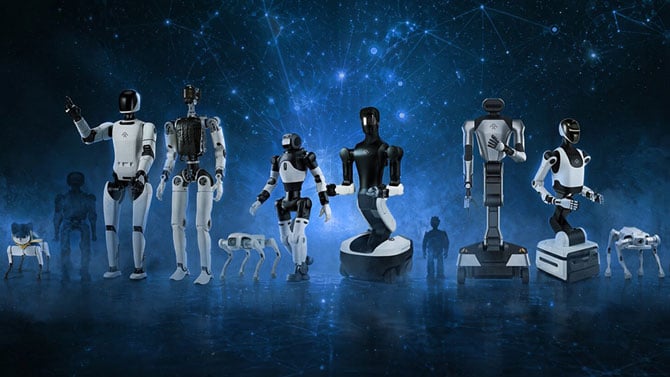
Faraday Future (FF) has spent the past year building out one of the more ambitious robotics portfolios in the U.S. market. At the Automate show in Chicago this week, the California-based company pulled it all together, unveiling the final pieces of what it calls its Full-Form EAI Robot World – the full six-series family now includes three humanoids (Futurist, Master, and Nova), two quadruped lines (Aegis and Navi), and the newly launched mobile manipulator series, Faber.
The strategy behind the lineup is what FF calls "one brain, multiple forms." Rather than developing separate AI systems for each robot type, the company built a single AI brain that learns from everything its robots see and do and then adapts it across different hardware configurations. In practice, that means a skill developed for one robot can be transferred to another. As Hong Liu, FF's Manager of Social Media Channel Growth, put it at the show: "It's basically an app store for the robots. Somebody already developed how to fold clothes, you just download that function and your robot has it."
The All-New Futurist
The centerpiece humanoid is the All-New Futurist, a full-size robot standing about 5'8" and weighing roughly 121 pounds – about 14% lighter than the previous generation. The robot can move its joints in 31 distinct ways (not counting the hands), giving it human-like range of motion across its body. A new dual-battery system that delivers around six hours of continuous operation, three times what the previous Futurist version managed. The Ultra version can return to its charging dock autonomously when the battery runs low.
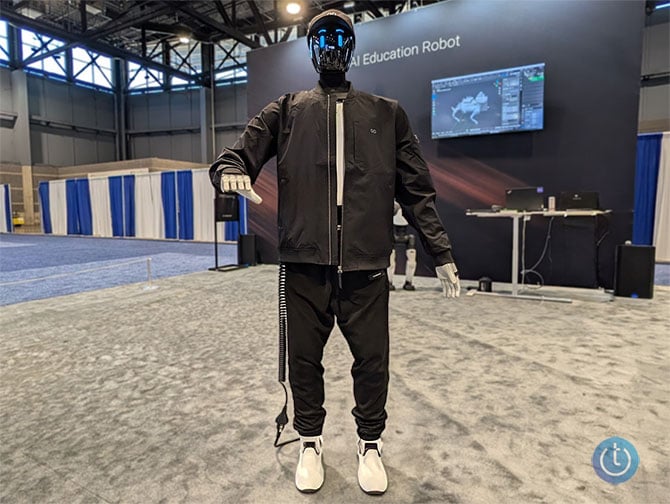
What makes the Futurist useful for robotics researchers is its native compatibility with NVIDIA's SONIC whole-body motion control system – FF says it's the first full-size humanoid in the U.S. to support it natively. That gives academic labs a purpose-built platform for humanoid motion research. Price is $89,900 on the FF website, which includes a $10,000 Skills package. The upgraded Ultra version powered by NVIDIA's Jetson Thor compute platform is planned for later this year, with pricing to be announced.
Faber: the industrial mobile manipulator
The bigger news for commercial buyers may be the Faber series, FF's first industrial-grade mobile manipulator. The name comes from the Latin for "skilled craftsman," and the product sits in the middle ground between fixed robotic arms (precise but stationary) and autonomous mobile robots, or AMRs (which move freely but can't pick things up). Faber does both – it can navigate a factory floor or warehouse independently and then use dual arms to handle loading, unloading, sorting, and material transfer.
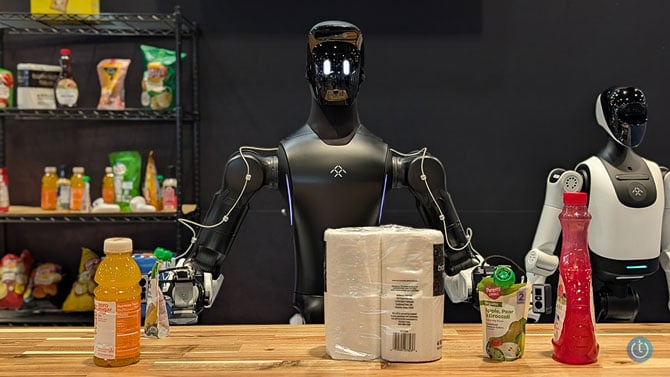
A single arm can lift up to 11 pounds; both arms together can tackle heavier or more delicate operations. At the show, FF was demonstrating a supermarket shelf-sorting scenario – showing how the robot handles objects of different shapes, weights, and materials. As Liu explained, teaching robots to handle varied objects is one of the genuinely hard problems: "Every potato looks different. There might be 100 million different kinds. Similarly, the robot needs to learn how much force to apply so it doesn't crush a plastic bottle or dent an aluminum can."
According to the company, FF plans to eventually put Faber to work on its own production line to help manufacture future robots – a "robots building robots" use case that would serve as both a proof of concept and a way to bring down production costs over time.
Robot bodies are available for purchase now via FF's website.
Aegis: the security robot dog
On the quadruped side, the Aegis is positioned as a practical tool for small businesses and property managers. FF says customers in Florida and Las Vegas are already using Aegis robots to patrol Airbnb complexes – communities with 15 or more units where a roving robot with flashing deterrent lights handles overnight security rounds. Car dealerships and shopping malls have also shown interest.
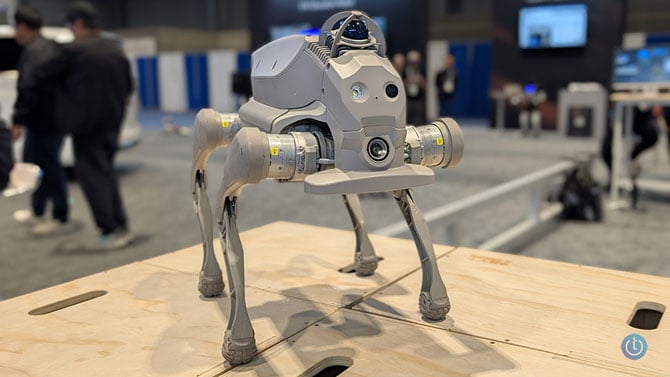
The base Aegis Ultra starts around $4,000 and scales up to roughly $12,000 for a fully configured version on wheels. What makes the platform flexible is its modular upgrade system: LiDAR, a 5G modem, a speaker, and night vision can all be added through a battery port. Battery life runs about two and a half hours per charge, but the batteries are hot-swappable – pull one out, snap in a fresh one, and the robot keeps going without waiting for a charge cycle. The robot can also return to its dock and recharge autonomously if that's your preferred setup.
Navi: the $1,990 robot dog for education
Navi is a simpler robot dog that is a core piece of FF's education strategy. At $1,990, FF says it's the only robot dog in the U.S. under $2,000 that supports secondary development – meaning students and developers can actually program it, not just watch it perform pre-set routines.
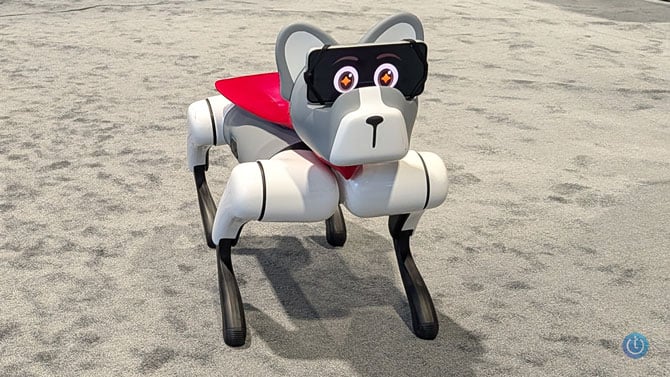
FF is already working with after-school programs and school districts through its Brain Blocks platform, a drag-and-drop coding environment aimed at younger students. Kids write code, validate it in simulation first, then deploy it to a physical robot. The platform also surfaces the underlying Python code that the visual blocks generate, giving students a bridge into real programming. For more serious developers, FF offers full SDK access and open APIs for motor control and reinforcement learning.
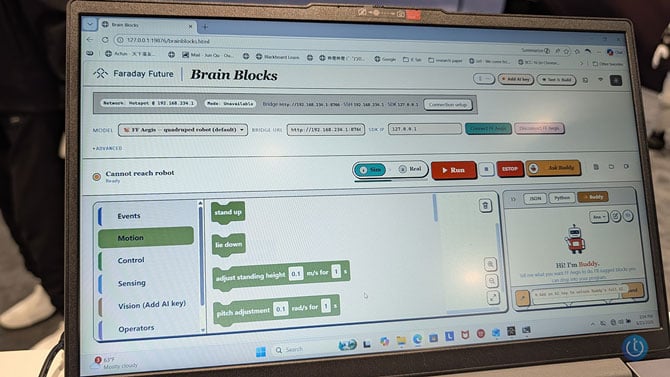
Brain Blocks isn’t limited to the Navi, however. The same modular programming tool can be used with some of FF’s humanoid robots, as well. Anyone who wants to give Brain Blocks a try can use it for free in a simulation environment at developer.ff.com/block-coding.
The ecosystem underneath
The hardware is only part of what FF is selling. The company's longer-term play is a platform where developers build and share robot skills, industrial partners deploy customized solutions, and data collected across all those robots feeds back to improve the underlying AI. FF's subsidiary AIxC is also launching robotshare.com, a robot-sharing platform designed to let businesses rent out idle robots – an Uber-style model that turns a capital purchase into a revenue-generating asset.
On the manufacturing side, FF does final assembly at its U.S. headquarters in California. Core components including chips and batteries are sourced domestically. All data generated by the robots is stored in the U.S. – which Faraday Future sees as a critical distinction for enterprise or government buyers navigating the current tariff and supply chain environment.
[Image credit: Josh Kirschner/Techlicious, Faraday Future]

