
We may earn commissions when you buy from links on our site. Why you can trust us.

The best open-ear earbuds of 2026, tested
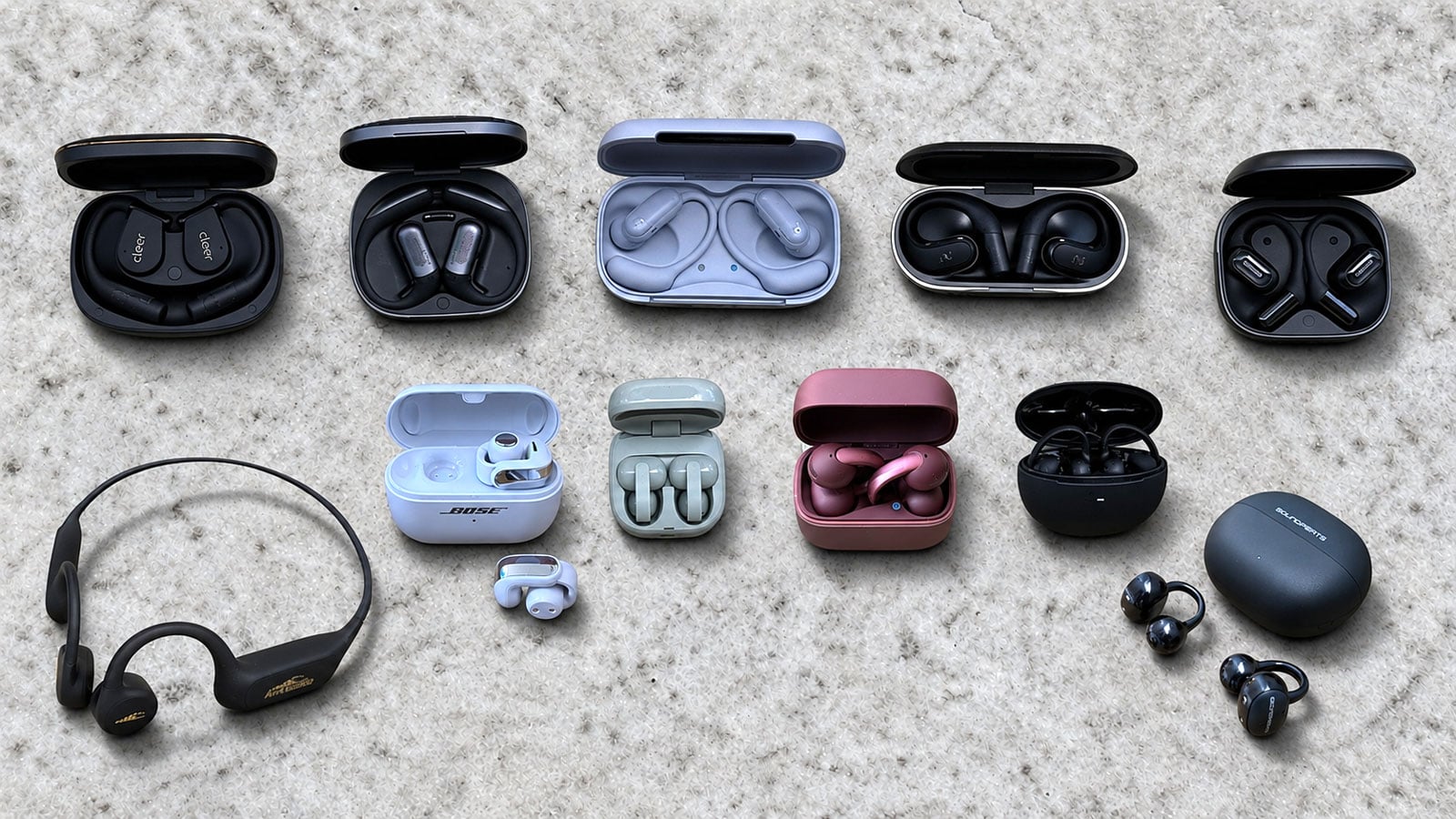
Image credit: Jonathan Takiff/Techlicious
Open-ear (OE) buds leave your ear canals open, which can feel more comfortable than sealed earbuds or over-ear headphones. You can hear more of what is going on around you while you listen. For any headphone style, hearing risk depends on how loud and how long you listen.
Start shopping around and you'll find that OE buds now come in two dominant varieties that both answer to the technical description "Air Conduction."
"Ear-hook" models, a bit more headphone-ish, suspend an oval-shaped combination speaker, microphone, and control component so it hovers over the opening to your ear canal. This business end is held in place by a springy, supportive, rubber-coated hook that wraps around the back of the ear, with a weighted stabilizer piece at the end. These suspension rigs have gotten slimmer and more flexible in recent models, so they coexist better with the temples (arms) of your glasses frames.
The "Clip-on" variety of open-ear buds resembles cuff-style earrings. A springy, grippy, semicircular band (silicone-wrapped) connects front and back components and wraps the package around your earlobe. Electronics are split between the two sections. The rounded front speaker sits inside the bottom bowl of your ear, millimeters away from the ear canal. Controls and battery are fitted into the back portion tucked behind your earlobe, which can be a little problematic for long-haired users. But there's no interference when wearing glasses or most hats.
Bone conduction headphones also leave the ear canal open. Small transducers rest against the cheekbones and send vibrations through the skull to the inner ear. Ear-hook and clip-on earbuds use small speakers that send sound through the air toward the ear canal. Bone conduction models typically hold the transducers in place with a band around the back of the head.
That wraparound fit can work well for running, and swim-rated models can play audio from onboard storage in the pool, where Bluetooth is unreliable. This roundup includes both styles of air-conduction earbuds and one swim-ready bone conduction pick, the H2O Audio TRI Ultra Pro. For running, I also recommend the Shokz OpenRun Pro 2.
Some audiophiles have complained in the past that all open-ear models sacrifice performance. They cite undernourished bass, muffled voices, brittle high-end response, and poor phone call quality that sparked grumbling: "Are you stuck in a tunnel?"
In the best models I tested, larger, better-focused drivers improved sound, and extra microphones and digital processing helped make calls clearer.
Quick Picks
Top ear-hook open-ear buds
- Best ear-hook all-around performance
- Best ear-hook sound quality
- Best noise-cancelling open-ear buds
- Best note-taking open-ear buds
- Best budget ear-hook buds
Top bone conduction headphones
Top clip-on open-ear buds
- Best clip-on all-around performance
- Best for accurate sound and active use
- Best for phone calling in noisy environments
- Best budget clip-on buds
- Best budget clip-ons for calling
How I tested
In picking "Best of 2026" OE buds faves, accurate, true-to-life sound reproduction remains the highest priority. But novel features and seriously sharp pricing are also worthy of attention and praise.
For comparison's sake, I repeatedly played well-engineered, high-resolution tracks (sourced mostly from Qobuz) that challenged the earbuds' ability to reproduce voices and instruments as I've heard them sound in person. Comparisons were initially done with all the buds left at their factory default EQ setting, though I'd later revisit and fuss with settings to see if I could correct deficiencies.
For starters, I cycled Icelandic jazz pop darlin' Laufey's lyrical waltz Carousel and the Steely Dan classic Doctor Wu. Both are numbers I could tolerate hearing many times over. Then I moved to some heavier tracks, including the fresh and boisterous neo-soul tune She Knows Too Much from Thundercat (with the late Mac Miller) and a 2025 remastered rendering of the orchestral rock classic Kashmir from Led Zeppelin.
And yeah, what proved good for the goose was good for the gander too.
Other factors were also considered in culling the herd (from 30 to a final 11). My best-of-the-bunch offer extended (multi-hour) wearing comfort, reliable controls, lengthy battery run time, and (at least) reasonably clear sound on phone calls.
This year's top crop also includes more applications of noise cancellation, spatial audio, and the first OE buds I've encountered with AI note-taking and translating skills. And even the bargain buds we're spotlighting offer multipoint pairing, useful when bouncing between audio sources on your computer and smartphone.
Top ear-hook open-ear buds
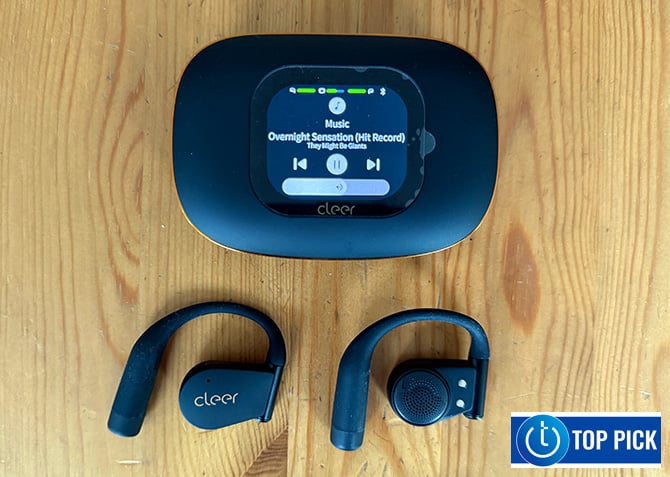
Cleer ARC 5: Best all-around performance
With this fifth-generation update, the Cleer ARC 5 earns "primo" status with dramatic, over-sized sonics (from 16.2 mm drivers!), a slimmed-down ear-hook design and a host of added features you won't find elsewhere.
The ARC 5s offer two spatial audio options: THX Spatial Audio and Dolby Atmos optimization. With the latter engaged, the ARC 5s outdazzled the likewise Atmos-adept Shokz OpenFit Pro buds (see below) on Atmos mixes old (The Who's Baba O'Riley), blue (Taj Mahal and Keb' Mo's Junkyard Dog), and new (Robyn's aptly named Blow My Mind). This spatial processing enhances video game and movie soundtracks, too.
Controls on the ARC 5 are super-abundant, a treat for listeners who like to "fuss." A very spiffy AMOLED color touchscreen on the case lid offers a good array of music monitoring and operation options, freeing up your phone for other chores. With some form of motion detection on board, just shaking your head can pick up or reject a phone call. The thermal touch control pads on the buds are maybe too sensitive (be careful). But I've got only good things to say about the uncommon button that reliably triggers power on/off.
For germaphobes, UV-C light sterilization kicks on every time you return the ARC 5 buds to the case. That's a nice thing to have working after your snot-nosed kid borrowed them.
Phone pals were impressed by the sound of my voice at their end of a Cleer-miked call, thanks to Qualcomm aptX Voice processing.
The Cleers also impress with their unusually long playback time per charge, superior water/sweat resistance rating and rare embrace of alternative, high-res codecs. Yeah, the ARC 5s check almost all the right boxes.
Key specs:
- Battery: Up to 12 hours per charge and 60 hours with the case. A 10-minute charge gives up to 4 hours. USB-C charging.
- Microphones: Two Qualcomm cVc microphones.
- Water and dust resistance: IPX7 (earbuds).
- Codecs: SBC, AAC, LC3, LDAC, aptX Adaptive and aptX Lossless, THX Spatial Audio and Dolby Atmos optimization.
- Bluetooth version: 5.4
- Weight: 11.5 g per earbud and 117 g with the case.
- Extras: AMOLED touchscreen case, multipoint pairing.
Price: $219.99
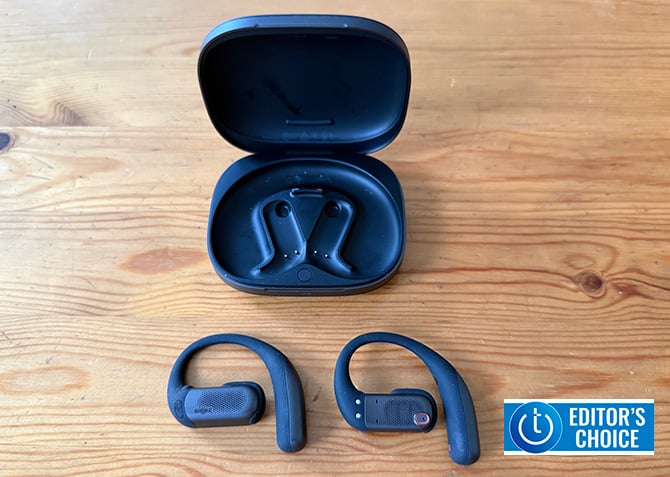
Shokz OpenFit Pro: Best sound reproduction
There's serious competition going on in the "most accurate sound" category amongst ear hook buds. But the very forward, tightly articulated and sometimes even visceral sound coming out of the Shokz OpenFit Pro won this category by a sliver, besting the also worthy Beyerdynamic Amiron 200 and the aforementioned Cleer ARC 5.
What's this winner's ace-in-the-hole? The Shokz OpenFit Pro stands apart with a rare, two-driver configuration in each bud plus an open-backed sound chamber. Both contribute to the extra-impressive musical airiness and clarity. And when the low-frequency EQ boost is activated, these things deliver a bass response so tingly they could pass for bone conduction headphones (Shokz' original claim to fame).
The well-featured OpenFit Pro also stands out with an Active Noise Reduction option that tamps down persistent sounds (like fan noise). And its licensed Dolby Atmos processing mode does work some cute location-shifting trickery on your senses with spatial mixed content. Wiggling your noggin with "head tracking" engaged likewise enhances the soundfield-expanding sensations.
Key specs:
- Battery: Up to 12 hours per charge and 50 hours with the case, or 6 hours per charge with noise reduction. A 10-minute charge gives up to 4 hours. About 70 minutes for earbuds, 2 hours for the case over USB-C or 3 hours over Qi.
- Microphones: Triple-mic system with AI call noise reduction.
- Water and dust resistance: IP55 (earbuds).
- Codecs: SBC and AAC.
- Bluetooth version: 6.1
- Weight: About 12.3 g per earbud and 99.3 g for the empty case.
- Extras: Physical buttons, multipoint, and Dolby Atmos with head tracking.
Price: $249.95
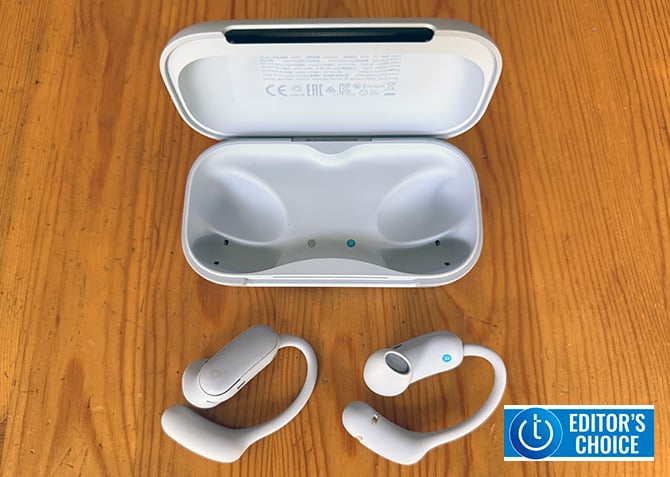
Soundcore AeroFit 2 Pro: Best noise-cancelling open-ear buds
Two-two-two buds in one. That's the novel "Dual Form" AeroFit 2 Pro from Soundcore, billed by the company as the world's first earbuds to function differently, in two separate modes, as both open-ear and active noise-cancelling earbuds.
Shift each rotating bud upwards into the first or second "click" position (so they sit north of your ear canal) and you get to enjoy a sedate, laid-back sound, with lots of the outside world filtering in. Deploy this mode for calming companionship as you go about your daily routines.
But then when you rotate the almond-shaped buds downwards to their bottom (4 or 5) click stop position, you get to enjoy a whole 'nother listening experience. Hovering extra close to the ear canal, the sound is bright, bold, brassy, and bassy.
Closer proximity of the bud drivers to your ear canal accounts for part of the change, but Soundcore also actively retunes and re-equalizes the buds when they're shifted downwards (you can hear it transitioning if listening closely). And now a substantial level of true Active Noise Cancellation kicks in, too. The ANC works especially well at eliminating steady droning sounds like the hum of a vacuum cleaner or bus engine. While they weren't a match for the 95-percent cabin-shushing Bose QC Ultra Earbuds 2nd gen on an airplane ride, the Soundcores did cut the jet engine roar by about 50 percent.
Phone calls also sound terrific with the buds in their down-pointing position. You might think the other party was literally whispering in your ear.
An AeroFit 2 Pro wearer also gets to weigh in on the musical soundscape tuning, more so than with any other OE buds in my testing. There are two dozen EQ preset options, including a hearing-test-generated (then automatically re-tuning) "Preference Mode" and a "Volume Boost" option that makes these entries the loudest of the lot.
While comfort level was consistently good for me, Soundcore knows their hybrid design might not be a good fit for everyone's ears. So these things come with a 30-day return policy. The maker is also upfront that the 56-degree bud-rotating chassis (and an equally accommodating carry case) do make this package a little larger and heavier than the competition.
Key specs:
- Battery: Up to 7 hours per charge and 34 hours with the case in open-ear mode, or 5 and 24 hours with ANC. A 10-minute charge gives up to 3.5 hours. About 1 hour for earbuds, 2 hours for the case over USB-C, or 4 hours with wireless charging.
- Microphones: Four microphones with AI call noise reduction.
- Water and dust resistance: IP55 (earbuds).
- AI and Voice Assistants: Touch controls activate the connected device's voice assistant.
- Codecs: SBC, AAC and LDAC.
- Bluetooth version: 6.1
- Weight: 10.4 g per earbud and 88.2 g for the empty case.
- Extras: Adjustable open-ear and ANC modes, multipoint pairing and app-based translation.
Price: $179.95
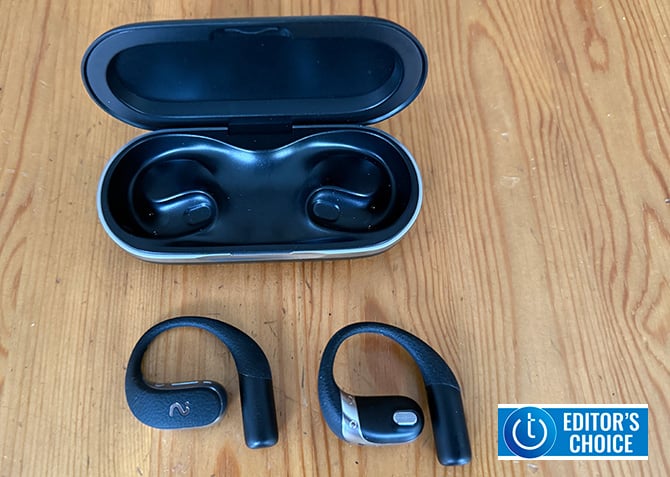
Viaim OpenNote: Best note-taking open-ear buds
Viaim's new AI-enhanced OpenNote buds have special skills that could serve you well in the workplace or classroom.
If an important call comes in or a lecturer starts talking while you're wearing them, a single tap on the buds (or on the companion Viaim app for Android, iPhone and iPad) triggers a recording to start and a text transcription you can then share. What happens if you're stuck in the back of the room? No problem. Mic sensitivity is rated at 7 meters, or 23 feet.
If multiple people are engaged in your (recording in progress) conversation and refer to each other by name, the buds' integrated AI assistant differentiates between the voices and tags comments with the speaker's name. The smart transcriber also summarizes the session with key points (effectively creating a study guide) and strategically suggests next avenues or actions to pursue.
What if the conversation is in another language or bilingual? OpenNote can perform transcription and translation in both languages (it's adept in 78!) that you can share on your connected phone's screen.
Just as with the "real time" translation feature on the Apple AirPods 3, I found the Viaim language conversion is laggy and skips lines when transcribing if the speakers don't pause after every sentence. But the Smart Assistant summarization (available shortly thereafter) proves more accurate, thorough, and shockingly analytical.
Can't say I love the Viaim OpenNote buds on all levels. Optimized for voice clarity, music playback is hard-edged and at times scratchy even at the optimized (default) "Master EQ" position.
That said, the Viaim OpenNotes are lightweight, securely snug, and comfortable. The claimed run time is dramatically long, best of the species. Pinch and voice-activated control options work well.
One last thought: the OpenNote buds would benefit from a more reassuring, dedicated recording trigger button on the carry case, as found in the maker's RecDot in-ear true wireless earbuds.
Key specs:
- Battery: Up to 19 hours per charge and 53 hours with the case. A 10-minute charge gives up to 3 hours. About 1.5 hours for earbuds and 2 hours for the case over USB-C.
- Microphones: Four microphones with call noise reduction. Voice recording range up to 7 m (23 ft).
- Water and dust resistance: IP55 (earbuds).
- AI and Voice Assistants: Vitana assistant in the viaim app. The Basic plan lists Google Gemini, OpenAI GPT and Anthropic Claude models for note processing.
- Codecs: SBC, AAC, and LHDC.
- Bluetooth version: 5.3
- Weight: 10.5 g per earbud and 55.5 g for the empty case.
- Extras: Onboard storage for recordings, translation, transcription in 78 languages, 600 transcription minutes per month on the Basic plan, and multipoint pairing.
Price: $169.95
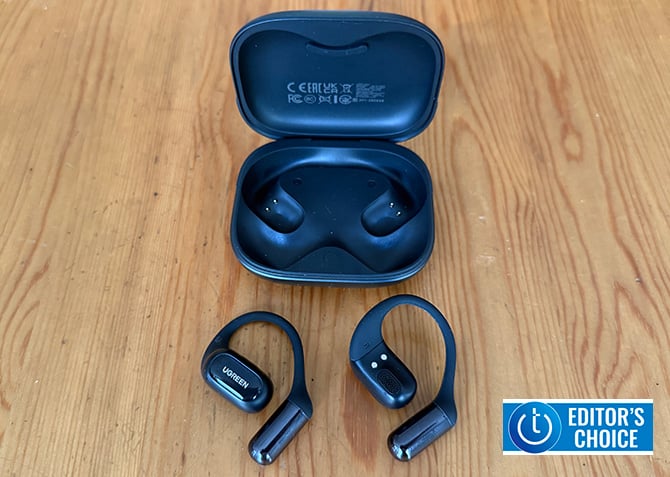
UGREEN FitBuds: Best budget ear-hook buds
Still not sure if open-ear buds are worth a serious investment? The UGREEN FitBuds let you wade into the waters at a surprisingly modest (under $40) price, with much better than expected performance. And even when you later work up to a primo "Hi-Res Audio" rated pair, I bet you'll hold onto these things as backups or kindly give them away to a pal or child.
Yes, there's a little telltale cost-cutting going on here. Control tapping operations on the bud backs are delicate and take practice to get right. Lacking in-ear sensors, music keeps playing until the FitBuds are back in their case. Codec support is limited to SBC and AAC.
Still, these things are plenty pleasing. The case is sturdy, the buds look nice and are feather-light. The silicone-wrapped hooks fit around my ears securely and very comfortably.
Best of all? You'll like what you hear: nicely balanced, uncolored music reproduction, neither burying nor exaggerating any instruments on a track. Vocals have presence, lyrics are cleanly telegraphed, which made for a fine first encounter with the clever Canadian singer-songwriter Boy Golden (aka Liam Duncan) who's now touring the States.
These OE buds' 8-hour playback time per charge is respectable. And the UGREEN app features most of the essentials: battery gauge, control customization, 8 EQ presets (though not a user tune-up option), Dual Link device switching. There's even a (modestly effective) Spatial Sound mode and "Find your Earbuds" homing feature.
Key specs:
- Battery: Up to 8 hours per charge and 28 hours with the case. A 10-minute charge gives up to 2 hours. About 1.5 hours to charge the earbuds and 2 hours for the case.
- Microphones: Four microphones with AI call noise reduction.
- Water and dust resistance: IPX5 (earbuds).
- AI and Voice Assistants: Controls can activate the connected device's voice assistant.
- Codecs: SBC and AAC.
- Bluetooth version: 6.0
- Weight: About 5 g per earbud.
- Extras: Spatial audio, multipoint, and a low-latency gaming mode.
Price: $35.99
Top bone conduction headphones
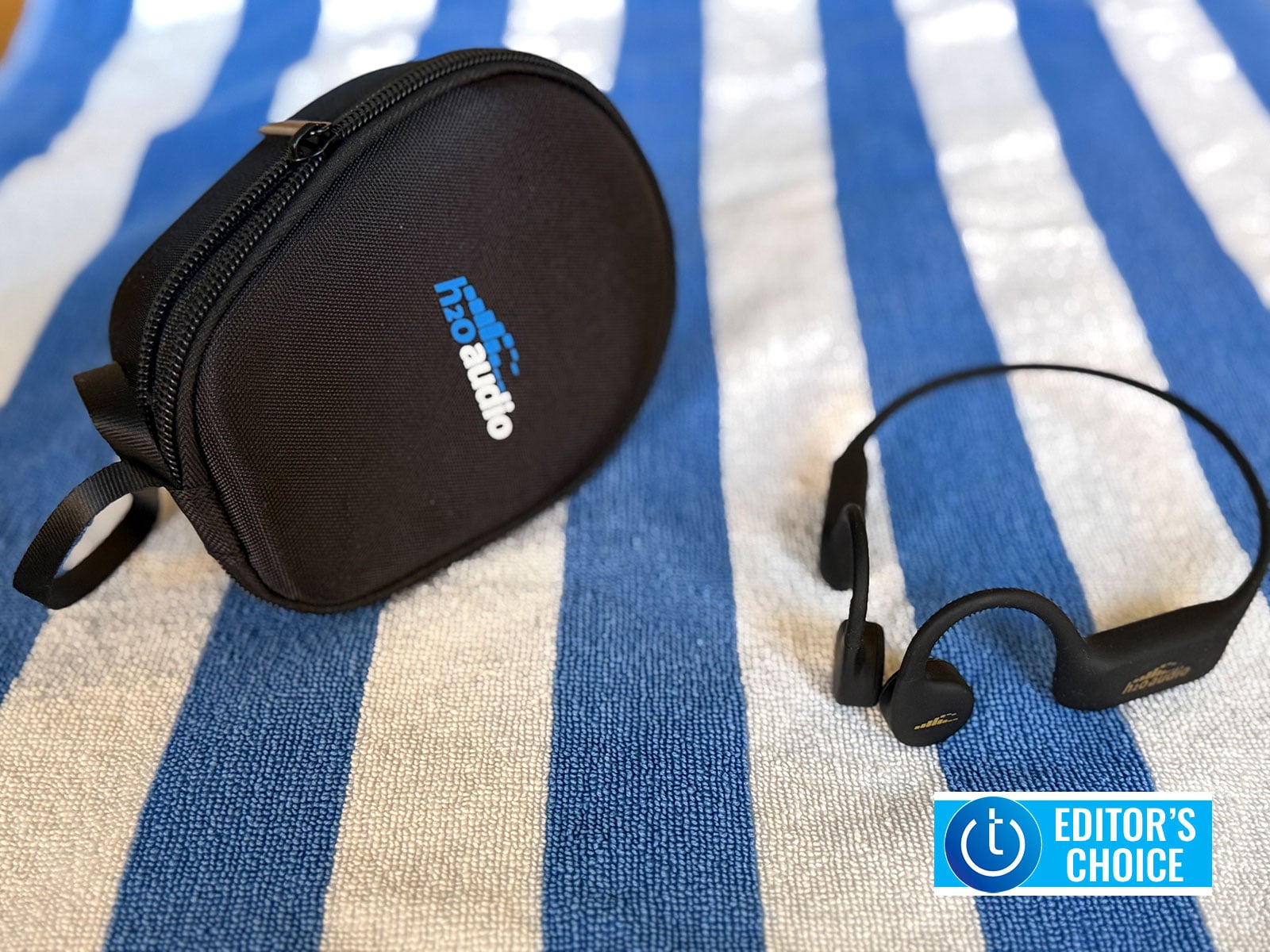
H2O Audio TRI Ultra Pro with Playlist+: Best bone conduction headphones with onboard storage
Like to hit the gym, jog in the park, or swim lots of laps with motivational music or a favorite podcast humming in your brain? H2O Audio’s new line-topping, ultra-waterproof (IPX8), Bone Conduction TRI ULTRA PRO let you carry on those active pursuits in ultra easy fashion, with nary a phone in sight but all your favorite tunes or blab fests just a click away.
Like some other noteworthy, open-ear Bone Conduction headphones (talking ‘bout you, Shokz), these H2Os link wirelessly to a Bluetooth-connected source and feature an onboard memory chip (8 GB) to stockpile MP3 music files transferred from your computer in “drag and drop” fashion. That local storage locker lets you keep listening even in isolated locales or a lap pool where wireless signals can’t penetrate.
H2O Audio’s Playlist+ feature saves what you are playing over Bluetooth so you can listen to it later from the headset’s onboard storage.
To save Bluetooth audio with Playlist+, double-press the plus button while it plays. It records in real time, so a 60-minute album or podcast takes an hour to save.
Elaborating on prior Playlist+ models, the TRI ULTRA PRO adds a specialty button for fast switching between an external Bluetooth 5.3-connected source and your onboard inventory of music.
H2O Audio rates the headset for up to 17 hours over Bluetooth and 24 hours in memory mode.
And take cheer: with the supplied earplugs (or others) installed, the bone-conducted sound whilst swimming doesn’t get too, um, watered down. Limited voice range podcasts are especially pool-playback friendly.
On the downside – the TRI ULTRA PRO chassis has stiff ear hooks and a larger-than-needed neck band that sometimes annoy this wearer (your results may vary.)
The rival Shokz OpenSwim Pro model is also worth considering. These smaller banded bone conductors flesh out music a bit better than the H2Os, utilize more pliant materials, and are priced lower - $179.95. The give back? Shokz rates the OpenSwim Pro for up to 9 hours over Bluetooth or 6 hours in local playback mode. It carries an IP68 rating and is rated for submersion in up to 2 m of fresh water. Its 32 GB of storage accepts drag-and-drop files in several formats, including MP3.
Key specs:
- Battery: Up to 17 hours over Bluetooth or 24 hours in memory mode. About 2 hours to recharge.
- Microphones: Built-in waterproof microphone.
- Water and dust resistance: IPX8. H2O Audio rates the headset for submersion to 12 ft (3.6 m).
- Bluetooth version: 5.3
- Weight: 44 g for the headset and 139 g with the carry case (review figures).
- Extras: 8 GB of onboard storage. Swim plugs and a carry case are included.
Price: $249.99
Top clip-on open-ear buds
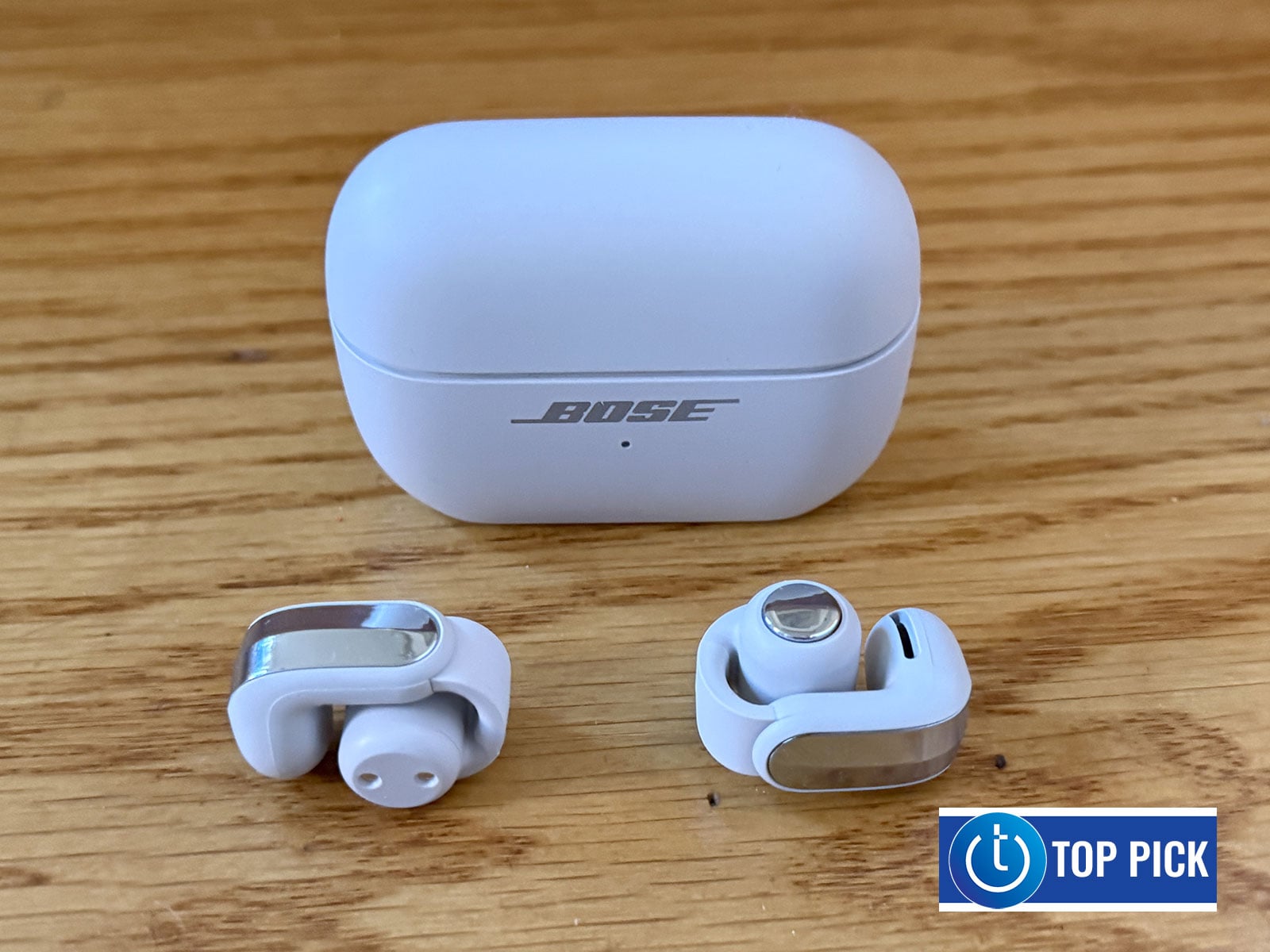
Bose Ultra Open Earbuds 2nd Gen: Best clip-on all-around experience
Bose jump-started the clip-style open-ear buds revolution in early 2024 with the Bose Ultra Open Earbuds and set a very high mark in comfort and sonic quality. Now the maker’s taking the species a tad higher with the Ultra Open Earbuds 2nd Gen.
A more efficient driver extends battery run time to 9 hours (up from 7 on the original UOEs). Bass response now digs a little deeper without doing harm to the attention-grabbing presence and small detailing; sonic sweets that grabbed our attention on the original UOEs (especially with the Immersion mode engaged on our Led Zeppelin test track).
And with just the slightest modifications to the physical design, the Bose Ultra Open Ear 2s still do an excellent job of keeping you in touch with the outside world.
What's the secret to their neat balancing act? I'm thinking it's the special way the Ultra Opens are angled to cling and exploit the curvature of your ears with (Bose-patented) half-rigid/half-pliant flex arms. These clip-on bud suspenders make for a comfy fit, easy to shift around until you find your sweet spot. The driver enclosure has been minutely reshaped in the Ultra OE 2s, slightly lightening their grip on my ears relative to the originals.
No changes have been made to the best-of-breed controls, thankfully. Physical buttons topping the rear ear barrels are easy to locate (by "feel") and deploy.
The carry/recharge case has also seen upgrades – most prominently the addition of wireless charging. The Gen 2 buds now sit higher and flatter in their magnetized cradle for easier removal and replacement. The Bluetooth connect/reset button and USB-C charging ports have been moved to the case sides (from the back and bottom, respectively).
Bose has also done some minor software tweaking. There’s a new Cinema Mode processing option. And “SpeechClarity” technology ostensibly delivers better phone call interactions, though there’s still an opportunity here for third-generation improvement!
Key specs:
- Battery: Up to 9 hours per charge and 28 hours with the case, or 5 and 16.5 hours with Immersive Audio on. A 10-minute charge gives up to 2 hours. About 1 hour to recharge the earbuds. Wireless case charging.
- Microphones: Two microphones, per Bose's spec sheet.
- Water and dust resistance: IPX4 (earbuds).
- AI and Voice Assistants: A shortcut can launch the phone's native voice assistant. Bose announced Alexa+ for a firmware update.
- Codecs: SBC, AAC, and aptX Adaptive.
- Bluetooth version: 5.4
- Weight: About 6 g per earbud and 64 g with the case.
- Extras: Multipoint pairing, Immersive Audio, Cinema Mode and SpeechClarity for calls.
Price: $299.00
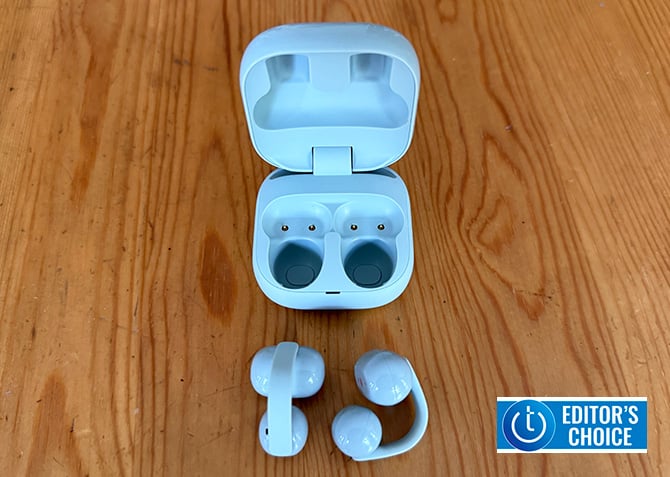
Sony LinkBuds Clip: Best clip-style for sound accuracy and active use
Sony's audio team has long been sticklers for sonic accuracy and snazzy, ultra-compact industrial design. Both traits are celebrated in the LinkBuds Clip.
Spinning Laufey's wistfully waltzing Carousel, the Sonys brought out the intimate, breathy nature of her vocals (both lead and multilayered background) best of any in my test.
Likewise with the track's atmospheric tinkling bells. When played back on other buds, the bells were generic "ringy-dingy." Here I could accurately identify them as the output of a Celeste, a bell tone-emulating keyboard instrument. Not a glockenspiel, nor orchestral bells. If you're a recording engineer or musician with a perfectionist streak, these might be the check monitors for you.
Not sure if it's because product designers insisted on a very compact bud and carry cube package, but I also found the LinkBuds Clip have a slightly shorter "wingspan" on the elasticized band connecting front and rear sections. So they squeeze tighter on the earlobes than most other OEs. That pinching got to me after just a couple hours.
On the bright side, fear of buds flying off is an ongoing concern with active wearers, especially runners, so there is a receptive audience for these extra-clingy buds. Also playing to the exercise crowd: the Scene Sensing (movement tracking) feature triggers your favorite music service and an appropriate playlist to auto-start when you're walking, running or commuting. Spooky.
Sony flaunts its audio credentials with special sound-contouring options as well. Their AI noise reduction contributes to excellent-sounding phone calls on both ends of the line. DSEE processing refines the fidelity of compressed tracks. Preset listening modes can boost voices in a music mix (or podcast), reduce the music to "background" level or lower the sound leakage from the buds (essentially by cutting the high-end response). And Sony's 360 Reality Audio spatial decoding is applicable if you're a subscriber to Amazon Music Unlimited or the jam bands-lovin' nugs.net service.
Key specs:
- Battery: Up to 9 hours per charge with AAC and up to 37 hours with the case. A 3-minute charge gives about 1 hour. About 1.5 hours for the earbuds or 3 hours for earbuds and case.
- Microphones: Microphones with AI voice pickup for calls.
- Water and dust resistance: IPX4 (earbuds).
- AI and Voice Assistants: Tap to access Siri on iPhone or Google Gemini on compatible Android phones.
- Codecs: SBC and AAC.
- Bluetooth version: 5.3
- Weight: About 6.4 g per earbud and 54 g with the case.
- Extras: Multipoint pairing.
Price: $229.99
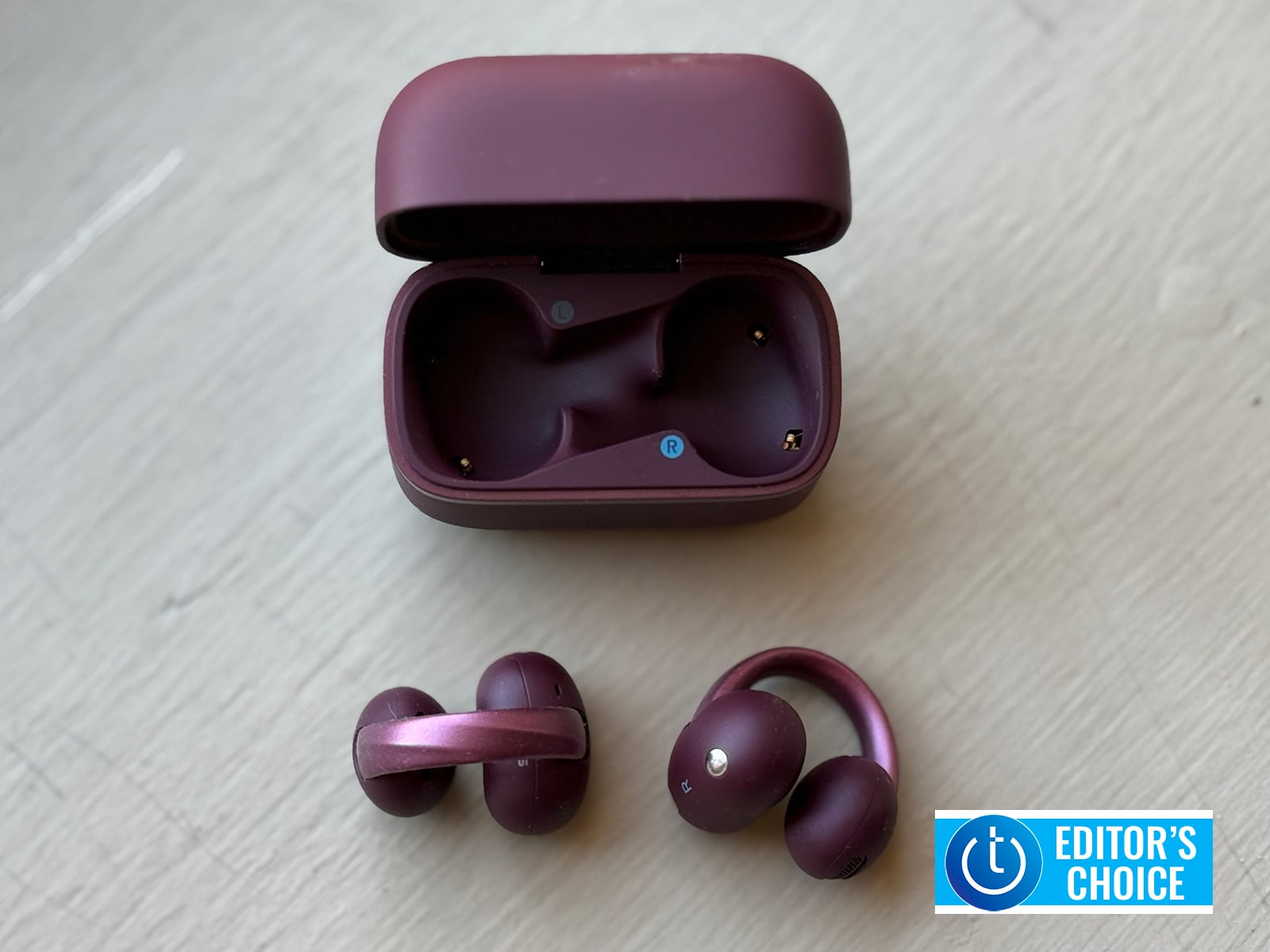
Anker Soundcore AeroClip 2: Best for phone calling in noisy environments
Do you ever find yourself in an uncomfortable “got to take this call” predicament? The boss needs to chat when you’re playing hooky at a ballgame. You’re out at a raucous bar on a first date when your old beau calls, hoping to make amends. And how the hell are you going to hide it from clients that your prosperous new startup biz is based at the corner coffee shop?
If you’re wearing Soundcore’s new AeroClip 2 buds when you make or take a call, you can pretty much fool all these people all the time. The AeroClip 2s are the first open-ear buds to utilize Anker’s innovative Thus AI Chip - described by the maker as “The World’s first Neural-Net Compute-in-Memory AI Audio Chip – fusing CPU and memory to deliver 150+ the computing power . . . (of) Anker’s previous flagship earbud chip.”
Rather than relying on rule-based noise filters, the Thus chip has been trained on “massive audio datasets” to recognize and suppress all manner of environmental noise in “real time.” At the same time, it’s combing out and presenting the speaker’s voice in a very clear, crisp fashion.
Whilst wearing the AeroClip 2 buds, I’ve made and taken calls with the vacuum cleaner running and music blasting at 85 decibels, and all that my friends at the other end could hear were my dulcet tones. I kept watching a TV show as a phone pal blabbed, and he had no clue how rude I was being. (BTW - The same Ultra-Clear Calls tech is also utilized in Anker’s new Space 2 Pro headset along with Adaptive ANC, which is not found in the buds.)
In looks and musical performance, AeroClip 2s bear a marked resemblance to their predecessor, which I greatly admired for their easy wearability, novel controls and natural, balanced sound. (The original AeroClips are still available at a reduced price.) The newbies have a slightly cooler, brighter sound and sit more compactly (oriented vertically) in a smaller charging case. Thermal touch controls on the first gen’s bands have been swapped out for push buttons on AeroClip 2’s back barrels. Water resistance rating is upped to IP57 (from IP55) and the Bluetooth to 6.0 from 5.4.
The newbies also arrive with “real time” 100 language AI translation skills accessible on the Anker Soundcore app for iPhones and Android mobiles. As it plays out, the original language sound is captured on the earbuds’ microphones, quickly processed and displayed in two-language form on the phone, then sent back to the earbuds for a delayed voice translation. Phew!
Key specs:
- Battery: Up to 8 hours per charge and 32 hours with the case. A 10-minute charge gives up to 4 hours. About 1 hour for the earbuds and 2 hours for the earbuds and case over USB-C. The case also supports wireless charging.
- Microphones: Four microphones and two voice pickup units for AI call noise reduction.
- Water and dust resistance: IP57 (earbuds).
- Codecs: SBC, AAC and LDAC.
- Bluetooth version: 6.0
- Weight: About 6.2 g per earbud and 52.7 g with the case.
- Extras: Real-time translation in 100 languages and recording through the Soundcore app.
Price: $169.99
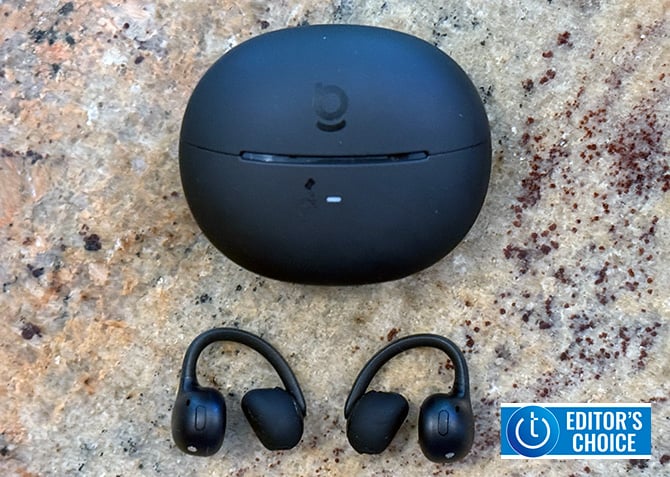
Baseus Bowie MC2: Best budget clip-on buds
One of several late entries, the Baseus Bowie MC2 so impressed me I had to call back this review for a rewrite/update. And scrub the previously planned winner in this category.
The Baseus clip-ons don't quite pass my Laufey test, but come close. And if you don't make direct comparisons (or raise the question) you'll be happy with the playback of almost anything you pump through the Bowie MC2s, from "Aladdin Sane" to "Ziggy Stardust." (Sorry, I couldn't resist.)
Smart tuning of the 11 mm tri-magnet drivers is key. Doesn't matter which pre-set equalization option you select. The EQ always sounds clean and balanced on its own terms, doesn't crumble into a soggy mess as I've often experienced in earbuds and headphone models that strive too hard to cover all bases (and basses) with separate EQ mixes for rock, jazz, acoustic, classical, et al. That even-tempered playback also holds true (most of the time) when activating the buds' non-branded but reasonably effective Spatial modes for music and movies. (The processing lends an Atmos-like sense that sound is coming from a wider field, outside your head.)
Also on the subject of non-partnerships: I must note that Baseus didn't license Bose tuning technology for the Bowie MC2s as the maker did on an earlier OE clip bud model (Inspire XC1). Still, I gotta presume that pointers picked up then have helped sharpen the engineers' aim on these new and better buds. The warmly rounded EQ peaks and valleys of the "Baseus Classic" EQ option comes closest to the Bose sound aesthetic, I think.
The comfort card also is getting played here, big time. Slip on these buds and what you don't feel is as important as what you do. The speaker side of the bud that rests inside your ear has a soft silicone cover, what Baseus calls an "air cushion," that enhances fit and long-term comfort. (Swappable small, medium and large cushions are included.) If these silicone covers also blunt the high-end clarity just a tad or make these buds slightly less open to outside sounds, I'd argue those are sacrifices worth making for many people.
While not offering the prettiest representation of the clip-on species, the oval-shaped loop bands connecting the front and back portions of these OE buds likewise contribute to the superior comfort level. The Bowie MC2 loops poke out farther than I've noticed on competitors' models. So there's barely any sense of the bands rubbing or pressing against earlobes, which can get to be annoying after a while (especially on the Sonys). I kept these things on and humming for 7 hours straight without feeling any need to take a break.
Good thing I didn't hang in until the battery went dead. With a staggering 13-hour maximum run time per charge, I'd have missed my bedtime.
Key specs:
- Battery: Up to 13 hours per charge and 60 hours with the case with Bass Boost off, or 11.5 and 55 hours with Bass Boost on.
- Microphones: Four beamforming microphones with AI call noise reduction.
- Water and dust resistance: IP67 (earbuds).
- AI and Voice Assistants: App-based AI chat.
- Codecs: SBC, AAC and LDAC.
- Bluetooth version: 6.0
- Weight: 5.1 g per earbud and 52 g with the case.
- Extras: App-based translation in more than 135 languages, smart note-taking, multipoint pairing.
Price: $79.95
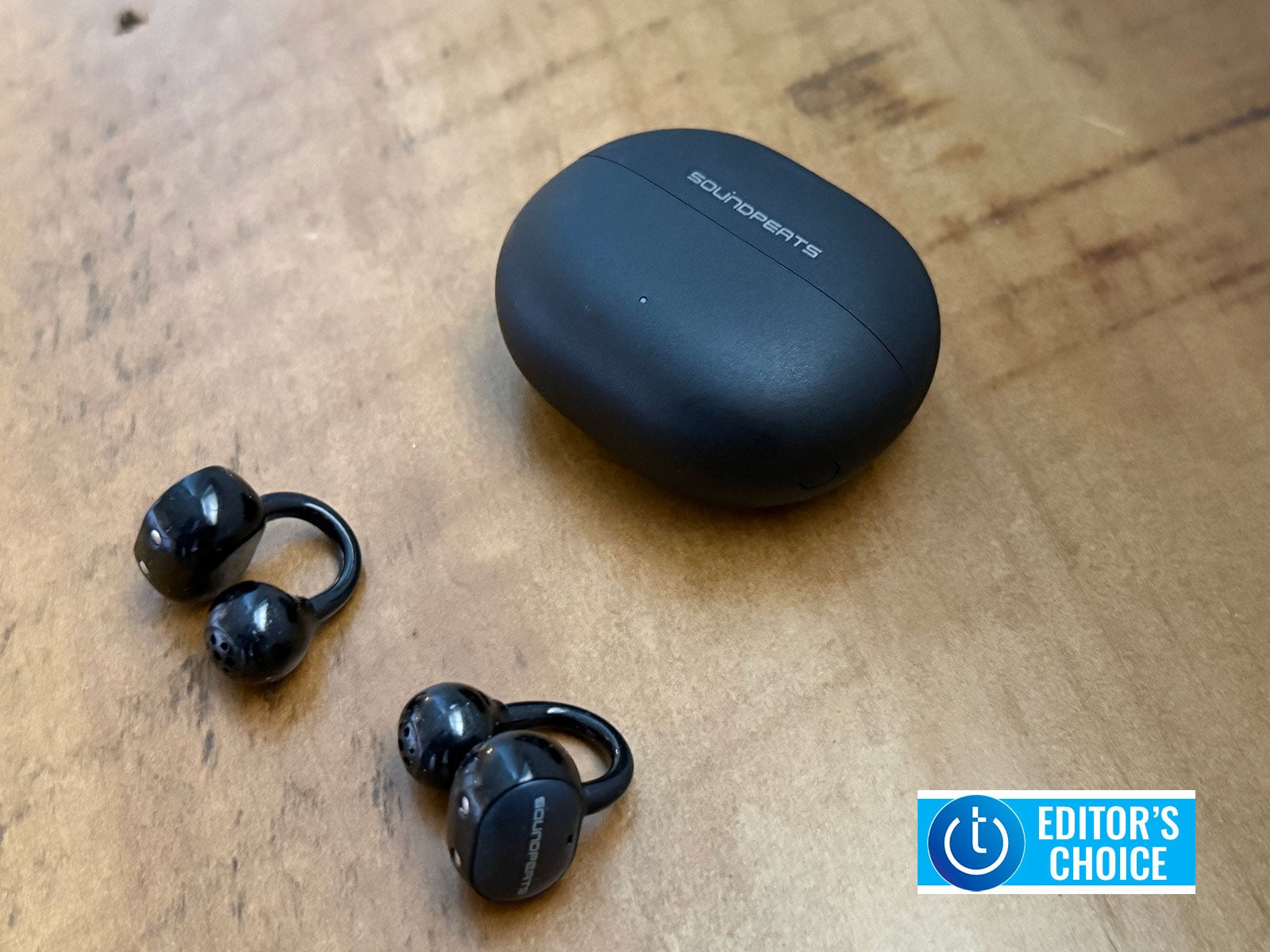
SoundPEATS UU2: Best budget clip-ons for calling
When the phone rings and I have multiple earbuds sitting in front of me, I often reach for the SoundPEATS UU2, also packaged and sold as POP Clip2 for a mere $49.95.
So why are these my go-tos?
With just a little push, their carefully curved, memory steel wire-enhanced arch design helps to POP them onto my ears faster and smoother than any other in my lot. Easy does it!
And when used indoors, in a quiet zone, they’re one of the clearest talkers (and listeners) in my open earbud arsenal, rivaling the much pricier AeroClip 2s in clarity though not working any of the latter’s background noise elimination magic.
So I don’t have to suffer any of that “Did you fall down a well?” or “Why do you sound so muffled?” grumbling that my “friends” sometimes spout. Shaming me to pull off the buds and talk directly on my phone.
The SoundPEATS offer clear-as-a-bell music, too. Listening to the new Bruce Springsteen track “A Rainy Night in Soho” (from the tribute album “20th Century Paddy-The Songs of Shane MacGowan”) I could practically see the lights reflecting off the puddles (and the sheen of a soloing trumpeter’s brassy horn.) In direct comparison with the closely priced Baseus, the latter filled out the soundscape better, with a warmer, fuller representation of the lead piano and The Boss’ vocal. Still I’m thinking - as a work mate, the PEATS lighter presence might make them easier to live with.
Specs in general are impressive. And these little critters are so light, I often forget I’m wearing them.
Key specs:
- Battery: Up to 10 hours per charge and 42 hours with the case. The spec table lists about 2 hours of playback from a 10-minute charge. About 45 minutes to charge the earbuds and 96 minutes for the USB-C case.
- Microphones: Two microphones with AI call noise reduction.
- Water and dust resistance: IPX5 (earbuds).
- Codecs: SBC, AAC and LDAC.
- Bluetooth version: 6.0
- Weight: About 5 g per earbud and 47.7 g with the case.
- Extras: Either earbud can be worn in either ear. Multipoint pairing, physical buttons and app-based EQ.
Price: $49.95
Discussion 

You left the tozo OpenEarRong out of the mix?
https://share.google/YrWmspo6rKICOQmQ0
With their app. You can do real time translation which is surprising. Also their app provides additional custom eq curves to make them sound slightly better.
I think the basis ones sound slightly better, but the tozos fit my ear better and literally look like gauges. So I’m in with the hip mountain bike crowd! 

Thanks for this comprehensive breakdown of open-ear styles. I’ve been debating between the clip-on design and the traditional ear-hook style for running. Based on your review, it seems like the ear-hooks provide a much more secure fit during high-intensity workouts. Have you noticed any pressure points behind the ear after wearing them for more than two hours?

Great comparison of the sound leakage on these models. Many open-ear options I’ve tried in the past practically broadcast my podcasts to everyone sitting near me on the train. It’s helpful to know which brands have successfully minimized this issue while still allowing ambient awareness.

Do any of the recommended ear-hook models fit comfortably over thick-rimmed glasses? I usually struggle to find sports earbuds that don’t fight for space behind my ears with my spectacles.

From David on June 26, 2026 :: 1:38 pm
Ummm…
Where’s the Shoks Open Air Pro?
Shokz Opendots 2?
Huawei Freeclip 2?
Not a real list unless those are mentioned
Reply