

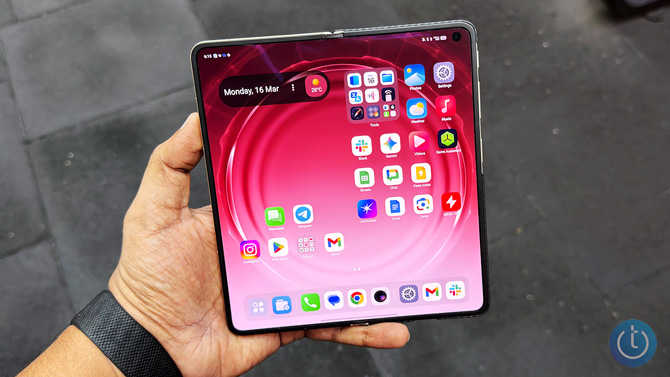
Foldable phones have had the same problem since day one: that crease down the middle of the inner screen. It's the thing that reminds you, every single time you unfold your phone, that you're using a foldable. Not just that, it tends to be the part where foldable phones break the most. OPPO has been chipping away at this problem for years with its Find N series, and with the Find N6, the company is claiming to have finally solved it.
I've been daily driving OPPO's foldable N line for over two years now, and after spending some time with the Find N6, I can say the crease situation is a rather significant improvement. It's not completely invisible in every light, but it is noticeably reduced to the point where you stop thinking about it. Compared to the Find N5 from last year, this is a solid incremental update, but if you put the N6 next to the Find N3 from a couple of years ago, it feels like a whole different phone. That's how far OPPO has come.
The crease is the headline, and it’s impressive
OPPO calls it the "Zero-Feel Crease," which is the kind of marketing speak that usually makes me roll my eyes. But in practice, the screen feels smoother than any foldable I've used. The company achieved this with a 2nd-generation Titanium Flexion Hinge that uses a 3D Liquid Printing process to fill in microscopic surface irregularities. On top of that, OPPO developed what it calls Auto-Smoothing Flex Glass, which is 50% thicker than standard ultra-thin glass and should help the screen stay flat over time. TUV Rheinland has certified the device for 600,000 folds with minimal crease, and one million folds for overall reliability.
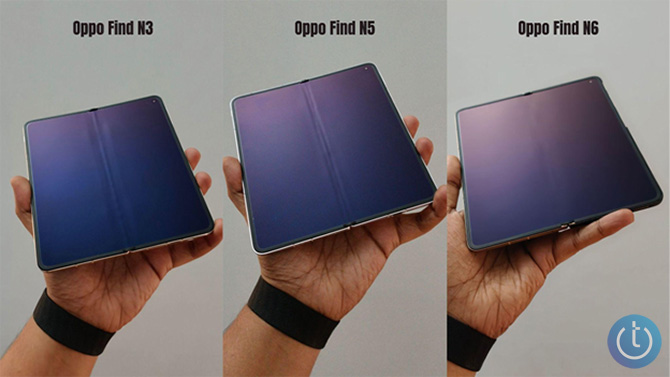
Based on my first impressions, I feel like the screen will hold up with minimal creasing as promised. It’s noticeably better than the Find N5 was at launch, and that one held up decently well over a year of me daily driving it, so I have higher hopes for the N6. Time will tell, but the foundation here is rather impressive.
The hinge feels sturdier, too. OPPO redesigned it with an 11% wider waterdrop shape and a new Clover Balance Pivot that provides 20% more support force. The dimensions are very similar to last year's Find N5 – the phone is 8.93mm thick when folded and weighs 225 grams – but the feel in hand is better. It's the kind of thing that's hard to quantify, but you notice it when you're folding and unfolding the phone throughout the day.
Cameras finally catch up
Cameras have always been a pain point with foldables. The combination of moving parts and the race for thinness has meant you couldn't really fit a large sensor in there, and foldable cameras have lagged behind their bar-phone counterparts as a result. The Find N6 finally addresses this with a 200MP Hasselblad main camera, joined by a 50 MP ultrawide and a 50MP 3x periscope telephoto that can go up to 120x digital zoom.
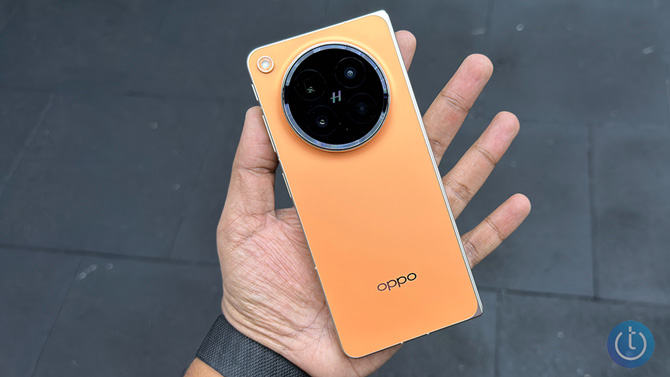
I loved the photography on this phone. The 200MP sensor captures a level of detail that I haven't seen from a foldable before, and the Hasselblad color science produces natural, pleasing results. The telephoto lens doubles as a tele-macro with a 10cm minimum focus distance, which is a nice touch. There's also a dedicated True Color Camera – a spectral sensor that first showed up on OPPO's Find X9 Series – that helps nail white balance. All three rear cameras can shoot 4K 60 fps Dolby Vision video, with the main camera going up to 4K 120 fps. Night mode was pretty nice, too, and here’s a photo of my new Royal Enfield Bear 650 motorcycle that I took with it.
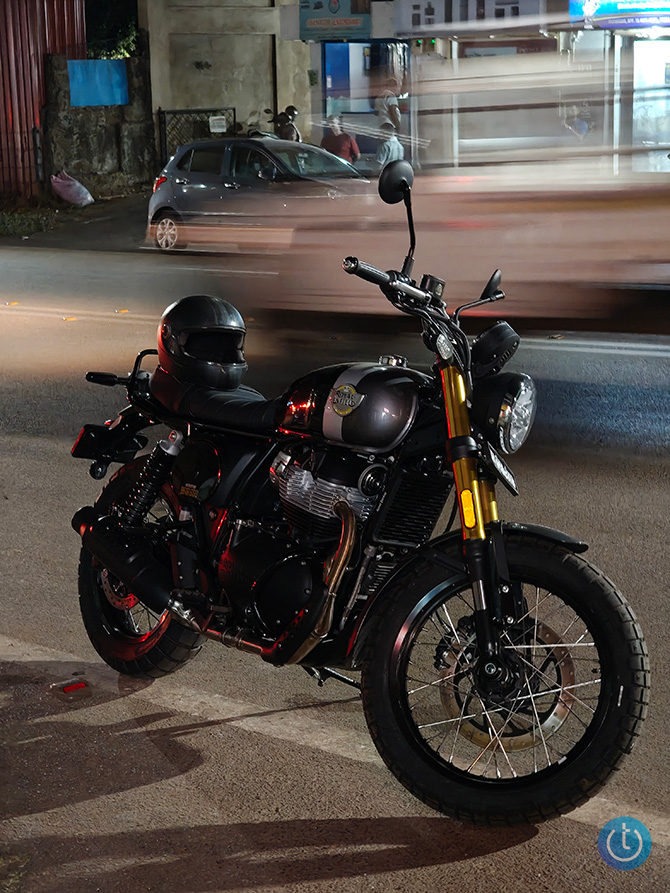
All in all, I would put it a notch or two below the camera in the company’s flagship series X Ultra phones, but it’s still pretty great for a foldable phone.
Software is clean, performance is flagship
The Find N6 runs ColorOS 16 on a Snapdragon 8 Elite Gen 5, paired with 16GB of RAM and 512GB of storage. Software has been a strong suit for OPPO's foldables for a while now, and the N6 continues that trend. ColorOS is as clean as it has ever been.
OPPO has introduced Free-Flow Window, which lets you run up to four apps simultaneously with freely resizable windows. It integrates with the existing Boundless View feature (a foldable multitasking UI I have loved using), so you can switch between focused work and multitasking with a gesture. There's also a new OPPO AI Pen with 4,096 levels of pressure sensitivity that charges through the phone's reverse wireless charging, although I didn’t get to test that. The battery is a 6,000mAh silicon-carbon cell – the largest in a Find N phone yet – with 80W wired and 50W wireless charging.
Availability stops it from going up against the Galaxy Z Fold 7
Samsung's Galaxy Z Fold 7 is pretty much the only real foldable competition in the U.S. market right now, and the Find N6 has it beat in a few areas. The battery is substantially larger – 6,000mAh versus the Fold 7's 4,400mAh – and the charging speeds are in a different league at 80W wired compared to Samsung's 25W. OPPO also offers a stylus with AI features, while Samsung dropped S-Pen support entirely on the Fold 7. And the crease on the Find N6 is noticeably less prominent.
Read more: Galaxy Z Fold7 Review: Samsung Finally Gets the Fold Right
That said, I wish the Find N6 was available in the U.S. OPPO's foldables have been consistently impressive, but limited availability means most American buyers won't be able to get their hands on one easily.
The OPPO Find N6 is available globally starting March 20, 2026. It comes in two colors: Stellar Titanium and Blossom Orange, the latter featuring genuine gold accents on the titanium hinge. OPPO has revealed the pricing, and it starts at CNY 9,999 (approx. $1,437) for the base 12GB RAM and 256GB storage model, scaling up to CNY 11,999 (approx. $1,725) for the top-tier 16GB/1TB configuration. The phone will be available through OPPO's official stores and authorized retailers globally, although there's no official US release planned.
[Image credit: Palash Volvoikar/Techlicious]

