

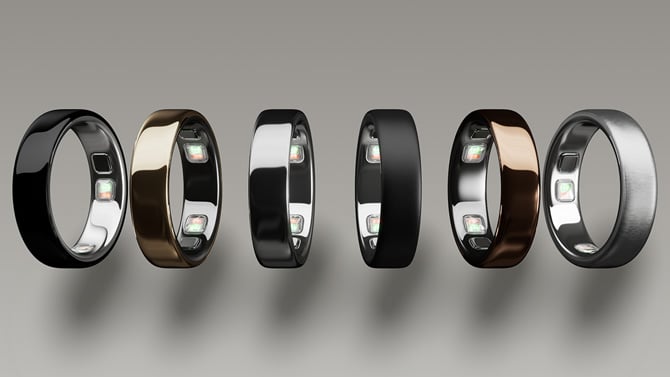
Oura's fifth-generation smart ring arrives with two undeniable improvements and one persistent headache. At 6.09mm wide and 2.29mm thick, the Ring 5 is 40% smaller than the Ring 4, making it look far more like a piece of jewelry than a piece of technology. And despite that size reduction, battery life stretches to six to nine days, up from five to eight on the Ring 4. The headache: the Ring 5 starts at $399, up $50 from the Ring 4, and still requires a subscription at $5.99 per month or $69.99 annually.
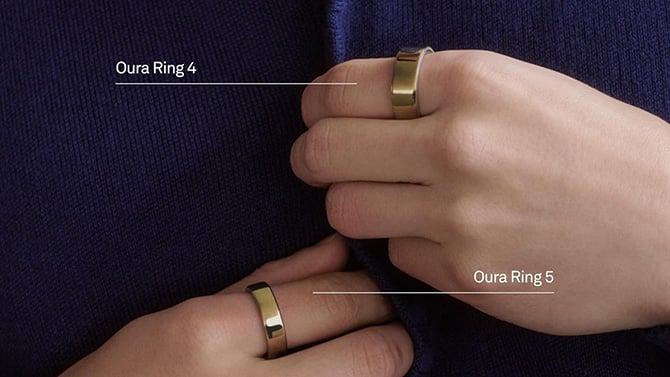
The engineering required to shrink a functioning health tracker by nearly half is impressive. Every part of the ring has been redesigned to be both smaller and more power-efficient. The Ring 4 read the signal from your finger along 18 separate light paths; the Ring 5 uses 12, with LEDs around four times as powerful and lower-profile sensors that sit closer to the skin. Oura claims this improves accuracy across more skin tones and finger types, rating heart rate accuracy at 99% against a medical ECG and sleep staging at 95% against a clinical sleep lab. Those numbers come from Oura, and independent reviewers haven't yet had enough time with the device to verify them.
The Ring 5 ships in black and silver for $399, with gold, stealth, brushed silver, and the new Deep Rose finish at $499. A portable charging case sells separately for $99. All models are dust and waterproof to 100 meters, and Oura says this is its most scratch-resistant ring yet, thanks to an upgraded physical vapor deposition coating.
Health Radar is the biggest software addition
Oura is launching Health Radar, a proactive monitoring system that runs in the background, watching for early warning signs of health problems. The idea is to surface patterns in your biometric data before symptoms appear, rather than waiting until something is obviously wrong. The two initial capabilities are blood pressure signals and nighttime breathing.
The ring doesn't directly measure blood pressure the way an arm cuff does. Instead, it tracks changes in blood flow and blood vessel behavior that are correlated with high blood pressure. Oura calls this Blood Pressure Signals, focusing specifically on overnight readings. That focus makes physiological sense: research published in the journal Hypertension has found that blood pressure during sleep is a better predictor of cardiovascular disease than daytime or office readings. In healthy individuals, blood pressure should decrease at night, and when that dip doesn't happen consistently, it can be an early sign of increased cardiovascular risk that daytime measurements miss entirely. Members can also log actual cuff readings in the app to build a longer-term picture alongside the ring's data.
Nighttime Breathing gives users a 30-day view of sleep-related breathing disturbances, an improvement over the night-by-night snapshots the app previously offered. Oura has also partnered with ResMed so members who notice elevated disturbances can connect to a sleep assessment and access a healthcare provider through the app.
Health Radar is rolling out to members in the United States, India, and the UAE starting in June 2026.
More features, some meaningful
The Ring 5 can now track workouts in real time, letting you see pace, distance, and heart rate during runs, cycling sessions, and strength training from your phone. Competing rings have had live activity tracking for a while; Oura's absence of it was a legitimate knock that's now addressed.
Health Records lets U.S. members import diagnosed conditions, medications, lab results, and allergies from eligible providers into a personal health record. Oura is also partnering with Counsel Health to let members consult with licensed physicians directly through the app, available initially in 43 states. GLP-1 Insights is a new addition aimed at people managing weight-loss medications, letting users log doses, side effects, and weight changes alongside their existing biometric data.
The upgrade question
A Ring 4 owner with an active membership gains almost the entire 2026 feature set at no additional cost. What's exclusive to the Ring 5 is the smaller, lighter body and the improved activity detection that comes from the new sensor layout. If you're happy with how the Ring 4 fits, there's no urgent reason to spend $399 to $499 on new hardware.
For anyone new to smart rings who's held off because the bulk bothered them, the Ring 5 changes the calculation. At 2.28mm thick, it's one of the slimmest wearables on the market, and it finally looks like something you'd wear every day without thinking about it. Samsung's Galaxy Ring costs $399 with no subscription, and RingConn's Gen 3 starts at $349, also subscription-free, so the value question is real. Oura's depth of health data and research partnerships are its strongest argument for the premium.
The Ring 5 is available for pre-order now on Ouraring.com and on Amazon. Shipping starts June 4.
Read next: RingConn Gen 3 hands-on: Finally a smart ring that 'talks' back
[Image credit: Oura]

