

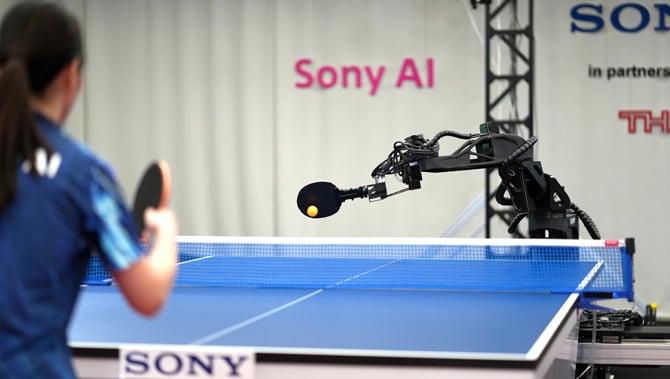
Sony AI has built a robot that can beat elite ping-pong players, and the way it wins is probably the most interesting part of the whole thing. The robot, called Ace, competed against elite amateur and professional table tennis players under the same official rules used at the Olympics, with licensed umpires calling the match on an Olympic-size court inside Sony's Tokyo headquarters. It won three of five matches against elite amateurs and has since beaten professional players in rematches, too.
This is the first time we’ve seen something like this. No robot had beaten expert human players at a real sport under unmodified rules before this.
It wins by wearing you down
Here's the thing about Ace. When human players go for a winning shot, they swing harder. They commit and put extra power into it. That difference is measurable and statistically significant. With Ace, its winning shots are statistically identical to its regular shots. It does not wind up. It has no killer move.
What it does instead is return 75% of incoming shots, even ones spinning at up to 72 full rotations per second. It hits the ball sooner after the bounce than humans do, and stretches rallies to an average of 5 shots versus 3.9 in human-vs-human play. It just keeps the ball coming back until the human slips up. Professional player Mayuka Taira said the robot is hard to read because it shows no emotion, which makes sense.
Ace uses nine cameras and three specialized Sony vision sensors that detect spin by watching the logo printed on the ball as it rotates. The whole system reacts in about 10 milliseconds, roughly 22 times faster than a human's reaction time of about 230 milliseconds. The robot learned to play entirely in a simulated environment Sony spent five years building, and it didn't need any additional tuning when it moved to a real table.
Read more: Vbot Companion Shows What Robot 'Pets' Are Becoming
This could be a big deal for athletes
Sony AI's chief scientist, Peter Stone, compared the project to the Apollo program. He noted that this isn’t about immediate commercialization, but about the technologies that come out of it. I think the more exciting near-term possibility is what a system like this could do for professional athletes. You could tune a robot like Ace to target a specific weakness in your game, like a tricky backhand or dealing with heavy topspin, and train against it relentlessly until you've figured it out. That kind of targeted, tireless practice partner doesn't exist right now.
Former Olympian Kinjiro Nakamura watched Ace pull off a shot he said he "didn't think was possible," then added that if a robot can do it, maybe a human can too. I can't wait to see how this technology gets used beyond the lab.
[Image credit: Sony]

