

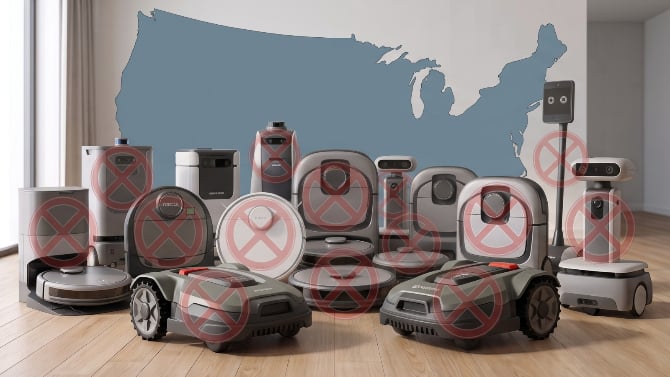
Generated with Gemini
The FCC has effectively banned new robot vacuums, robot mowers, and most other household robots made outside the US, and it did it without ever naming them. On July 28, the agency added foreign-made "advanced robotic devices" to its Covered List, the roster of equipment it considers a national security risk. Anything on that list can't get the FCC authorization every wireless device needs before it can be sold in the US, so no new models get in. The announcement specified humanoid and quadruped robots, which is why the news broke as a ban on Chinese humanoid robots. Then the FCC confirmed to The Verge that robot vacuums count too, because they fit the definition the agency published.
That FCC definition never mentions vacuums or mowers by name. It broadly covers any robot that moves along the ground, weighs more than 4.4 pounds including its charging dock, has a sensor that lets it see its surroundings, connects to Wi-Fi or Bluetooth, and runs software that steers it around. Nearly every robot vacuum on the market matches that description. The rule only blocks new models from getting approved, so the one you own isn't affected, and existing models can still be imported.
Pool robots got a pass from the FCC, mowers didn't
Your robotic pool cleaner is exempt, because the FCC order carves out underwater robots as allowed. Cars are exempt too, no matter how many cameras and sensors they carry, along with drones (which got their own restrictions in December), surgical robots, powered wheelchairs, and the fixed robot arms that work in factories.
Robot lawn mowers get no exemption, so the affordable models from Segway, Dreame, Eufy, and others are covered by the ban. As is pretty much the entire robot vacuum aisle. The five biggest robot vacuum makers are all Chinese companies: Roborock, Ecovacs, Dreame, Xiaomi, and Narwal. And the Roomba is no longer the American exception. After iRobot's bankruptcy, the brand was acquired by Picea, its former Chinese contract manufacturer.
The order goes by where a device is made anyway, not who owns the brand. And the ban isn't just about China. The general-purpose home robots that Korean manufacturers Samsung and LG keep showing off at CES will also be casualties.
There is a way back in, technically. Companies can apply for what the order calls Conditional Approval. To count as American-made, at least 65 percent of a device's components have to be US-sourced, which no major robot vacuum maker currently manages. Even Matic, which assembles its robots in California, doesn't hit that number yet, per the same report. The application also asks for a timed plan to move manufacturing to the US, complete with hiring numbers and quarterly progress reports.
Your robot keeps working, and you don't need to rush out and buy one
Robots that already have approval can keep being imported and sold, and the FCC isn't coming for the ones already in homes. Nothing changes for the vacuum in your hallway, and it keeps getting software and firmware updates.
Stores can also keep selling approved models, with no deadline attached, so despite headlines saying almost all robot vacuums were just banned, the shelves aren't emptying out. What the ban blocks are the 2027 and 2028 models. Chinese brands undercutting each other is a big part of why $300 to $500 now gets you laser mapping, mopping, and a dock that empties the bin for you. With fewer new products entering the market, that downward pressure on prices weakens. Whether prices actually go up will depend on how many companies win waivers or move their manufacturing to the US.
Read More: Dreame's new robot vac sprouts arms to clean around chair legs
Where the security argument gets thin
The National Security Determination the FCC is using to justify the ban isn't working off hypotheticals. It explicitly cites The Verge's reporting on a DJI security failure from February. Sammy Azdoufal, who leads AI strategy at a vacation rental company, built a custom app so he could drive his DJI Romo vacuum with a PS5 controller. In the process, he found that DJI's servers accepted his token for roughly 7,000 other Romos across 24 countries. He could watch and listen through the robots' live camera feeds and pull up floor plans of strangers' homes. He took what he found to DJI and The Verge instead of exploiting it, and DJI rolled out patches in February.
What fixed that problem, though, was a disclosure and a software update, not a rule about where the robot was built. The FCC's order doesn't require any company to fix flaws faster or keep your floor plan off its servers. And American companies have had their own problems here. Images captured by iRobot's Roomba J7 test units, including one of a woman on a toilet, leaked online after being shared with the gig workers who label the company's AI training data.
The country-of-origin worry isn't baseless: China's 2021 vulnerability rules require companies operating there to report security flaws to the government within 48 hours of discovering them, which can put Chinese authorities ahead of the customers whose devices are affected. But the waiver application doesn't ask companies a single question about security. It asks where a robot is designed, made, assembled, and tested, and for the commitment to manufacture in the US. Of course the US has no similar reporting requirement, so companies can withhold security risks entirely.
The net-net is that if you're worried about a camera-equipped robot inadvertently putting a map of your house on some publicly accessible server, this rule doesn't help you. Open your robot's app and go through the privacy settings yourself, and check whether the maps and photos it makes are stored on the company's servers or only on the device.

