

Artificial intelligence is moving so fast that lawmakers are struggling to keep up. Some states have started passing their own AI rules to deal with safety, transparency, and bias in AI systems. Now the Trump administration is trying to stop many of those laws before they take effect.
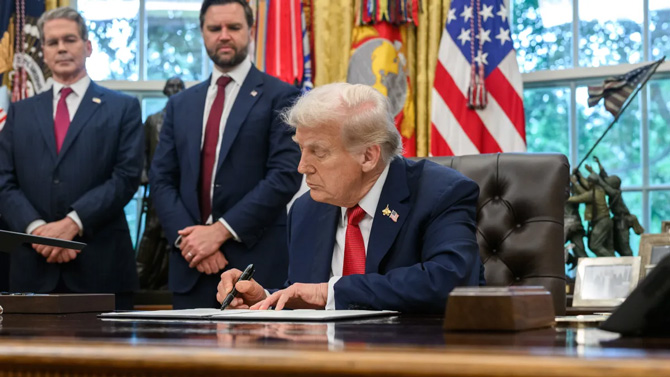
In December, the White House issued an executive order aimed at preventing what it calls a “patchwork” of state regulations for artificial intelligence. The order argues that state-by-state rules could slow innovation and make it harder for American companies to compete globally. The move sets up a major clash between the federal government and states that want to regulate AI themselves.
The White House wants a single national AI rulebook
The executive order directs federal agencies to push back against state AI laws that conflict with a future national framework. In the order, the administration says the U.S. needs “a minimally burdensome national policy framework” to maintain leadership in AI.
To enforce that policy, the order does several things. First, it creates a new AI Litigation Task Force inside the Department of Justice. Its job is to challenge state AI laws in court if they are seen as interfering with federal policy or interstate commerce. Second, the Department of Commerce must review existing state AI laws and identify which ones conflict with the administration’s approach. Third, the federal government could withhold certain federal funding from states that pass what the administration considers “onerous” AI regulations.
According to the White House, its stated goal is to prevent “an inconsistent and costly compliance regime resulting from varying state laws.”
Why states started regulating AI in the first place
The federal government hasn’t passed comprehensive AI legislation yet, and that vacuum has pushed states to step in. California and New York have been the first to pass laws.
In September 2025, California enacted the Transparency in Frontier Artificial Intelligence Act (SB 53), which requires large AI developers to publish safety frameworks and report major incidents involving AI systems. New York followed in December 2025 with the RAISE Act, which requires AI companies to conduct risk assessments, report safety incidents within 72 hours, and face penalties of up to $3 million for violations.
Supporters of these laws argue that they’re necessary to address real risks posed by powerful AI models. In a statement posted on the New York Governor's website, Gov. Kathy Hochul said, “By enacting the RAISE Act, New York is once again leading the nation in setting a strong and sensible standard for frontier AI safety, holding the biggest developers accountable for their safety and transparency protocols.”
The conflict isn’t just between the White House and blue states. According to Axios reporting, lawmakers in several Republican-led states have slowed or abandoned their own AI safety bills amid concerns about clashing with Trump. In Utah, an AI safety bill reportedly collapsed after federal officials criticized the proposal. Similar tensions have emerged in Florida and Ohio as state lawmakers reconsider their own AI rules.
The legal fight is just beginning
Even though the executive order signals the administration’s intentions, it doesn’t automatically erase state laws. A brief from Statt, a public policy platform that monitors legislative and regulatory change, warns that federal agencies will likely have to challenge many of those laws in court. And states may argue that the federal government cannot override their authority without congressional legislation.
Statt also warns that using federal funding as leverage could face legal challenges from states that see the move as coercive. In the meantime, tech companies may find themselves stuck in the middle.
The battle over AI rules is really a debate about who should control the technology’s future. Some policymakers want strong guardrails to prevent discrimination, misinformation, and safety risks posed by powerful AI systems. The White House argues that too many rules could slow innovation in a field where the U.S. is competing with countries like China.
Until Congress creates a national AI framework, the tug-of-war between Washington and the states is likely to continue. And that means the rules governing artificial intelligence in the United States may remain uncertain for quite some time.
[Image credit: WhiteHouse.gov]

