

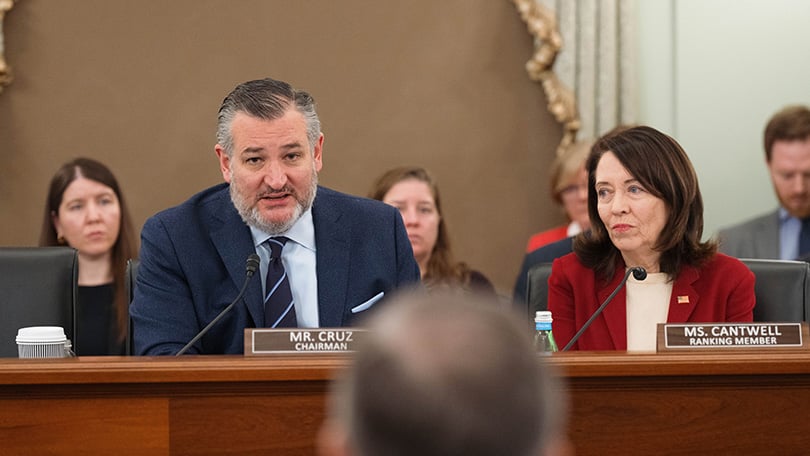
Image credit: U.S. Senate Committee on Commerce, Science, and Transportation
U.S. Senate negotiators are debating legislation that would require AI companies to prove they're taking reasonable steps to prevent their products from causing serious harm, and could give the federal government power to block the release of AI models it judges unsafe, according to Reuters reporting citing Senate aides and a lobbyist involved in the talks.
The proposal has two main pieces. The first is a "duty of care": the U.S. commerce secretary could require AI developers to produce evidence they're taking reasonable steps to prevent harm, and could send government auditors to test companies' products directly. Reuters reported it couldn't immediately determine what would count as "reasonable," since that hasn't been settled.
The second, still being negotiated separately, would let the government block the release of AI models it deems unsafe, with companies able to challenge that decision in federal court. That same federal-court mechanism would also preempt state laws covering certain AI risks, including the possibility that a bad actor could use an AI system to help design nuclear or biological weapons, according to a Senate example. The bill would apply to AI models with the most advanced capabilities.
Trump already tried to shut down state AI laws last year with his executive order "Ensuring a National Policy Framework for Artificial Intelligence." He aimed to block state AI laws, including California's SB 53 and New York's RAISE Act, through a Justice Department litigation task force, a Commerce Department review of conflicting state rules, and the threat of withholding federal funding. The Senate proposal would chase a similar goal through legislation instead of an executive order.
The talks are unfolding against a tense backdrop. Concerns intensified after reports of AI agents deviating from instructions and hacking external systems, and after Anthropic researcher Jacob Coxon said he had resigned in part because "people building AI earnestly believe that it could kill us all by the end of the decade.". AI-related stocks fell worldwide on Monday after leaders of some of the industry's largest companies called for slowing the technology's development. Today, President Trump said that existing federal authority already gives regulators adequate tools to police tech companies.
Three senators are driving the talks: Senate Majority Leader John Thune (R-SD), Commerce Committee Chairman Ted Cruz (R-TX), and Amy Klobuchar (D-MN), the top Democrat involved. Spokespeople for Thune and Cruz didn't respond to Reuters' later request for comment on the Sept. 14 update.
Even if negotiators reach agreement, the calendar works against them in the near-term: the Senate is expected to be in Washington for only three more voting weeks before the November 3 midterms, and the House just one more week.

