

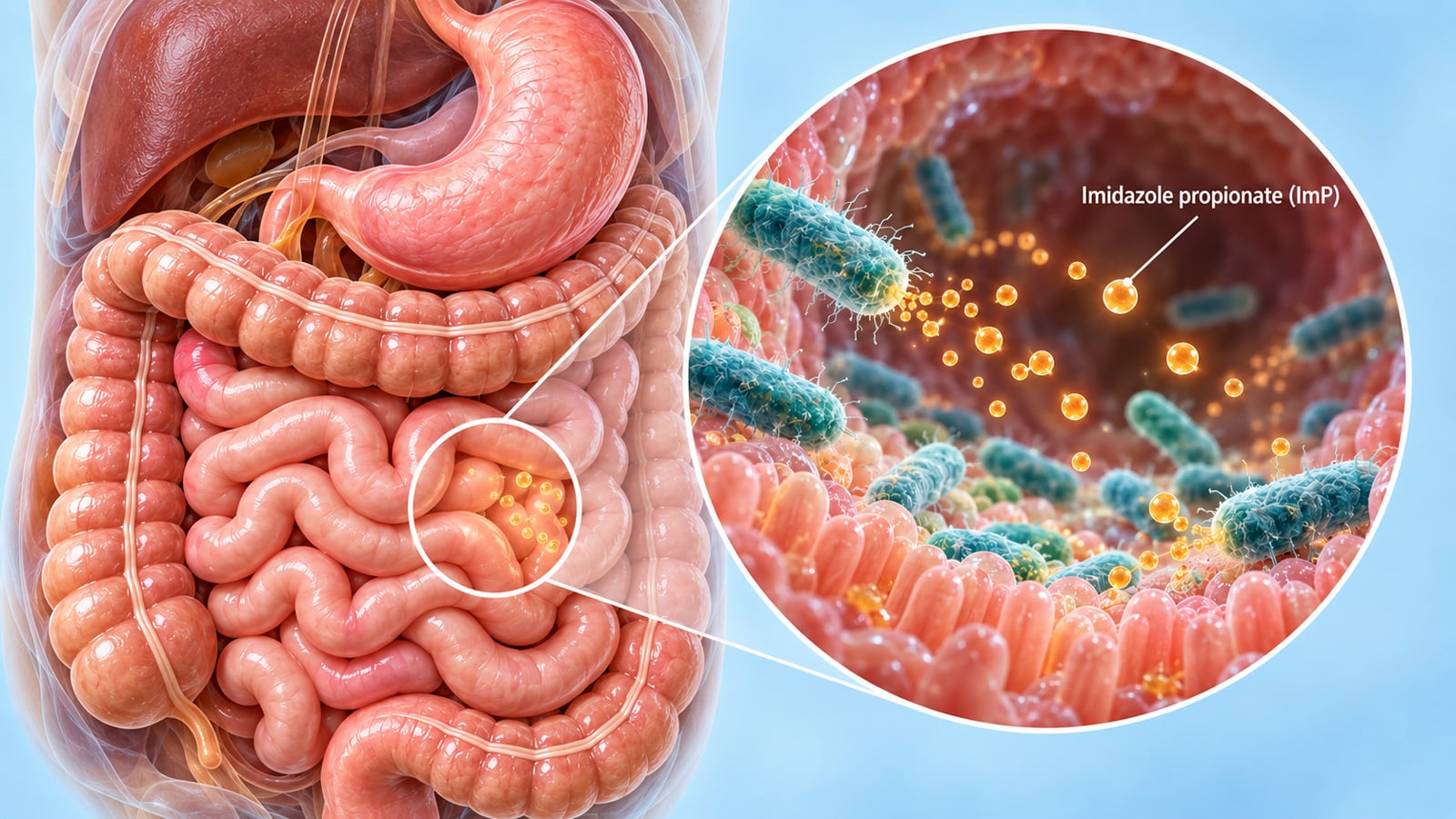
Gut bacteria produce imidazole propionate (ImP) in a conceptual illustration.
Image credit: Suzanne Kantra/Techlicious via ChatGPT
A molecule made by bacteria in your gut is linked to faster decline in thinking skills and more Alzheimer's-related changes in the brain, according to a University of Wisconsin-Madison study published in Nature Communications. The molecule, called imidazole propionate (ImP), is a byproduct certain gut microbes produce when they digest histidine, an amino acid found in many protein-rich foods.
Researchers measured ImP in the blood of 1,196 adults with no cognitive impairment, whose average age was 61. People with higher ImP scored lower on tests designed to catch early Alzheimer's-related changes, and their blood also showed more markers of Alzheimer's-related protein damage and nerve cell injury.
Over repeated visits, the quarter of participants with the highest ImP levels declined faster than the quarter with the lowest.
Those findings show a connection, not the cause, so the team looked for more evidence. A gene variant carried by about 43% of people of European ancestry is linked to higher ImP levels, and earlier large genetic studies had tied the same variant to higher Alzheimer's risk. Because inherited variants are set at conception, they can work as a natural experiment that sidesteps diet and lifestyle. Using it, the researchers estimated that each step up in genetically predicted ImP came with 16% higher odds of Alzheimer's.
In the lab, male mice bred to develop Alzheimer's-like disease received ImP in their drinking water. They built up more amyloid plaques, the sticky protein clumps associated with Alzheimer's, and showed more of the tau protein changes seen in advanced disease.
The lab studies also showed that ImP reached the brain and made the blood-brain barrier, the tight lining that controls what gets into the brain from the bloodstream, more leaky. The researchers had not expected that, since computer modeling suggested ImP could not cross the barrier freely. Human brain blood vessel cells grown in a dish also lost barrier strength when exposed to ImP.
The gut side of the story is murkier. The team sequenced the DNA in stool samples from 294 people and found several bacterial species carrying the gene for the enzyme that makes ImP, including members of the Lactobacillus and Streptococcus groups. Only one of them, Streptococcus pasteurianus, rose and fell with blood ImP levels.
Federico Rey, a UW-Madison bacteriologist who co-led the study, says the ImP-producing bacteria are present in a large share of people but are rarely abundant, yet a microbe does not need to be abundant to affect its host.
For now, the findings do not support giving anyone a diet plan. The human data cannot prove that ImP causes Alzheimer's, the mouse experiments used only males, and the mice received ImP directly rather than producing it through gut bacteria. The study also measured ImP in relative units rather than absolute concentrations, so no threshold for a "high" level exists yet.
Co-lead Barbara Bendlin, UW-Madison professor of medicine, says cutting out eggs or red meat is no solution, because the body needs histidine and "it's all over the place."
The researchers see several possible ways to lower ImP that have not been tested in people: changing the bacteria that make it, blocking the bacterial enzyme involved, using diets that limit its production, or stopping it from entering the bloodstream. Bendlin compares the hoped-for result to statins, which lower cholesterol in people whose levels run high.
ImP has also been tied to type 2 diabetes, high blood pressure, clogged arteries, and chronic kidney disease, so lowering it could matter beyond your brain health. Longer-term studies in people and animal experiments using defined bacterial communities are the researchers' next steps.

