

Halliday
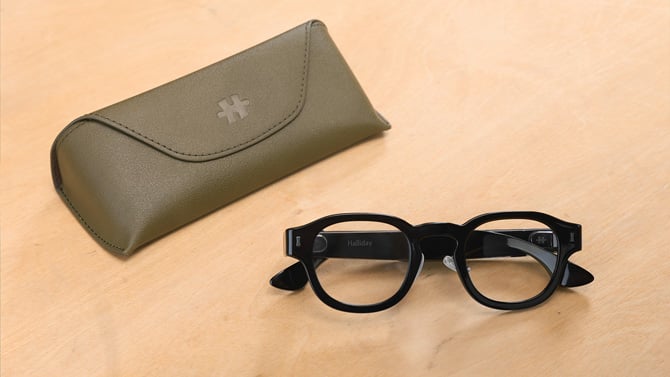
Smart glasses have mostly been sold to us as camera gadgets: something to record a hike or livestream a concert. Halliday, a San Francisco eyewear startup, is betting that the more useful job for AI glasses is in our workplaces. Its new Halliday G2 glasses, announced July 21, skip the camera entirely and instead put a small AI assistant behind the lens whose main job is to help you get through your next meeting.
Typically, AI meeting tools work by recording a conversation and generating a transcript once it's over. The centerpiece of the new G2 is software Halliday calls Meeting Flow, designed to surface useful context, flag unresolved questions and confirm who owns what while a meeting is still happening rather than after it ends.
I spoke with Carter Hou, Halliday's COO and co-founder, about the new glasses ahead of launch. The pitch he kept coming back to is that most AI tools show up too late. "We believe the best moment to make a meeting more effective is during it, not afterwards," Hou told me. "You can send a dozen follow-up emails after the meeting, but it's more efficient to just close everything while you're still in the room."
Meeting Flow runs in three layers of features that work simultaneously during a conversation, according to Halliday. The first layer has multiple components that help you stay on top of the discussion. Caption & Translation puts live captions or translated speech into the wearer's view for meetings that cross languages. Quick Summary recaps the last few minutes on demand for anyone who tuned out or checked their phone. While Quick Research answers a factual question pulled from the conversation's context, with a short answer on the glasses and full sourcing sent to the companion app.
A second layer tracks where the conversation is headed: Thread Tracker maps how the topic has drifted so the group can see what got left unresolved, Decision Confirmation restates an emerging decision in plain language before the room moves on, and Commitment Check flags when someone makes a promise without naming an owner, an action, or a deadline.
Finally, a third layer, Open-Item Tracker, keeps a running list of what's still unresolved and surfaces it as the meeting winds down. Post-Meeting Summary delivers a transcript along with confirmed decisions and open items to the Halliday app once the meeting ends.
Deciding which of those prompts actually reaches the wearer, and when, is its own challenge. Hou described a master agent that filters the output of Meeting Flow's other features before anything appears on the display, since surfacing too much would defeat the point. How well that filtering holds up across the range of meetings people actually sit through, rather than in a company demo, is something that will only show up once G2 ships.
Meeting Flow runs on a subscription. Halliday includes a free year of its Basic tier, worth $9.90 a month, with every G2 pre-order, and buyers can upgrade to a Pro tier at $19.90 a month or a Max tier at $99 a month for more monthly credits. Everyday features like the Halliday AI voice assistant, live translation and notifications don't draw on that credit pool, but Meeting Flow and Post-Meeting Summary do; Halliday estimates its free tier covers around 120 minutes of Meeting Flow use a month.
Hou described a longer roadmap that extends past meetings into interviews, negotiations, and even doctor's visits. He said that Halliday eventually wants users to write their own "skill files" so Meeting Flow can be pointed at whatever conversation matters to them, potentially by connecting the glasses to outside AI tools over a protocol like MCP. None of that exists yet. So, for now, Meeting Flow runs only on whatever Halliday builds into it directly.
Outside of meetings, the G2 carries over Gen 1's everyday features: real-time translation across more than 45 languages, phone calls and music through the glasses' speakers, notification previews, a glanceable dashboard for schedule and weather, and Cheatsheet, a teleprompter-style mode for keeping notes or talking points in view. A "Hey Halliday" wake word triggers the voice assistant hands-free.
Halliday based the G2 on the design of its first-generation glasses, which earned our CES 2025 Editor's Choice Award, and raised $1 million in the first 24 hours of a Kickstarter campaign that became the platform's most-funded AI glasses project. G2 keeps that Gen 1 model's prescription-compatible frame and adds a binocular waveguide display (vs the poorly-received monocular display on the Gen 1) and an upgraded four-microphone array.
The new display uses dual micro-LED projectors rated at up to 1,600 nits of peak brightness and a resolution of 600 by 300 pixels per eye, positioned in the upper field of view so information stays glanceable without pulling the wearer's eyes away from whoever they're talking to. Halliday says the panel dims automatically in darker rooms. The new microphone picks up voices from up to two meters away and separates the wearer's speech from everyone else's in the room to improve transcription accuracy in group settings. A magnetic charging cable clips onto the right temple, a design Hou said the company chose over a charging case because it lets someone top up the battery without taking the glasses off as well as eliminating the need to carry a bulky case; Halliday rates typical battery life at more than 12 hours and says the glasses reach an 80% charge in 20 minutes.
G2 keeps Gen 1's camera-free design by choice. Hou said the goal is giving users a tool built for their work and everyday life rather than for recording it, and argued that a camera on the frame would make people in a meeting uneasy in ways a normal pair of glasses does not. Skipping the camera also frees up battery and weight; Halliday targets a device under 50 grams.
The G2 glasses are available for pre-order now at Halliday's site. A $10 deposit that locks in a $100 discount, bringing the price to $499 ahead of a $599 retail launch when shipments begin in September.
Read next: The best open ear earbuds of 2026, tested

