

Falling asleep is often harder than staying asleep. You can be exhausted and still lie awake, stuck in that half-alert state where your body is ready for rest but your brain won’t quite settle. A lot of sleep tech tracks what happens overnight, but very little does much to help with that first, frustrating transition.
That’s the context for LumiSleep, a wearable sleep headband LumiMind showed at CES 2026. Instead of focusing on sleep scores or post-hoc analysis, LumiSleep listens to the brain in real time and uses sound to gently guide it toward sleep.
In use, it feels much less futuristic than that description suggests.
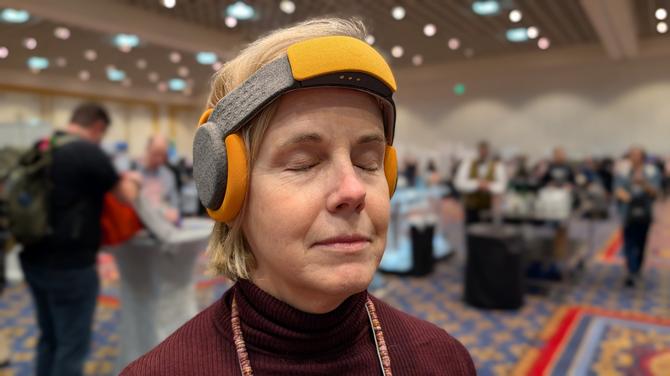
The headband itself is light and comfortable, with soft fabric and cushioned earpieces that sit gently over the ears. It’s easy to wear in bed, including on your side, and doesn’t feel like medical equipment. Built into the band are EEG sensors that read brain activity passively. There’s no stimulation involved, no gels, and nothing being sent into your body.
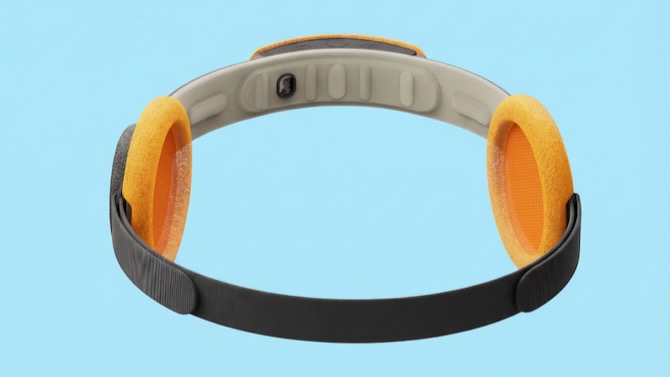
What LumiSleep does with that data is intentionally subtle, but there’s a clear process behind it. First, the headband continuously monitors brain activity using its EEG sensors, building a real-time picture of what the brain is doing moment to moment. That signal is then decoded on the device to understand the user’s current brain state, not in broad sleep stages, but in finer transitions as the brain starts to slow down.
From there, LumiSleep generates adaptive audio in real time, producing low, unobtrusive sound that responds immediately to those brain signals. As brain activity changes, the system modulates the sound to stay in sync, creating a closed feedback loop that gently nudges the brain toward sleep. In practice, the result is a soft, rhythmic hum rather than music or spoken guidance, closer to an adaptive noise machine than a meditation track.
Listening to it at CES, we wouldn’t have described it as “audio therapy” or anything especially technical. It’s quiet, restrained, and easy to tune out in the way good sleep sounds usually are. The difference is that the sound isn’t fixed. It responds to what the brain is doing in the moment, rather than playing the same loop every night.
Traditional white noise machines and sleep apps don’t know whether the brain is tense, relaxed, or hovering on the edge of sleep. LumiSleep adjusts its output based on those signals, and if you wake up during the night, it can adapt again instead of restarting a preset routine.
LumiSleep feels less like a piece of consumer neuroscience and more like a familiar sleep aid that happens to be more responsive than most. For people who already rely on ambient sound to wind down at night, that subtle adaptability is likely what they’ll notice most.
Visit Lumimind.com for more details. LumiSleep officially releases on March 31, 2026, with price to be announced.
[Image credit: Techlicious]

