

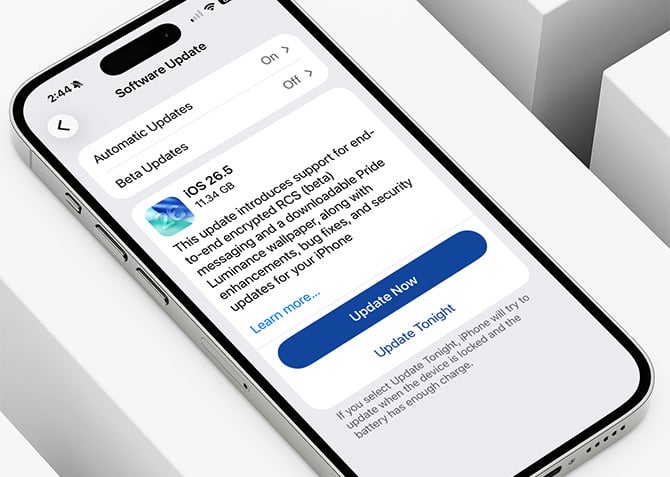
For years, texting between an iPhone and an Android phone meant sending your messages in a state that carriers, and anyone intercepting network traffic, could theoretically read. iMessage has always been end-to-end encrypted, but RCS conversations between iPhone and Android users had no such protection. With iOS 26.5, that changes – sort of.
Starting this week, end-to-end encrypted RCS messaging is rolling out in beta for iPhone users running iOS 26.5 with supported carriers, and Android users on the latest version of Google Messages. Apple and Google worked together on this, with backing from the GSMA, the body that governs mobile communication standards globally. The encryption is built on the Messaging Layer Security protocol and is part of RCS Universal Profile 3.0, a spec Apple co-developed with Google and the GSMA.
The practical result: when the feature kicks in, neither Apple, Google, your carrier, nor anyone else in the middle can read your messages while they're in transit. That's a real privacy upgrade for the billions of cross-platform conversations happening every day.
What you'll see, and what it means
On an iPhone, the Messages app will display "Text Message · RCS | Encrypted" at the center of the conversation screen when protection is active. In Google Messages on Android, users see the same lock icon that has already been used to indicate encrypted Android-to-Android RCS chats. Encryption is on by default; you don't have to go hunting for a setting to enable it. There is a toggle in Settings > Messages > RCS Messaging if you want to verify or change it.
If you don't see the lock, there are four likely explanations. Either your carrier hasn't upgraded its network infrastructure to support Universal Profile 3.0, the Android device you're texting hasn't updated Google Messages, or the iPhone hasn't upgraded to 26.5. Reddit users have also been reporting issues with the production release of iOS 26.5 breaking encryption that had been working in the beta version. That seems to be the case for my iPhone. I assume that Apple will patch this issue quickly.
The carrier problem
Here's where the "sort of" becomes relevant. For a conversation to be encrypted, both the sender and the receiver must use a carrier that supports the latest version of RCS. Apple's software is ready. Your carrier's network may not be.
In the US, the carriers that currently support the feature include AT&T, Boost Mobile, C Spire, Consumer Cellular, Cox Mobile, Cricket, FirstNet, Metro by T-Mobile, Mint Mobile, T-Mobile, TracFone/Straight Talk, US Cellular, Verizon, Visible, and Xfinity Mobile, among others. That's a solid starting list – the major national carriers are on board, along with a good number of MVNOs. But coverage isn't universal, and the more important variable is whether the person you're texting is also on a supporting carrier.
Carrier support for encryption is a separate qualification from carrier support for basic RCS traffic. Your carrier may already carry RCS messages without supporting the Messaging Layer Security encryption layer added in Universal Profile 3.0. That distinction is important. You might have had green-bubble RCS features – typing indicators, read receipts, higher-res photos – for months, and still have no encryption yet.
Group chats add another wrinkle. If any participant in a group thread connects through a carrier that doesn't yet support encryption, the entire conversation may not be protected.
What encryption doesn't cover
End-to-end encryption protects the message in transit. It doesn't protect against someone with physical access to your unlocked phone, doesn't stop screenshots, and doesn't shield you from targeted surveillance that compromises the device itself rather than the network. It also doesn't extend backward to old SMS messages, or to chats where one party falls off RCS and the conversation reverts to SMS. If the lock icon disappears mid-thread, something has downgraded.
For sensitive conversations where carrier support hasn't landed yet, Signal remains the more reliable option. It has always been end-to-end encrypted, works across platforms, and doesn't depend on carrier adoption of any standard.
A long time coming
Back in November 2023, Apple said it would not support Google's proprietary E2EE extension for RCS, but committed to working with the GSMA to create an open standard. Apple and Google formally announced support for Universal Profile 3.0 with E2EE in March 2025. Getting here required Apple, Google, the GSMA, and hundreds of carriers around the world to align on a single open protocol – which is why it took this long.
The GSMA has already published Universal Profile 4.0, finalized this past February, which adds interoperable video calling from RCS conversations for up to 32 participants, richer text formatting, and higher-quality media exchange. Whether those features reach users on any reasonable timeline depends on the same carrier adoption process that's creating uneven encryption coverage today.
This pattern is typical: the specs get written, then the industry waits (and waits) for infrastructure to catch up. For most iPhone users with Android contacts, the rollout is gradual, and Apple's carrier support list will expand over time. The lock icon, when it appears, means something real. When it doesn't, you're still texting in the clear.
Read next: How to use Wi-Fi calling on your iPhone
[Image credit: Josh Kirschner/Techlicious]

