

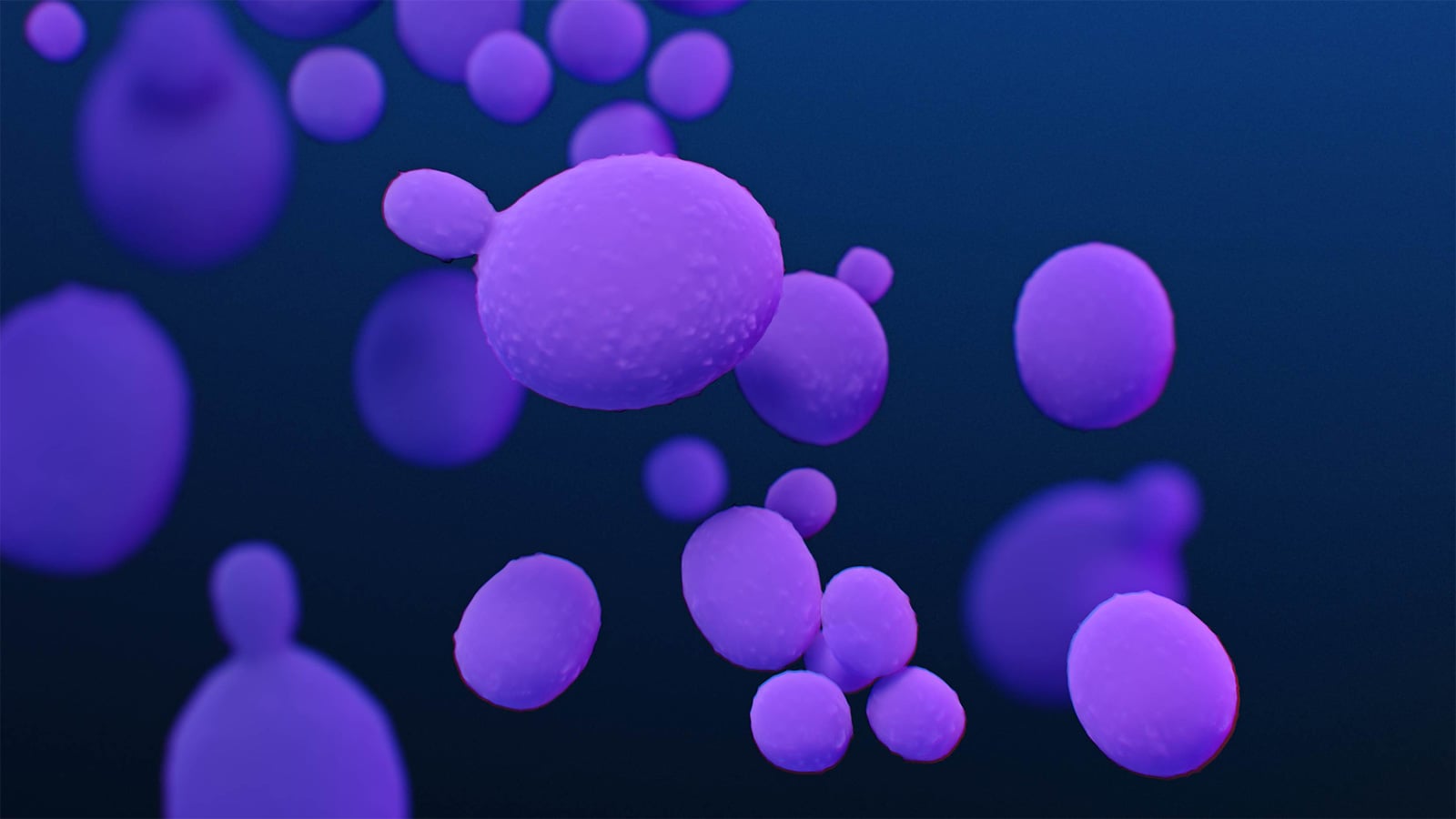
A CDC medical illustration shows Candida auris fungal organisms, with smaller buds growing from several cells.
Image credit: CDC/Stephanie Rossow
A researcher who left lab plates incubating too long stumbled onto a trick that helps a deadly hospital fungus survive antifungal drugs, according to a new study published October 15 in Nature Communications.
The fungus is Candida auris, and it is rare in the general population but dangerous in intensive care units. It spreads between patients, clings to skin and equipment, and is hard to eliminate from the hospital environment. Dr. Hugh Gifford, an ICU physician and the study’s first author, says it has a 45 percent death rate once it reaches the bloodstream. The CDC counted 6,304 clinical cases in the U.S. in 2024.
The study by researchers at the University of Exeter and City St George’s, University of London, started with two critically ill patients in London. Their infections did not clear on anidulafungin, an antifungal drug recommended as the first treatment, even though hospital lab tests had rated the fungus susceptible to it.
To find out why the drug failed, the team exposed the fungus to high doses of anidulafungin in a lab. A researcher accidentally left the plates incubating longer than planned and came back to find small groups of cells still growing.
Survivors came in two groups: slow-growing cells that tolerated the drug and faster-growing cells that resisted it. Cells in both groups had made extra copies of their entire genome, meaning the full set of their DNA. The authors say extra copies give the fungus more chances to pick up helpful mutations.
The fast-growing group also carried mutations in CRZ1, a gene that regulates the fungus’s cell wall, the outer layer of which the drug attacks. The fast-growing colonies had changes that seemed likely to disable the gene.
Why losing the gene helps the fungus survive is still unclear, but the authors say it may change how the fungus reinforces its wall under drug attack. They propose that a few tolerant cells may survive first, extra DNA speeds up mutations in those cells, and CRZ1 changes then help produce the resistant fast growers.
The extra DNA is temporary; cells returned to normal after a day of growth without the drug. The team also found varying DNA levels even in Candida auris samples that had never been exposed to the antifungal. The authors say that suggests the fungus is naturally built to adapt to new environmental factors.
Prof. Tihana Bicanic of City St George’s, the senior author, warns the fungus has a “Swiss Army Knife” of genetic adaptations and that better antifungal drugs are urgently needed.

