

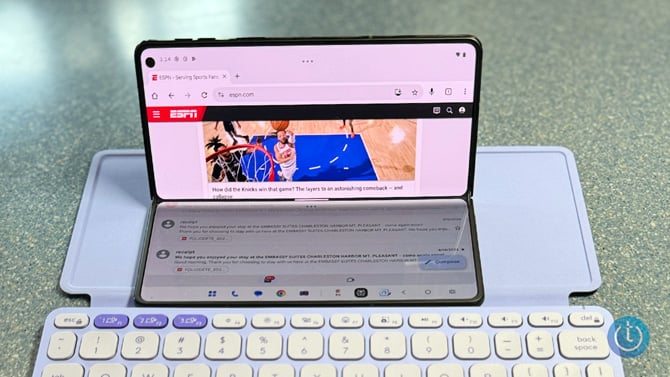
After using the Motorola's first book-style foldable, the razr fold, I quickly stopped thinking about the novelty that it folds and started noticing how much I enjoyed using it. The larger screen made reading, multitasking, and working on the go more comfortable, battery life exceeded my expectations, and the crease quickly faded into the background. But the experience left me wondering whether those benefits are enough to justify spending nearly $1,900 when some of the best flagship phones on the market cost hundreds of dollars less.
The question isn't the crease anymore
Whenever I show a foldable phone to someone who has never used one, the first thing they look for is the crease.
Like foldables before it, the razr fold has one. You can see it under certain lighting conditions, particularly on bright backgrounds (see below), but it's far less noticeable than the crease on early foldables, including Samsung's first-generation Galaxy Fold. More importantly, after a few days of reading, browsing, and watching videos, the crease faded into the background and became something I noticed only when I went looking for it.
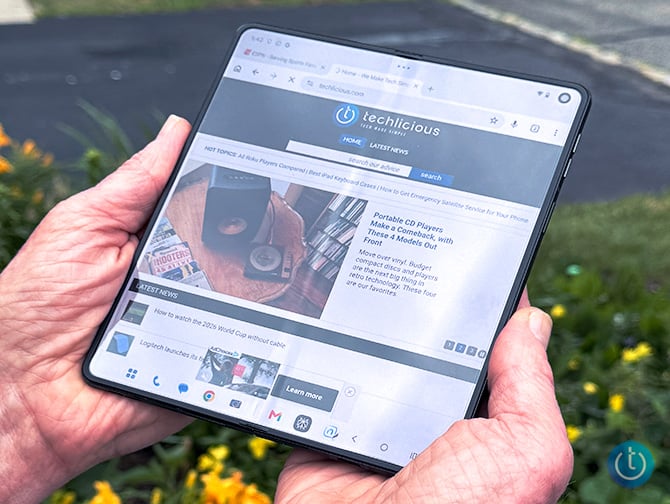
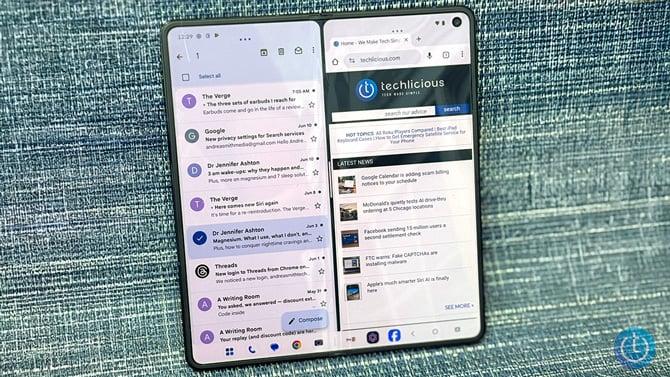
What stood out more was how often I actually wanted to open the phone. It has a 6.6-inch outer display and an expansive 8.1-inch inner display, giving it considerably more screen real estate than even the largest traditional smartphones. Looking through photos felt less cramped and multitasking was more practical. On several occasions in split screen, I had Gmail open alongside a browser while referencing notes from a press briefing. Sure, I can check emails and switch back and forth between apps on a traditional smartphone, but having both visible at once on the larger display felt closer to using a small tablet than a phone.
That aligns with what consumers are telling tech analysts. "Consumers gravitate toward it for video, browsing, reading, and multitasking, which are recurring behaviors rather than once-in-a-while moments," says Mark Vena, CEO and principal analyst at SmartTech Research. Still, he notes that foldable makers face an ongoing challenge: "Brands still need to teach people why opening the phone should become a daily habit." And that's really the question every foldable has to answer.
A bigger screen Is useful. Is it $1,900 useful?
The strongest case for the razr fold is that you're carrying both a phone and a small tablet in your pocket. The hinge, the displays, the cameras — they're all in service of that argument.
"The 'phone plus small tablet replacement' argument is the most convincing rationale because it feels practical, not gimmicky," says Vena.
It's especially practical while traveling. Answering emails on a train, reviewing photos, reading long articles, and pairing the phone with a compact travel keyboard all felt more comfortable on the larger display. Motorola even supports trackpad functionality and lets you run multiple apps simultaneously, which helps the device feel more productive than a traditional smartphone.
The flip side is that many flagship phones already have large displays. An iPhone Pro Max or Galaxy S Ultra can handle most of those same tasks for several hundred dollars less.
The battery is where Motorola surprised me
Foldables have traditionally faced a difficult balancing act. Manufacturers have had to fit two displays, a complex hinge, and flagship components into a device that's still pocketable. As a result, battery capacity often lagged behind similarly priced flagship phones.
The razr fold breaks that pattern. Its 6,000mAh battery is significantly larger than the 4,400mAh battery in Samsung's Galaxy Z Fold7 and even larger than the 5,000mAh batteries found in many premium flagship phones. During my testing I rarely worried about making it through the day, even when spending a lot of time on the larger inner display.
The phone also supports fast charging; up to 80W wired charging and 50W wireless charging. The catch is that you'll need Motorola's own charging accessories to achieve those maximum speeds, and neither charger is included in the box.
Foldables are waiting for Apple
As much as I liked using the razr fold, I kept wondering what it would take for foldables to break into the mainstream. Vena believes one obstacle may have less to do with the technology itself and more to do with who's making it.
"The foldable market is waiting for Apple more than most Android OEMs would like to admit," says Vena. According to SmartTech Research data (PDF), 33% of respondents are waiting for Apple before seriously considering a foldable phone, while 61% say Apple's entry into the market would make them more confident buying any foldable. Those numbers suggest many consumers aren't rejecting foldables; they're just waiting for the category to feel more established.
"Apple's launch would likely grow the entire category by making foldables feel safer, more durable, and more mainstream," says Vena.
Are foldables finally ready for the mainstream?
The razr fold has cleared most of the technical hurdles that held this category back. The bigger screen earns its keep, battery life is genuinely impressive, and the experience is polished enough that you stop thinking about the folding part. Whether all of that is worth $1,900 depends entirely on how you use a phone.
For frequent travelers, multitaskers, avid readers, and anyone who likes the idea of carrying a phone that can double as a small tablet, the high price tag might be worth it.
If a book-style foldable feels like more than you need, take a look at Motorola's razr ultra ($1,499.99). This clamshell-style flip phone is more compact and pocket-friendly with flagship performance, excellent battery life, and an outer display that lets me check messages, control music and glance at directions without even opening the phone. I've been using the Indigo Blue model, which looks more like a rich purple in most light, and it's one of the most striking phone colors I've seen in years.
The razr fold 2026 is available in Pantone Blackened Blue or Lily White at Best Buy and on Motorola for $1,899.99.
[Image credit: Andrea Smith/Techlicious]

