
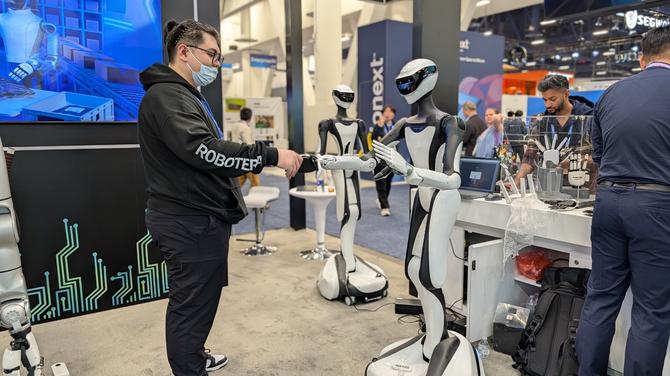
Humanoid robots tend to get attention for how they walk or how human they look. At CES 2026, what caught our attention at Robotera’s booth wasn’t spectacle, but control. Specifically, how well its robots could interact with the physical world in ways that already feel useful.
Robotera showed a lineup of working systems, including full humanoids, wheeled service robots, and, most notably, robotic hands.
Hands are one of the hardest problems in robotics. Walking is complicated, but grasping, adjusting grip, and responding to touch in real time is where robots usually fall apart. Robotera’s XHAND system is clearly designed with that challenge in mind. Watching it manipulate objects on the show floor, what stood out wasn’t strength, but restraint. The movements were controlled and deliberate, not rigid or overpowered.
That comes down to how the hardware is built. Robotera uses direct-drive joints, which remove gears between the motor and the joint. In practical terms, that makes movement smoother and more responsive, and it allows the robot to “give” slightly when it encounters resistance. When a person pushes back or an object shifts, the hand doesn’t fight it. It adjusts.
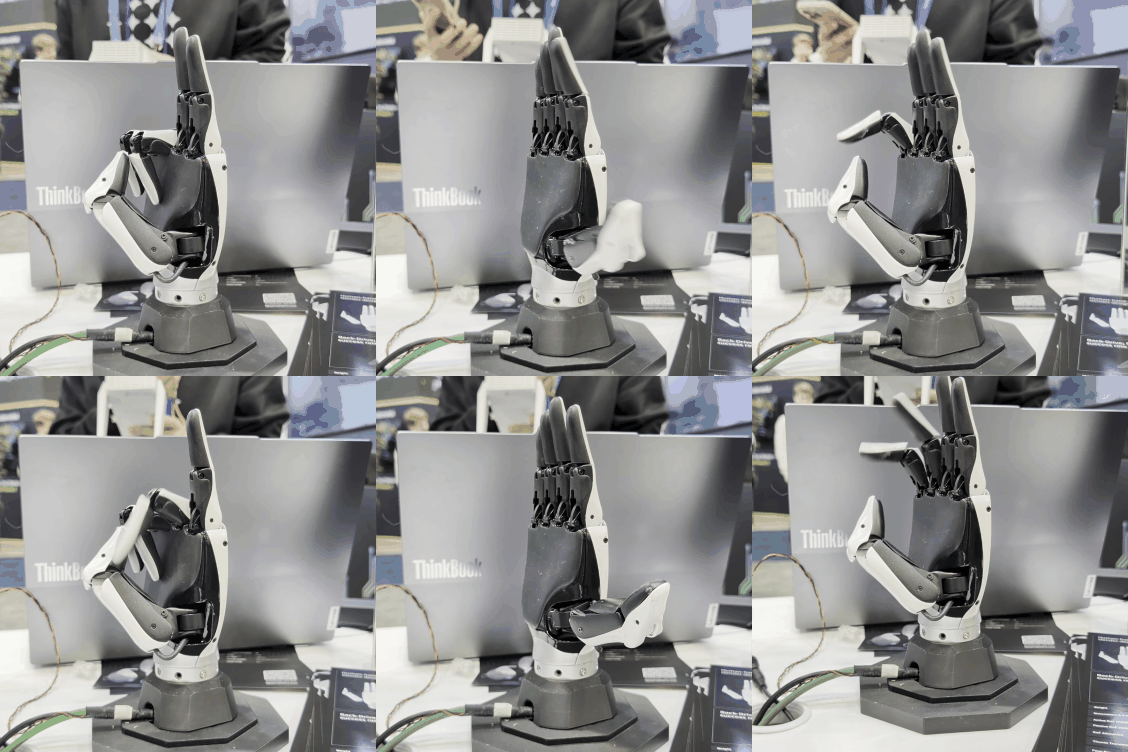
The tactile sensing in the fingertips is a big part of what makes Robotera’s hands feel practical rather than experimental. Each fingertip is fitted with high-resolution, wraparound sensors that can detect pressure, force direction, and changes in contact in real time. Instead of treating touch as a simple on-or-off signal, the system can tell when an object is starting to slip or when grip force needs to change. That’s what allows the hand to handle delicate items one moment and apply a firmer, more confident grasp the next.
Robotera was showing two versions of the hand at CES. The flagship XHAND is a five-finger, anthropomorphic robotic hand with 12 active degrees of freedom and a fully direct-drive, backdrivable design. That setup allows for smooth, responsive motion and makes it well suited to AI training, where repeated grasping, failure, and adjustment are part of the learning process.
Alongside it is the XHAND Lite, which keeps the same human-scale form factor and thumb-to-finger opposition but reduces mechanical complexity and weight. It’s designed for environments where consistency and durability matter more than maximum dexterity, such as education, service robots, and large-scale deployments.
Robotera’s full-size bipedal robot and its wheeled humanoid platform were both on display, performing tasks that emphasized balance, coordination, and interaction rather than speed or strength. The wheeled model, in particular, makes sense for public spaces, where efficiency and stability matter more than walking for walking’s sake.
Visit Robotera.com for more information.