

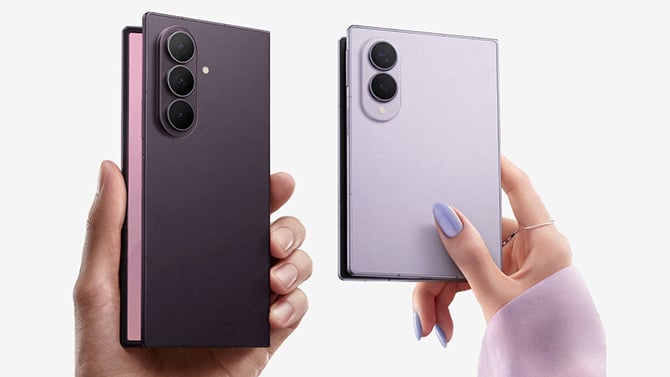
The new Samsung Galaxy Z Fold 8 Ultra (left) and Z Fold 8 (right)
Image: Samsung
Samsung has two new foldable phones that open like a book into a small tablet, and the big news is that you now get a choice of two shapes: tall and thin or short and wide. Until now, the company sold one of these book-style Folds at a time, so you took whatever shape it came in. The Galaxy Z Fold 8 and the Galaxy Z Fold 8 Ultra both turned up at Samsung's summer Unpacked event, and they are built for pretty different people.
The Fold 8 is the wider, shorter one. When closed, it's short and broad in the hand, a little like the small phones that quietly disappeared years ago, and you can reach across the whole screen with one thumb. Open it up and you get a screen shaped roughly like a sheet of paper. It's the lighter of the two, and the cheaper one. If you mostly read, browse, and watch things on your phone, this is the shape you want.
The Fold 8 Ultra goes the other way. It stays tall and narrow when closed, so it handles like a regular phone in your pocket, and it opens into a screen that's closer to square. That squarer shape is better for running two apps next to each other, and the Ultra is the one carrying the more capable camera hardware. It's built for people who actually get work done on their phone, and you'll have to pay for that.
I've carried the last three generations of OPPO's foldables, including the tall, narrow Find N6, and I keep going back and forth on form factor. Giving people two shapes to pick from is the best thing Samsung could have done here.
Read More: OPPO Find N6 Fixes Foldable Phones' Biggest Flaw
The wide Fold 8 is the reader's foldable
When you open the Fold 8, you get a 7.6-inch screen with a 4:3 shape, plus a 5.5-inch cover screen. At 201 grams, Samsung is calling it the "world's lightest fold ever," and that matters more than it sounds if you hold one open for a while.
The 4:3 shape is the interesting part. In portrait, a 3:4 screen is almost exactly the shape of a page. US Letter paper is roughly 3:4, so PDFs, comics, magazines, and text-heavy sites fill the screen with barely any wasted margin, and you see more lines at once. Photos are 4:3 too, so they fill the frame. Rotate to landscape and the 16:10 shape is good for video and social.
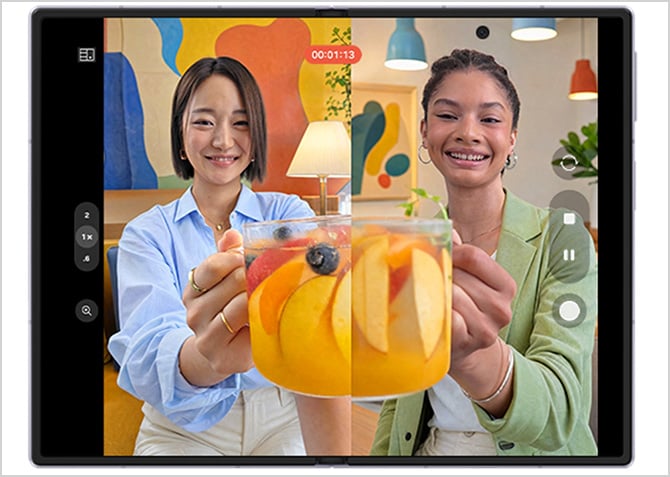
Image: Samsung
Read More: Samsung's $2,899 TriFold Is a Phone That Tries to Replace Your Laptop
The Ultra is for power users and camera people
The Fold 8 Ultra keeps the squarer, book-style shape of the old Fold 7. That near-square screen is worse for reading a single column of text, since you get big side margins or lines that run too long. It's better for real multitasking, though, because two apps side by side get more even space. If you live in split-screen or Samsung DeX, the Ultra is the one.
It's also the camera phone, with a 200MP main sensor and a 3x telephoto, versus the Fold 8's 50MP main and no telephoto at all. The Ultra packs Samsung's first silicon-carbon battery, at 5,000mAh, which fits more capacity into the same space. Both charge at 45W wired, a bump from 25W on the Ultra but still slow. OPPO's foldables have charged far faster for a while, and that speed is really useful for a quick top-up before you head out.
Both run the Snapdragon 8 Elite Gen 5 for Galaxy, add Samsung's new Flex Titanium tech that makes the crease much harder to notice, and launch on Android 17 with One UI 9.
The price problem
Here's where I have a problem. The Fold 8 starts at $1,899.99, and for that money you get a phone with no telephoto camera. A 50MP main and a 50MP ultrawide is basically Flip-tier optics, and asking nearly two grand for a foldable with no zoom lens is ridiculous. The Ultra starts at $2,099.99, which is $100 more than the Fold 7 launched at. I wish Samsung had held the Ultra at its old price and made the base Fold 8 much cheaper instead.
The wide Fold 8 exists for another reason, too. Apple is expected to launch its first foldable in September, and the rumors point to a shorter, wider shape, a lot like the Fold 8. Getting a wide foldable out first, priced below the Ultra, looks like Samsung planting a flag before Apple arrives. Both Folds are up for preorder now at Amazon and go on sale more widely on August 7, each with a six-month Google AI Pro trial.
Samsung also refreshed the clamshell Galaxy Z Flip 8 at $1,199.99, the cheapest and most pocketable of Samsung's new foldables. It gets the same Flex Titanium tech as the two Folds to keep its crease in check, and it sticks with the compact flip shape instead of chasing the tablet ambitions of its siblings. If a $1,900-plus Fold is more phone than you want, the Flip is the easy way into Samsung's foldables, and carriers are already running preorder deals on it.
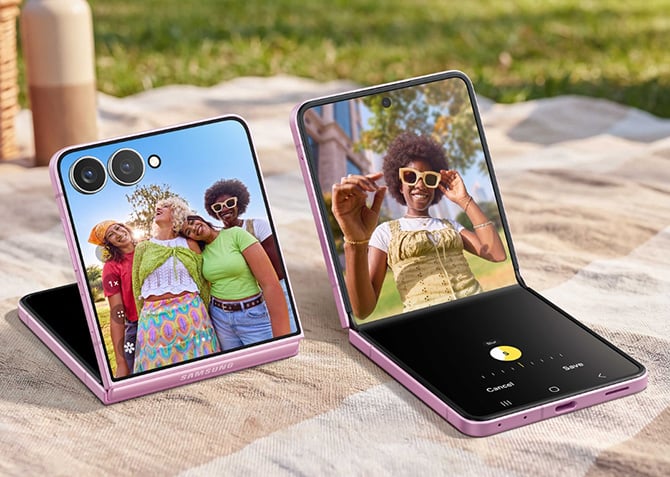
Image: Samsung
The Fold 8 is the one most people should look at, as long as you can live without a zoom camera. The Fold 8 Ultra is for power users who multitask hard or want the better cameras and battery, and don't mind paying for it.

