


Most people stopped thinking about satellite internet after hearing the horror stories – bandwidth speeds and lag that were so bad video calls were unwatchable, games were unplayable, and it all came with a price tag that made it hard to justify. Those complaints were valid. They're also increasingly out of date.
According to new data from Ookla, which operates the widely used Speedtest platform, nearly half of Starlink users in the U.S. (44.7%) were hitting the FCC's minimum broadband standard (PDF) of 100 Mbps download and 20 Mbps upload by Q4 2025. Earlier that same year, just 17.4% could say the same. Median download speeds on Starlink now top 100 Mbps in every state except Alaska.
The FCC benchmark matters because it's the government's own definition of what broadband actually is – fast enough for video calls, file uploads, and multiple users on the same connection at once. Starlink couldn't reliably clear that bar when it launched. Now it does in 49 states.
Upload speeds tell an equally dramatic story. In the second half of 2024, there wasn't a single state where Starlink users were hitting a median upload speed of 20 Mbps – the FCC's minimum threshold. By the second half of 2025, users in 22 states were.
The bigger surprise is latency. Satellite internet's worst reputation was always the delay – that half-second pause that made phone calls feel broken and video games unplayable. Old-school satellite services like HughesNet and Viasat use satellites parked 22,000 miles above Earth, and the round-trip signal time is genuinely terrible: both providers sit above 670 milliseconds of latency as of Q1 2026. Starlink's satellites orbit at around 340 miles up, which is why its median latency has dropped to around 50 milliseconds nationally – and in 10 states, it's under 40 ms. A year ago, only one state (New Jersey) could say that.
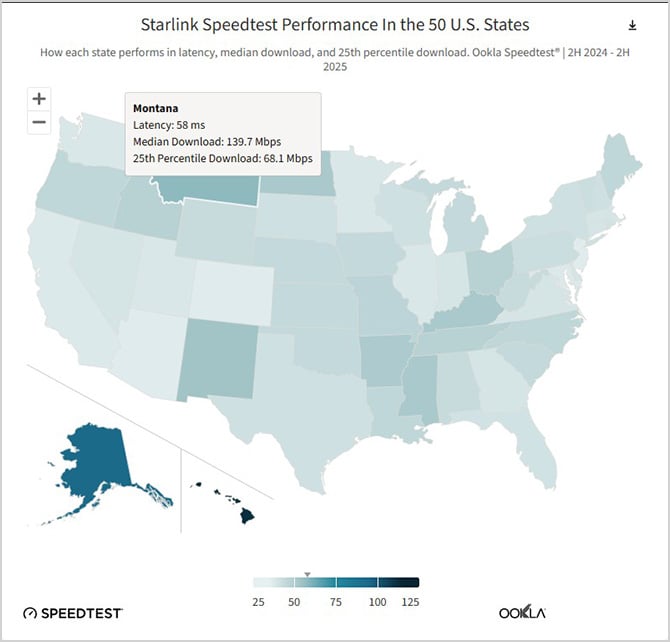
The gains come from SpaceX expanding Starlink's satellite constellation to more than 10,000 satellites as of February 2026, with newer Generation 3 satellites delivering roughly 10 times the downlink capacity of earlier versions. Notably, speeds have continued to improve even as the subscriber base doubled from 4.6 million at the end of 2024 to 10 million by early February 2026.
Starlink residential internet service is not right for everyone. Hardware runs $540 upfront and the residential data plan starts at $100 a month – more than most cable plans. Performance in Hawaii is hampered by the state's distance from mainland data centers, keeping latency high. And rural subscribers in flat, open terrain tend to get the strongest results: Nebraska led all 50 states with a median download speed of 200.80 Mbps in the second half of 2025.
But if you've dismissed satellite internet based on what it was three or four years ago, the technology you remember and the service available today are not the same thing. For anyone in an area where cable or fiber options are limited or overpriced, Starlink has become worth a serious look.
Read next: How to get better Wi-F speeds in your home
[Image credit: Starlink, Ookla]

