
TikTok is finally giving you a way to push back on the wave of AI “slop” in your feed – and it’s pairing that with some fairly serious behind-the-scenes watermarking tech. Here’s what’s coming, how it compares with Google’s YouTube approach and Meta’s, and why experts say watermarking still isn’t a magic fix.
Even if you haven't heard the term "AI slop," you may have seen it either in your video feeds or in the content your friends or news reports show you. As AI-generated video continues to improve, it's crossing the "uncanny valley" from creepily fake-looking to pretty convincing. Slop makes up an increasing volume on social video ground zero TikTok, and the company has recently announced new tools to let viewers turn the flow down – or up. TikTok has said that these features will be rolling out as a test "in the coming weeks."
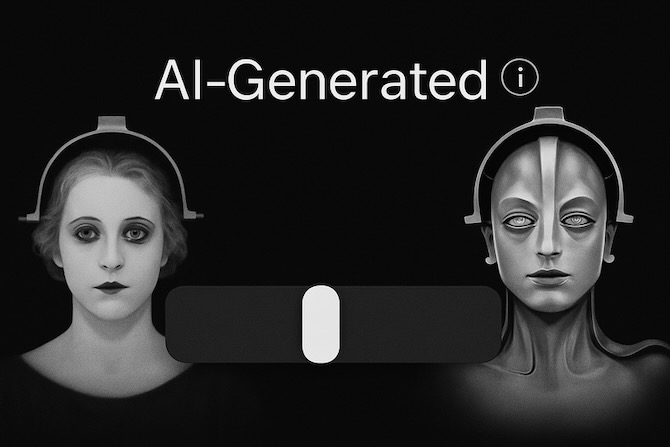
It will make use of the "Content preferences" sliders that you can already use to control how much of a particular content type you see, such as more or less Current Affairs, Dance, Fashion & Beauty, and Food & Drink. Soon you'll see a new slider for what it calls "AI-generated content," or AIGC. (It's not clear yet exactly what the control will be labeled.) You'll likely get to it by clicking "Profile" (bottom right corner) > three parallel lines icon (top right corner) > "Settings and privacy" > "Content preferences" > "Manage topics".
Read More: Google Brings Gemini AI to Mobile Photos App for Wild Edit Options
If it follows the format of the current content controls, you move the slider to the left to get less AIGC or to the right to get more. Note that the former is for "less," not none. TikTok isn't promising it can catch and filter out all AI content. However, if the new TikTok filter works reasonably well, it could provide the most control over AI slop to date, compared to what Google's YouTube and Meta's Facebook, Instagram, and Threads currently offer.
How TikTok’s AI filter will work
TikTok's filter will rely on a process of labelling of AI-generated content that is not foolproof. It already requires that video creators using its Content Studio label realistic AI-generated videos. TikTok also uses its own detection models plus C2PA Content Credentials, an industry standard that embeds details about how videos or photos were made into the metadata that accompany these files. TikTok says that it has already labeled more than 1.3 billion AI-generated videos using these techniques.
Now it will be adding “invisible watermarking” – a hidden label in AI generated files that TikTok's system can read. The watermarks will go on videos created by TikTok's own tools (like AI Editor Pro) and on uploads that already carry C2PA metadata. The goal is to keep TikTok’s AI labels intact even if a video is edited, downloaded, or re-uploaded somewhere else.
What Google/YouTube and Meta are doing
TikTok's approach resembles Google's invisible watermarking technology, SynthID, which labels AI-generated images, videos, and audio and is now being expanded to text. It’s meant to stay intact after common edits such as cropping, filters, compression, and video or audio speed changes. Google is starting to offer a SynthID Detector that can flag content created with its own tools.
Read More: Worried About Your Teen’s TikTok Use? Here’s What You Can Do
On YouTube, Google is also adding visible “AI-generated” labels for uploads of AI-generated or heavily AI-edited videos. If Google detects a video that isn't labeled as synthetic, it reserves the right to slap labels on it.
Meta is taking a similar route. On Facebook, Instagram, and Threads, photorealistic images made with Meta AI get an “Imagined with AI” badge plus invisible watermarks and metadata following C2PA standards, and another called IPTC. (Meta says that video labeling is coming.)
At the moment, both companies are focusing on transparency and disclosures, which TikTok is also promising to do, but not on the “strong” filtering capability that TikTok promises.
What experts say about watermarking
Outside experts and critics support watermarking but caution that it's far from perfect. Last week, I was discussing C2PA tech with Jacob Hoffman-Andrews, senior staff technologist at the Electronic Frontier Foundation, in the context of AI-generated images. "That’s increasingly common among the big AI generation tools, and is probably helpful to protect against unintentional deception," he said. "But someone who wants to pass off an AI-edited image as straight from the camera can simply remove the metadata." He then named an online tool called NO C2PA, that he used to remove C2PA metadata from an AI-edited image he'd created in Google Photos.
"Or simpler - take a screenshot," he added. "Of course, this is all well-understood stuff within the industry - C2PA is not designed to be hard to remove. It’s just metadata."
[Image credit: Sean Captain/Techlicious via ChatGPT]