

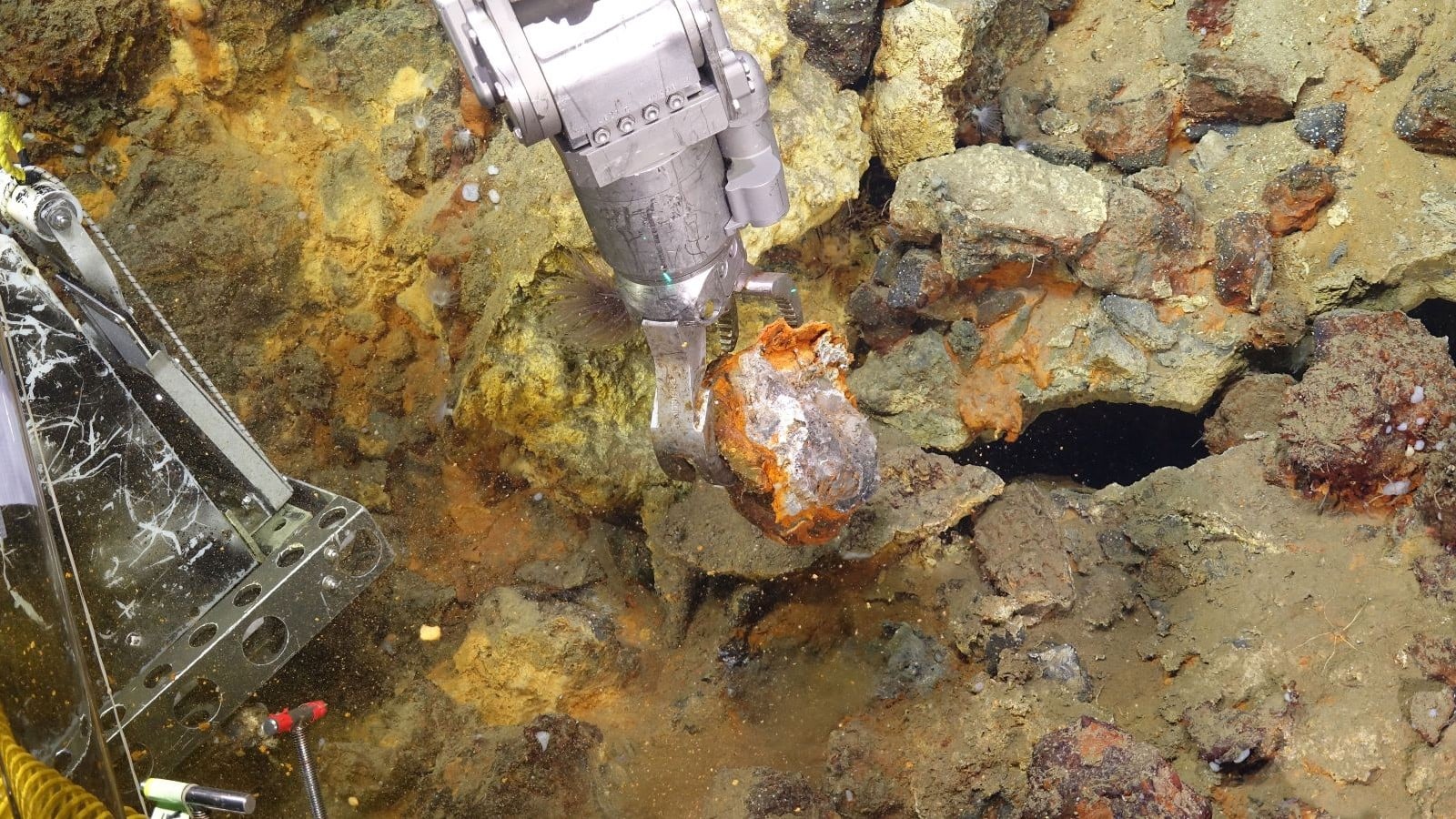
The remotely operated vehicle Jason collects a mineral sample from the seafloor at Escanaba Trough in 2022.
Image credit: ROV Jason/Woods Hole Oceanographic Institute
Two rocks pulled from the seafloor off the Oregon-California border heated up and began smoking on a lab bench as scientists broke them apart, according to a new study in Scientific Reports by U.S. Geological Survey researchers.
The rocks came from Escanaba Trough, a volcanic zone at the southern end of the Gorda Ridge, an undersea ridge off the Oregon-California border where the seafloor is slowly pulling apart. USGS researchers collected samples there in 2022 using a remotely operated vehicle, Jason. After the samples were freeze-dried and prepared for study, two of those metal sulfide-rich rocks ignited in the lab.
As researchers snapped the rocks into smaller chunks by hand and exposed fresh surfaces, the pieces began to heat up and smoke. By the end, the original rock had been completely oxidized.
The culprit appears to be a fragile form of iron sulfide called nanocrystalline marcasite, a relative of the fool's gold mineral pyrite. The marcasite crystals in these rocks were only 5 to 16 nanometers across, thousands of times thinner than a human hair, which gives oxygen an enormous amount of surface to react with. That reaction releases heat. When the heat builds faster than it can escape, the rock can keep warming itself until it burns.
On the seafloor, the rocks sat in water of roughly 2 degrees Celsius (about 36 degrees Fahrenheit) with relatively little oxygen, conditions that would slow that reaction and may help the unstable mineral survive. Pull the rock into warm, oxygen-rich air, and the reaction can take off.
The discovery of self-igniting rocks is important beyond the laboratory. Seafloor sulfide deposits, which can hold copper, zinc, and other valuable metals, are being explored as a possible source of minerals. The International Seabed Authority has granted eight mining exploration contracts for these deposits, covering parts of the Mid-Atlantic Ridge and the Indian Ocean. Yet, no engineering controls exist for mining these deposits, and the authors warn the chemistry could cause rapid-onset fires aboard ships.

