
We may earn commissions when you buy from links on our site. Why you can trust us.

Elehear Delight review: The best budget OTC hearing aid
by Stewart Wolpin on June 09, 2026

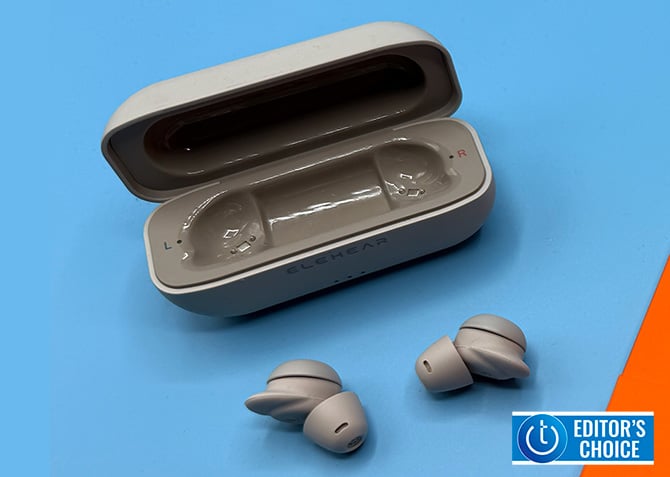
Elehear's new Delight Bluetooth bud hearing aids ($419) confirm what Apple asserted with its AirPods Pro 2 and 3: it is possible to build and sell a decent OTC hearing aid for the same price as a good set of dedicated Bluetooth buds.
As with many "budget" OTC hearing aids (OTC HAs), however, the Delight delights in some respects and disappoints in others. But for its now discounted $315 price, the Delight manages to find a happy compromise between the inherently contradictory main hearing aid amplification and Bluetooth music listening features for those with mild to moderate hearing loss.
In short, the Delight are a better hearing aid than the AirPods Pro 2 and 3 but are not as good as for music listening. And thanks to the proof from both the AirPods Pro and these Elehear Delight, perhaps sub-$500 pricing for OTC hearing aids will become the new normal.
| + Pros | – Cons | |
|
|
|
|
||
Ergonomics, Set Up, Fit
Elehear's beige Delight resemble most other standard Bluetooth earbuds, with one major upgrade for hearing aid usage I wish Apple would adopt: "open" slotted ear tips.
Hearing aids create a corrective and amplified natural aural environment by mixing ambient sound with the hearing aids' amplification. Apple's AirPods Pro 2 and 3 come with solid silicone ear tips designed to seal your ear canal, which eliminates the ambient sound mixing of the usual hearing aid equation. Instead, AirPods Pro 2 and 3 rely solely upon Apple's amplified Transparency mode, which is good, but does not produce natural hearing aid acoustics. Not only does everything you hear sound slightly artificial – because it is – even your own voice sounds slightly distant.
But Elehear has included three sets of both small, medium, and large "closed" solid and "open" slotted ear tips in an easy-to-identify cardboard array rather than loose in a clear plastic bag. "Open" slotted ear tips allow the Delight to mix ambient sounds with amplified sound to create a far more natural hearing aid-like amplified listening environment than the AirPods Pro. As a result, Delights produce a superior hearing aid experience compared to AirPods Pro that is comparable with my still-favorite, but far pricier, OTC HA, the Sony CRE-20, which also lacks Bluetooth.
In addition to the two sets of "open" and "closed" ear tips, Elehear also supplies three pair of stabilizing "ear wings" (large, "R" (regular?), and small) that help the buds sit more firmly in your ear. The R wings come pre-fitted.
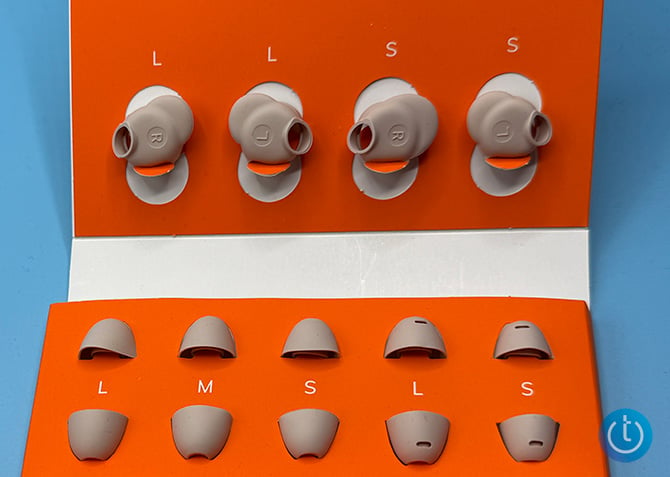
But a caveat for those with large ear canals: even with the L tips and wings, the Delights felt loose, and once one bud actually fell out of my ear with no real provocation. I would have liked either larger Larges or XL tips/wings.
You also get the obligatory USB-C charging cable and a bud-cleaning brush/pick.
Once you determine your desired wing/ear tip combo, you'll find the lightweight Delight buds (3.5 grams each vs the AirPods Pro 2 at 5.3g and the Pro 3 at 5.55g) sit comfy in your ears for as long as you wear them. I often found myself forgetting I was wearing them, even at the end of an hours-long stretch.
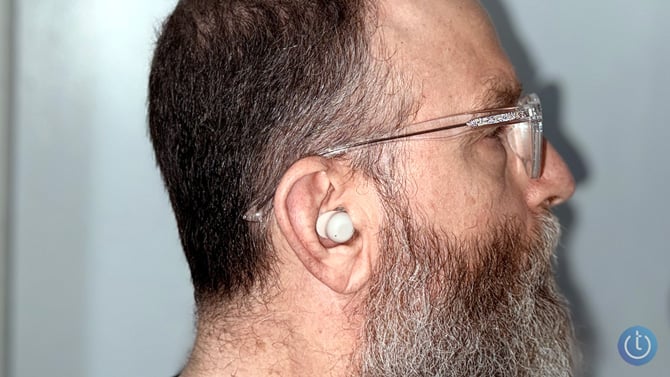
While they aren't exactly "invisible" as the Audien Atom X or RIC (rest in canal) type OTC HAs, the Delight certainly look less obvious in most ears than the white stick AirPods Pro.
Functions
First and foremost, unlike the Apple AirPods Pro 2 and 3, Elehear told me the Delight are NOT FDA-approved self-fitting hearing aids.
However, Elehear, after asking gender, age, and tinnitus status questions during set-up, DOES provide a short self-fitting-like hearing test the company claims "follows the same standards and procedures as those used in traditional audiology clinics." You also get access to Elehear-employed audiologist email support through the Elehear app.
"Rather than relying on a fully self-fitting approach, ELEHEAR prioritizes professional audiologist involvement because we recognize the critical role expert guidance plays – especially for first-time hearing aid users with no prior experience," an Elehear rep told me. "Audiologists help guide users through the entire journey, from hearing assessment to adaptation and daily use, ensuring they understand their hearing health and how to use their devices correctly to achieve the best possible outcomes."
In response to my app-generated audiologist request, I got a LOOOONG email that seemed mostly canned except for a couple of personalized messages in red advising me where to set the Delight's volume and tone settings, which I'd already figured out. Along with the audiologist's reponse, the recommended volume and tone settings are automatically sent to your Elehear app, which prompts you to apply them.
Elehear's audiologist email reply also offers to check out the results of any previous hearing test you may have taken for comparison. I did not/could not submit previous hearing tests to gauge Elehear's response since the offer is predicated on supplying purchase proof, which I don't have since I reviewed a company-supplied sample.
Battery Life
Delight buds are rated to last 13.5 hours in hearing aid mode; in mixed hearing aid/music listening/handsfree call usage, I got about nine hours of battery life, still impressive for such small and light buds. On its own, the case provides two additional complete charges.
Generally speaking, Delight provides nearly triple the battery life of the AirPods Pro 2 or 3, which is terrific battery life for any Bluetooth buds of any stripe, hearing aid or not.
However, hearing aids really need to offer "all-day" life to be truly usable. But it's hard to complain about their "most of the day" battery life considering the Delight's price and comfy lightweight build. I simply delayed donning the Delights as long as I could in the morning and returned them to the charging case whenever I didn't need them to squeeze a mostly "all-day" single charge usage out of them.
You charge the Delight buds in a compact rectangular charging case (2.95 x 1.37 x 1.10 inches), which is only slightly bulkier than an AirPods Pro case. On the front of the Delight case are three white LEDs to indicate the case's power level.
Inside the case, the buds conveniently magnetically snap into place for charging, and single white LEDs blink to indicate charging; your buds are fully charged when the LEDs become solid.
Other than these charging LEDs, there is no bud battery status level indicator on or in the case, only through the app. You will start getting low power voice cues with around 10-15 minutes of battery life remaining in each bud.
Controls/Functions
Ah, here is the Elehear app: the Delight's Achilles heel. For whatever reason, the app will not stay paired with the buds. To change the volume or access any other app function, I constantly and annoyingly had to re-pair the buds to the app each time I wanted to change any settings.
Elehear told me this incessant app re-pairing could be avoided by closing the app when I placed the buds in the charging case, then rebooting the app after I put the recharged buds back in my ears. However, this only worked occasionally.
Even if this reboot routine worked, it shouldn't have to. The app should ALWAYS stay paired with the buds, as apps do with most other Bluetooth OTC HAs I've tested.
Thankfully, you can manually raise (long tap) and lower (double tap) the volume on the buds themselves.
Handiest among the Elehear app controls are the volume and bass/treble tone, which can be adjusted for each individual bud or combined, on sliding bars that range from 0 to 11 – yes, the Delight go up to 11. Just these two controls help adjust the buds to your hearing issue that the non-self-fitting hearing test may have missed.
In addition, the Elehear app includes four aural presets: General, Restaurant, Music, and TV, which, to my pleased surprise, actually provide hearable differences. The Restaurant preset was especially effective at lowering ambient noise and increasing the volume of nearby vocals, quite a feat given how tightly packed and noisy New York City restaurants are.
Also available are five ambient noise reduction settings: Adaptive (automatic), Light, Moderate, Advanced, and Maximum. I didn't notice much difference except for Maximum, which is part of the Restaurant preset.
Perhaps the Delight's top extracurricular selling point is an included translator for (at press time) 19 global languages, including both simplified and Cantonese Chinese. On the two-sided screen, each speaker taps a mic to speak. Your phone not only displays the translation text but speaks the translation through the Delight buds. Translation works shockingly well and adds to the Delight's already high value.
You'll also get 22 nature "soundscapes" and four "color" noises – white, pink, brown, and blue – under the Serene app tab.
Performance
Thanks to their "open" slotted ear tips, the Delight are far superior to the AirPods Pro as a hearing aid in creating a natural ambient aural environment.
Delight's ability to go up to 11 isn't mere hyperbole: the buds get REALLY loud, perhaps the loudest OTC hearing aid I've tested.
Even better, like the AirPods Pro, you get no feedback squealing or distortion at all, even when you turn up the volume to 11, both rare attributes among OTC HAs at any price. However, when the Delights encounter loud sounds, the amplification gets automatically turned down until the higher volume situation passes.
While the Delight don't provide noise canceling, hearing aid amplification is cut off when Bluetooth music streaming begins. The Delight's ear tips and your own natural hearing loss provide a sort of natural noise reduction.
For music listening, the Delights don't delight especially in noisy situations compared to the AirPods Pro 2 and 3, which, of course, add active noise cancelation.
Listening to music via the Delight in a quiet setting, such as in an office, creates an acceptable melodic background while keeping you sonically aware of your surroundings. But without noise canceling, ambient city sounds completely wipe out everything . Even at top volume, I could barely make out a song's basic melody while walking down even a modestly quiet Manhattan street.
Hands-free calls are louder and clearer than music at both ends. Only a couple of times did my co-conversationalist complain about my vocal quality.
Delights do exhibit a couple of minor, not deal-breaking, quirks. For instance, once the buds are removed from their case and placed in your ears, it takes a seemingly interminable 12-15 seconds for the Delights to power on and connect to Bluetooth. Both the Delight and the AirPods Pro tend to magnify winds over around 10mph. And, you'll get occasional and seemingly random vocal Bluetooth disconnect-reconnect and "volume max" notifications.
Verdict
Considering their low price, even without the current discount, their high hearing aid volume, tone adjustments, preset effectiveness, and overall amplified aural quality, the Delight are today's best bargain OTC hearing aids for those with mild or moderate hearing loss.
Delight's Bluetooth music-listening drawbacks are somewhat offset by their light and comfy fit and the surprising translation feature. But when wearing them with the slotted ear tips, the Delight are nearly useless for music listening in any but the quietest environments.
If not for that damned disconnecting app, I'd rate the Elehear Delight a half-point higher. Not getting the Elehear app to stay paired with the buds is a self-goal by Elehear that I hope they can correct.
CHECK PRICE ON AMAZON
CHECK PRICE ON ELEHEAR
[Image credit: Stewart Wolpin/Techlicious]
Discussion 

I have the Audien Atom X (and previously had their AtomPro2), and dislike its lack of Base-Treble frequency adjustment; thus it becomes basically a, marginally helpful, simple PSAP. I have high frequency loss, and only need volume and conversational clarity. I wear in only one ear, so as to keep the better (but still defective) ear free. I also need no Bluetooth music listening, nor translations. But, I hate the phone apps, which the X does not require. Still, I would try this Delight, IF it can simply shut off or not use the Bluetooth music feature or translator complications. Should I? Better, lets tell Audien to add a frequency adjustment to an “X2”.
I very much appreciate your work and continuing posting on hearing aid testing. No other source, among so many HA posts, do I really trust. Please follow up the recent info from Audien on a, supposedly, smaller and “better” Atom X, “2nd Generation”. Is there really any difference with earlier models, I own the original X and, previously the Atom Pro 2. Maybe see how the 2nd Gen compares to the Elehear Delight; and referencing the disappearance of the Sonys and Eargos from the market. Thanks for all you do!

From Senior Tech User on July 12, 2026 :: 9:15 am
Excellent write-up. The physical buttons on the device seem much easier to manage than tiny touch controls found on other models. I might give these a try.
Reply