

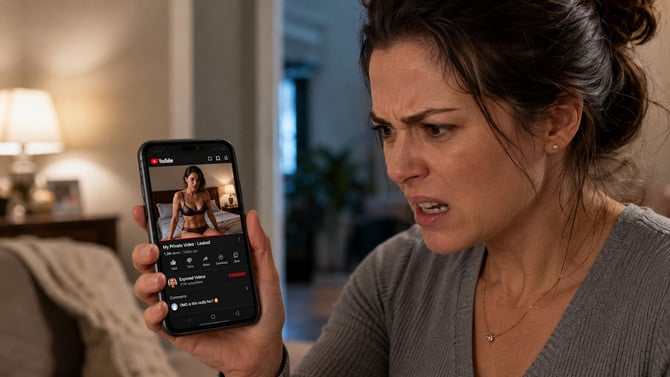
A fake video of you saying something you never said, or promoting a product you’ve never touched, is no longer hypothetical. YouTube built Likeness Detection to help you fight back: it automatically scans the platform for AI-generated videos of your face, alerts you when it finds a match, and lets you request removal. For the first time, it’s open to anyone with a channel.
If you’re 18 or older with a YouTube account, you can sign up now. Enrollment requires a selfie video and a government-issued ID, the same bar YouTube set for celebrities and politicians.
Think of it as Content ID, which YouTube has used for years to catch copyrighted audio and video, but for faces. The tool lives in YouTube Studio, available to channel owners and managers.
YouTube launched Likeness Detection in December 2024 in partnership with the Creative Artists Agency, initially covering only celebrities and major talent. It expanded to top YouTube Partner Program creators like MrBeast and Marques Brownlee in April 2025, then to all 4 million Partner Program creators in September 2025. This year, YouTube extended the program to politicians, journalists, and government officials in March 2026, then to Hollywood celebrities and entertainment industry accounts in April. Now it’s open to everyone.
How your data will be used
YouTube processes your video and ID to create a “face template,” a digital reference it uses to compare your face against suspected deepfakes going forward.
YouTube says this data is used solely for verification and likeness detection, not to train generative AI models. You can also opt out of letting YouTube use your templates to improve its detection models, which I recommend doing. Once you opt out, your data is deleted.
Handing your government-issued ID and biometric likeness to Google carries real risk, whatever YouTube’s policies say. Google has faced a $135M Android Cellular Data settlement alleging its phones used cellular data to transfer information without users’ permission, and paid a $170M FTC penalty over YouTube’s collection of children’s data.
Why YouTube is doing this now
In early 2024, YouTube removed over 1,000 AI-generated ads that used deepfakes of Taylor Swift, Steve Harvey, and Joe Rogan to promote Medicare scams. The videos had already accumulated 200 million views by the time they were taken down. In February 2025, an AI-manipulated ad of Tom Hanks promoting a fraudulent diabetes “cure” was still running on the platform when it was discovered.
Deepfakes have moved well beyond celebrities. Criminal cases involving children are now appearing in courtrooms. This year, two students at Lancaster Country Day School pleaded guilty to manufacturing explicit images of their classmates. Days ago, a teacher at Corinth Middle School in Mississippi was sentenced for using AI to create pornography using students’ faces.
Congress has also started responding. President Trump signed the TAKE IT DOWN Act in May 2025, but it covers only sexually explicit deepfakes. The NO FAKES Act, which hasn’t passed, would offer broader federal protection against the unauthorized use of someone’s likeness. Organizations including the Electronic Frontier Foundation argue the act would remove protections for legitimate satire and parody.
What Likeness Detection won’t do for you
After you enroll, detections aren’t immediate. YouTube hasn’t specified how long the initial scan takes, which is cold comfort if you’re already in the middle of a deepfake crisis and just discovered the tool exists.
When a match is detected, you get a notification, review the flagged content, and submit a removal request. Removal isn’t guaranteed, though. YouTube still permits satire and parody, so a fake video of you may stay up even after you’ve asked for it to come down. If that deepfake spreads across multiple channels, you’ll need to submit individual removal requests for each one, with no clear timeline and no stated consequences for whoever posted it.
Voice clones aren’t covered. Likeness Detection is for faces only, for now.
Should you enroll?
If you appear regularly in videos, even with a modest following, enrollment means YouTube’s AI is actively watching for fake versions of you, rather than you stumbling across one by accident. The alternative is doing nothing and hoping you’re not a target.
Just make sure to opt out of the model improvement setting before you finish enrollment. Your face and government ID will be in Google’s hands, and YouTube’s current policies can change. What feels like a reasonable trade-off today may look different in two or three years.
[Image credit: Suzanne Kantra/Techlicious generated by ChatGPT]

