

Image credit: AMD
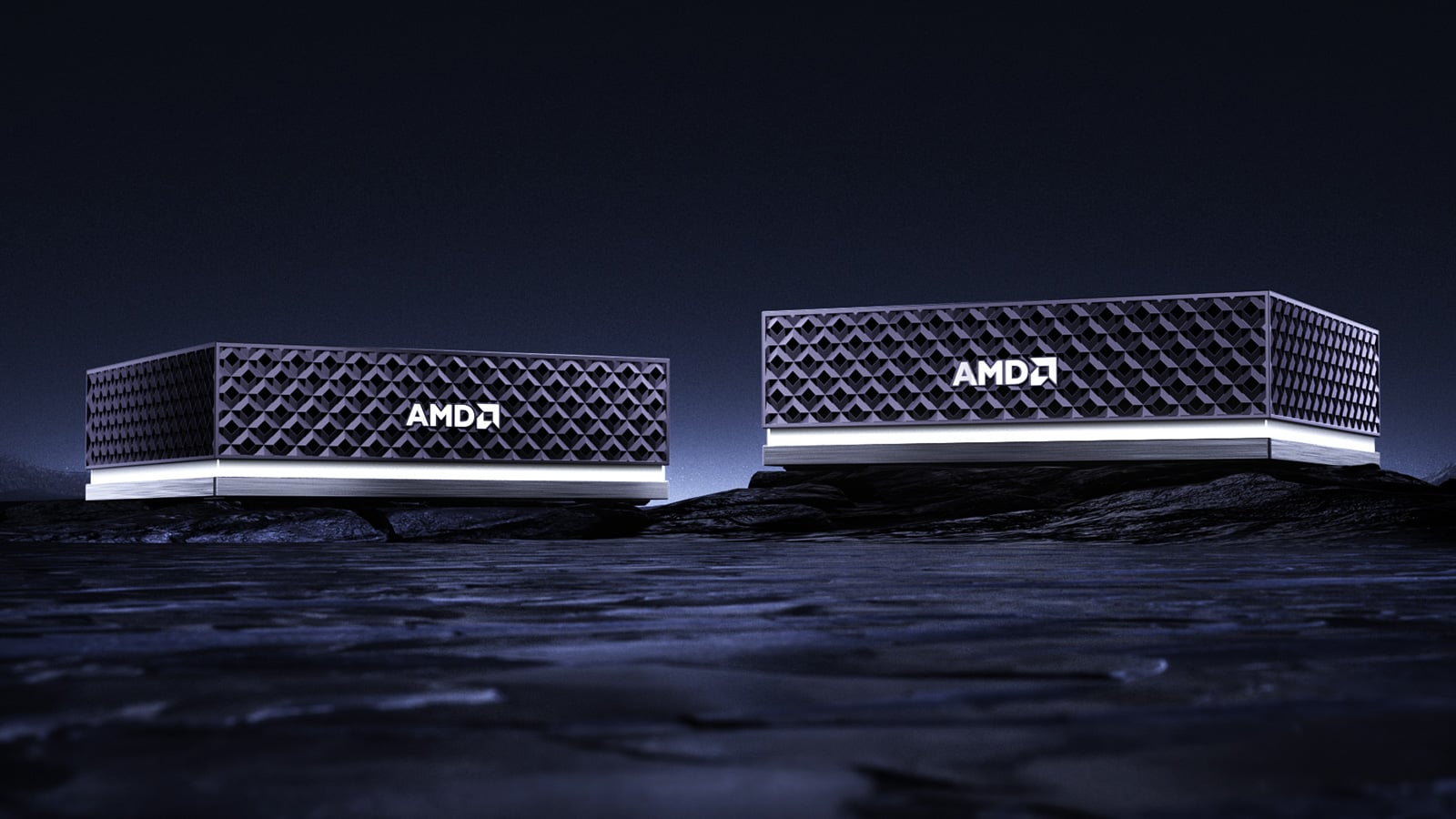
NVIDIA’s DGX Spark has arrived with plenty of promises about the large AI models developers can run locally. But not so fast. Perennial rival AMD says two can play that game. The red team is firing back with the Ryzen AI Halo developer platform, its own compact system for building, testing, and running AI models without relying on the cloud.
The current Halo is powered by AMD’s Ryzen AI Max+ 395 processor, formerly code-named Strix Halo. It combines a 16-core CPU, integrated Radeon graphics, and an AI-focused NPU with 128GB of unified memory. According to AMD, that’s enough capacity to run models containing as many as 200 billion parameters locally.
That puts Halo in the same general class as NVIDIA’s DGX Spark. Both systems have 128GB of unified memory and claim support for models up to 200 billion parameters. Halo, however, uses familiar x86 hardware and supports Windows and Linux, while DGX Spark pairs an Arm-based CPU with NVIDIA’s Blackwell graphics, CUDA software ecosystem, and Linux-based DGX OS. AMD lists Halo at $3,999, compared with $4,699 for DGX Spark. While both prices will make a wallet wince, it's nice to see that AMD continues its trend of being the more affordable of the two.
However, Halo’s hardware isn’t exactly new. The Ryzen AI Max+ 395 is already in computers such as the Framework Desktop, HP Z2 Mini G1a, and Corsair AI Workstation 300. Because these machines use the same underlying processor, similarly configured models should perform within the same general range, although cooling, memory, power limits, and drivers can still affect the results.
That means Halo’s real selling point isn’t the silicon. It’s AMD’s software support.
The preinstalled Ryzen AI Developer Center gives developers one place to access tools, updates, validated software configurations, and AMD’s guided AI Playbooks. Halo works with popular tools and frameworks including PyTorch, vLLM, llama.cpp, Ollama, ComfyUI, LM Studio, VS Code, and ROCm. AMD’s Playbooks provide step-by-step assistance for running language models, generating images, creating AI agents, and tackling other common projects.
AMD Sync is another piece of that experience. The remote-access application lets a developer control Halo from another computer and provides one-click access to a terminal, VS Code, JupyterLab, and system-performance information. Instead of configuring SSH connections and remote-development tools manually, AMD Sync is designed to handle much of that setup.
That convenience could save developers hours – or days – otherwise spent resolving incompatible drivers, missing software libraries, and complicated command-line instructions. AMD’s goal is to make Halo something developers can connect, configure, and start using without first becoming an expert in troubleshooting ROCm.
AMD also has a more capable version of Halo planned for later this year. The forthcoming version will use a Ryzen AI Max+ PRO 495 processor and increase unified memory from 128GB to 192GB, with up to 160GB assignable to graphics. AMD says that will support models exceeding 300 billion parameters at 4-bit quantization, as well as more complex workflows involving multiple models or AI agents.
The PRO 495 also increases the maximum CPU clock, graphics frequency, and NPU performance, but the biggest improvement is capacity—not necessarily speed. Being able to load a 300-billion-parameter model doesn’t mean it will run quickly. Actual performance will depend on the model, quantization, memory bandwidth, and AMD’s software optimization.
Ultimately, Halo’s success won’t hinge on whether AMD can put familiar Ryzen hardware inside another mini-PC. It will depend on whether the company’s validated software, Playbooks, and support can make local AI development easier than it is on all the other machines using the same chip.
Read next: NVIDIA RTX Spark is the PC chip that might actually deliver local AI

