

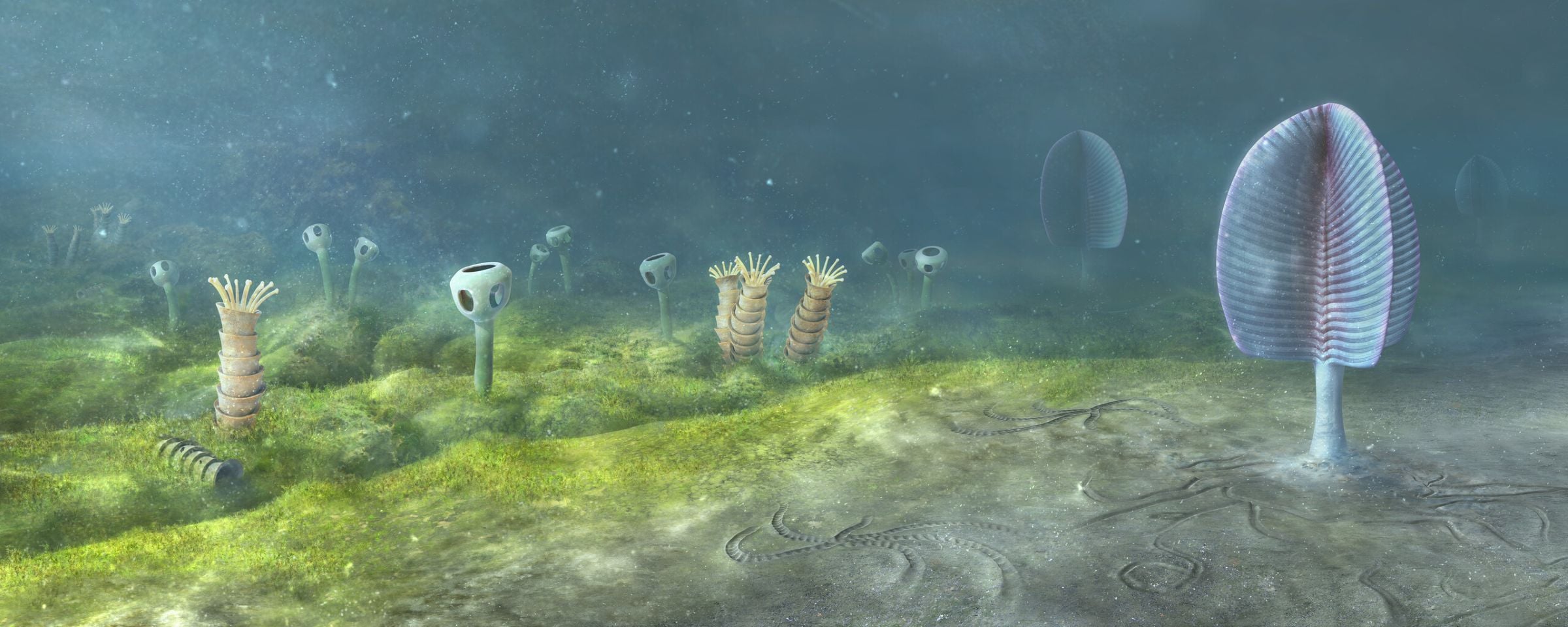
Ediacaran sea floor, Namibia, Southwest Africa - 543 million years ago.
Image credit: Museum of Natural History, University of Oxford / Mighty Fossils
Animals may have first appeared on Earth between 800 million and 700 million years ago, according to a study published October 2 in Science Advances. That timeline would put them 100 million to 200 million years ahead of the oldest known animal fossils, and possibly before the planet's Snowball Earth ice ages. The estimate comes from a molecular clock, a method that compares genetic differences among living species to work backward to when their ancestors diverged.
The oldest unambiguous animal fossils, from a group of seafloor creatures known as the Ediacara Biota, are about 574 million years old. That gives scientists a firm minimum: animals had to exist by then. Chemical traces left by sponges in older rocks suggest animals were around by at least 650 million years ago, according to the study, but no body fossils from that time have been discovered.
Absent those fossils, the molecular clock can help. To turn genetic differences into dates, the clock needs a maximum age, a ceiling before which animals could not yet have existed. Scientists set that ceiling by finding rocks that were good at preserving fossils but contain no animals. Think of dating a house: a 1950 photo showing it standing sets the minimum, and a 1920 aerial photo showing an empty lot suggests the maximum. Some recent analyses used the Weng'an Biota in China for that ceiling. The roughly 590-million-year-old deposit preserves microscopic organisms in extraordinary detail but holds no definitive animals. Anchored there, the clock put the origin of animals around 590 million years ago, only about 16 million years before the first fossils.
The Oxford-led team, which included researchers from UC Berkeley, ETH Zürich, and Yale, tested that reasoning against the Kheseen Biota in Mongolia. They examined 143 rock samples from the site, which formed roughly 534 million to 526 million years ago, when animals were already established elsewhere. The haul included spiny, spherical organisms called acritarchs, eight species of them new to the site, along with embryo-like fossils containing internal cells. None could be confidently identified as an animal, even though scientists know they existed at the time.
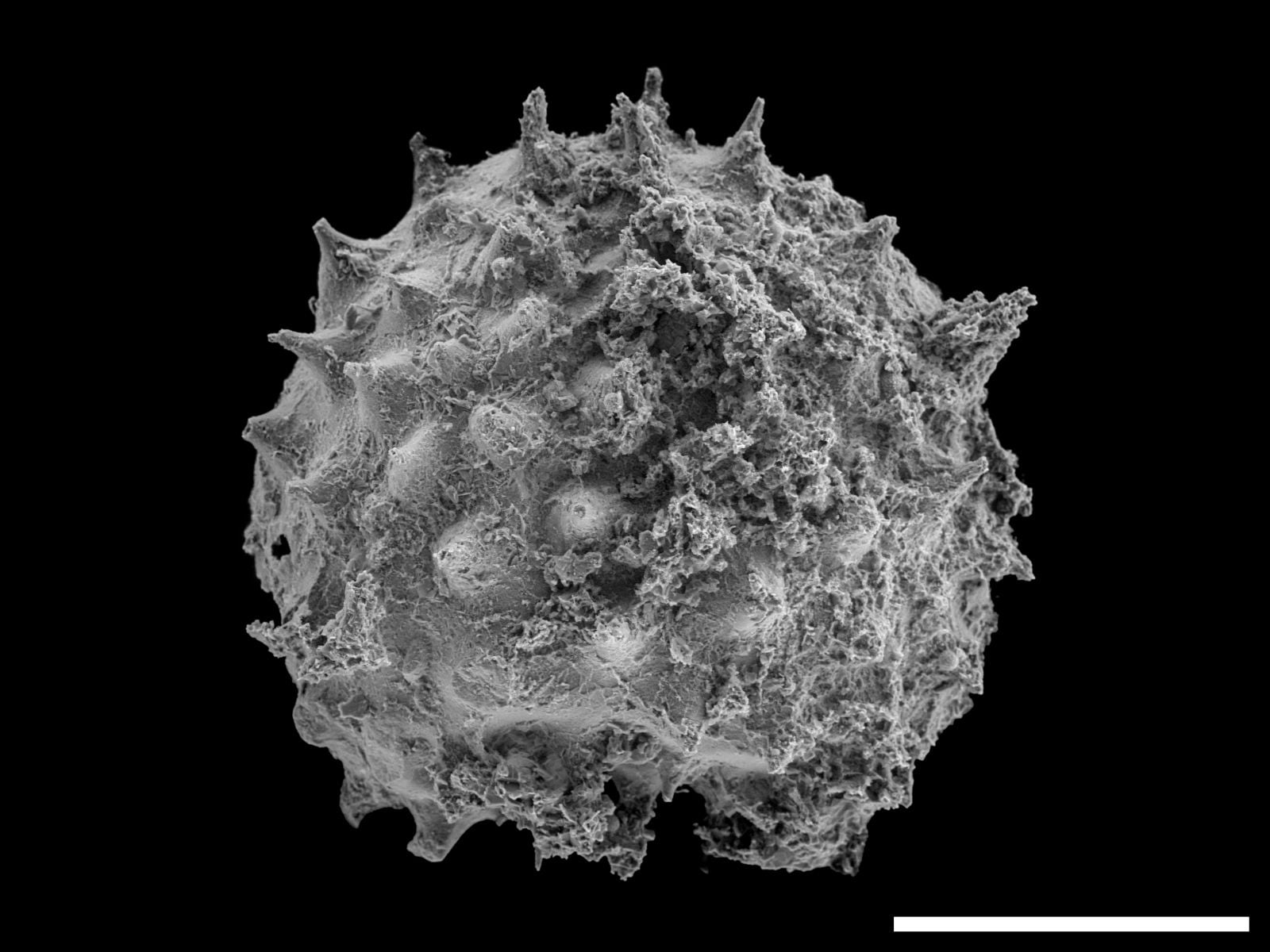
Asterocapsoides wenganensis, a spiny, single-celled acritarch from the Kheseen Biota in Mongolia. Scale bar: 0.1 mm.
Image credit: Yale News/Derek Briggs
If the chemistry or habitat at Kheseen kept animals out of the fossil record, the same could be true at Weng'an, which means its lack of animals cannot serve as a ceiling. The earliest animals were likely small, soft-bodied, and sponge-like, with no shells or bones, living in oxygen-poor oceans that favor thin bodies, the study says. Whether such creatures became fossils depended on where they lived and on an unusual mix of chemical conditions after death.
The researchers then reran the clock with looser ceilings from older sites in Australia, Svalbard, and Arizona, all rich in microfossils and all without animals. With the ceiling pushed back, the estimate for the last common ancestor of all animals landed between about 746 million and 791 million years ago, with margins of error of roughly 27 million to 54 million years. Absence of animals at those sites carries the same uncertainty as at Weng'an, yet the authors describe them as the best available choice.
Given those limitations in the fossil record, the team also decided to determine how much the genetics contribute on their own. To do so, they set the ceiling absurdly far back, using a roughly 1-billion-year-old site and, separately, the rise of atmospheric oxygen about 2.3 billion years ago, before which animals would not have been able to breath. Both runs produced nearly the same answer, about 814 million years ago, with a margin of error of about 90 million years. The genetic data and the other dated anchors in the model, in other words, all point to an origin in the 800-million-year neighborhood.
What's interesting about that timing is that it reaches back to the Cryogenian Period, which began around 720 million years ago, when glaciers spread across the planet in episodes called Snowball Earth. Paleontologists have debated whether those conditions helped or slowed animal evolution, and the authors write that they cannot rule out a link between the glaciations and the timing of animal diversification. In every scenario the team tested, most of the later branching of the animal family tree still falls after the glaciations ended.
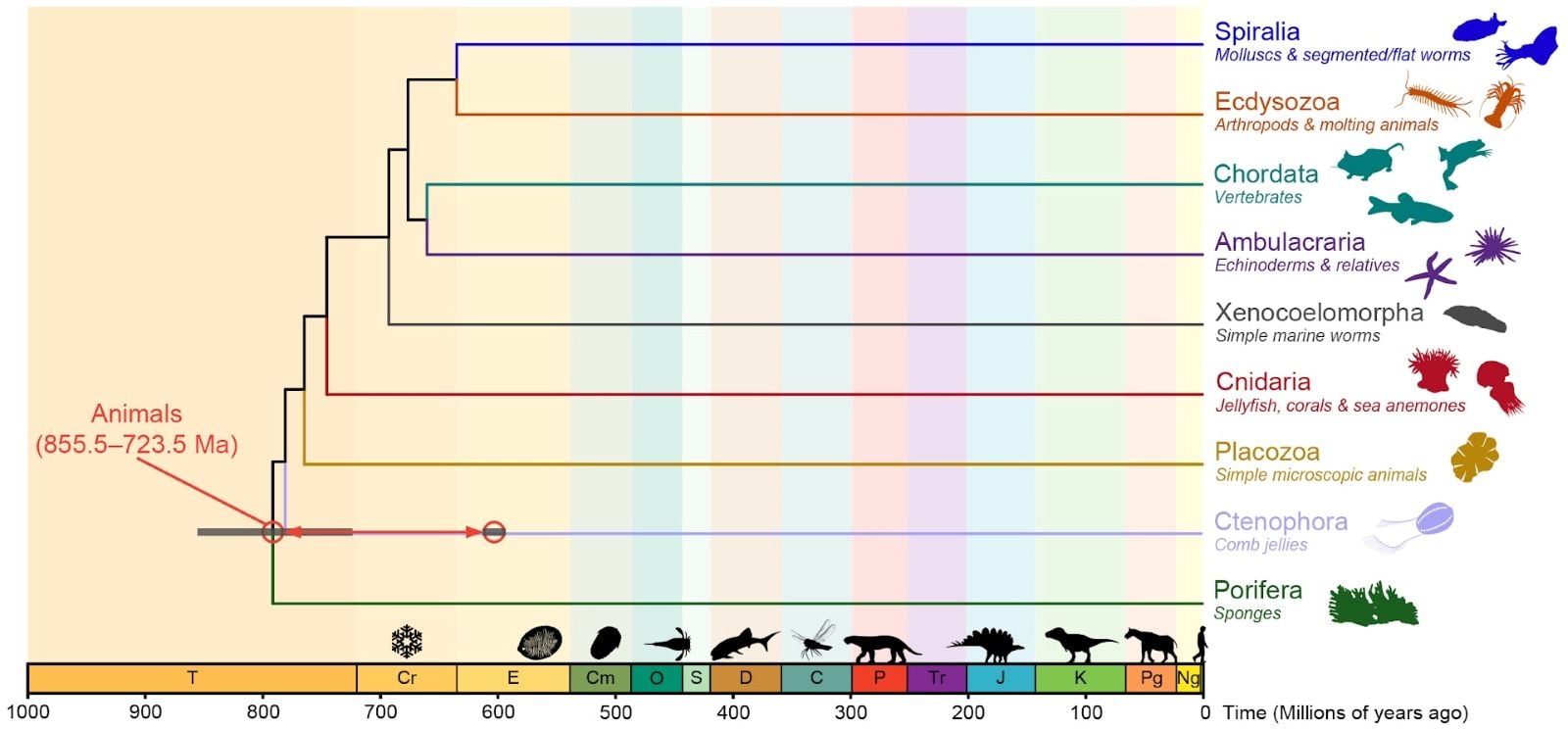
Estimated timeline for the origin of animals based on molecular clock analyses. The grey bar on the right of the image is the origin of animals based on an Ediacaran upper calibration. The grey bar to the left is the origin based on older deposits in the Tonian period, as suggested by the new study.
Image credit: Yale News/Orin Lole Durbin
For now, animal fossils older than 574 million still elude scientists. The authors hope that by continuing to search rocks from different environments, combined with traces of animal activity and chemical biomarkers, they will be able to develop better refined estimates for the origin of animal life.

