

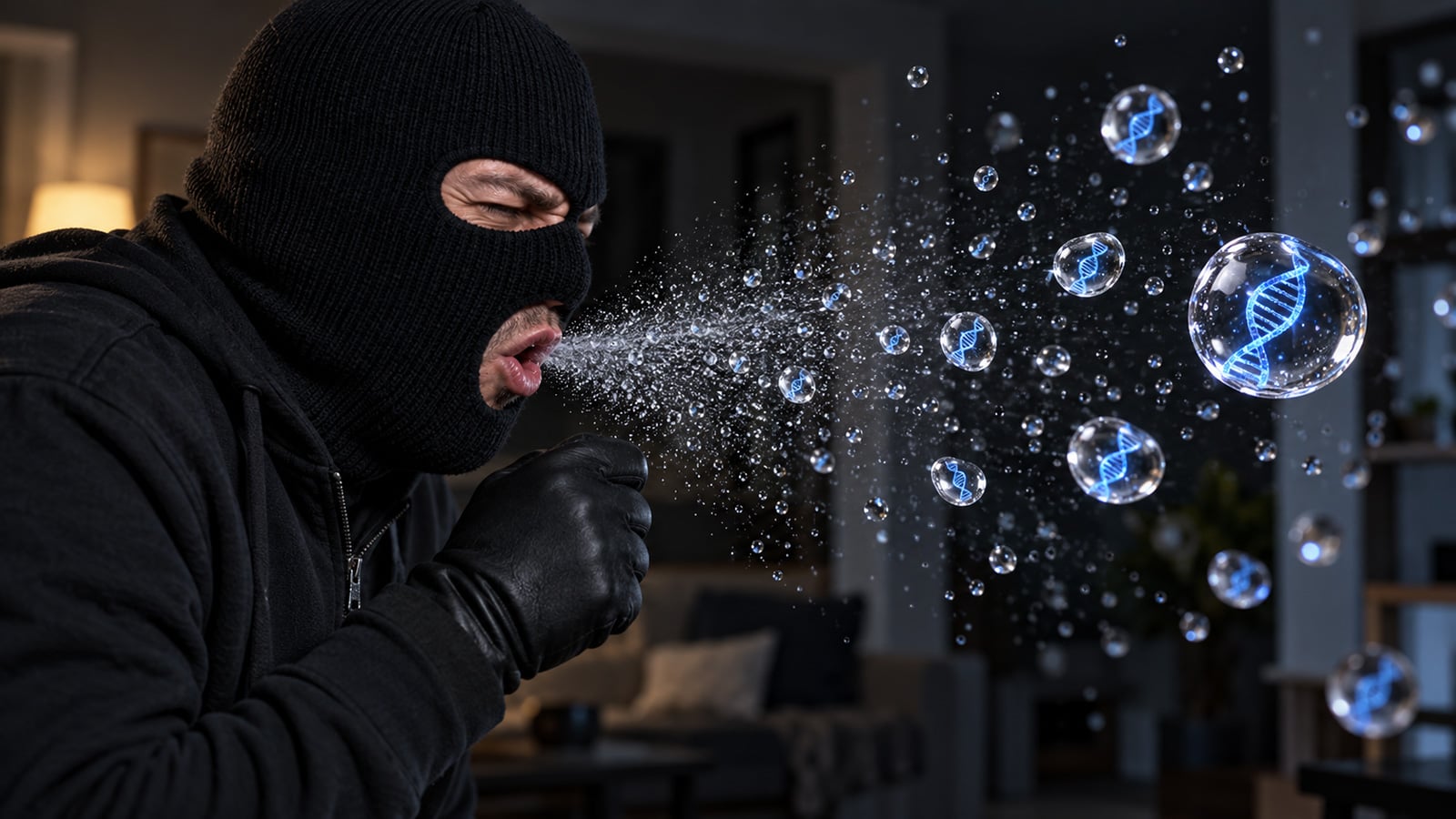
Even without touching a surface, a burglar may leave DNA suspended in the air that investigators could collect.
Image credit: Concept illustration by Suzanne Kantra/Techlicious via ChatGPT
Investigators may one day be able to pull a burglar’s DNA out of the air inside your home, even after the burglar has left.
People constantly shed skin cells and tiny saliva droplets into the rooms they occupy, and scientists call these traces environmental DNA, or eDNA. That matters for burglary cases because the average burglary lasts under 15 minutes, the study says, and many burglars wear gloves, which leaves little DNA on the handles and drawers they touch.
According to FBI estimates (PDF), an estimated 661,800 burglaries occurred in the U.S. in 2025. Law enforcement cleared just 17.4% of those reported burglary offenses. Airborne DNA could eventually give investigators another way to identify suspects in cases with little physical evidence.
Researchers in Norway and Australia staged 15-minute mock break-ins in 22 homes. Thirty minutes after each intruder left, researchers began collecting airborne DNA using an air filter in the kitchen. The filters detected the intruder's DNA in 9 of 11 Oslo homes (82%) and 4 of 11 Adelaide homes (36%).
In the experiment, volunteers who had never been inside the homes entered after the residents left and rummaged through the kitchen, opening cabinets, drawers, the fridge, and the oven. They wore no gloves or face coverings. Researchers then compared the DNA caught on each filter with cheek swabs from the residents and volunteers. Oslo University Hospital led the work with Flinders University and Victoria Police Forensic Services.
The filters also picked up the researchers themselves, even though they wore full protective gear, so crime scene teams would need strict contamination controls. Dr. Roland van Oorschot of Victoria Police Forensic Services says labs would also need standardized sampling and interpretation procedures and further validation across a wider range of conditions before police could use the method.
The brief 30-minute wait time before starting the filters is the biggest caveat of the study. The authors call it an optimistic response time that is rarely achievable in real cases, since crime scenes are usually examined hours or days later. They describe the results as a proof of principle that needs testing with longer delays.

