

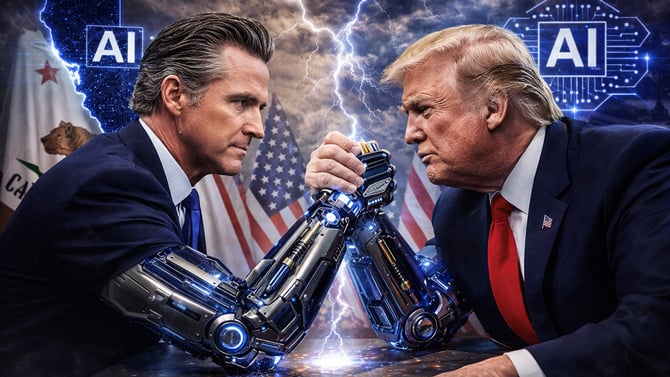
Governor Gavin Newsom signed an executive order Monday aimed at strengthening how California vets and purchases AI technology – a move that puts the state on a direct collision course with the Trump administration's newly released national AI policy framework. As the world's fourth-largest economy and home to 33 of the top 50 privately held AI companies globally, according to the governor's office, California is one of the few states with the size and power to go head-to-head with the federal government.
The Newsom order directs California's Department of General Services and Department of Technology to develop new certification requirements for AI companies that want to do business with the state. Within 120 days, those agencies must submit recommendations for standards that would require vendors to attest to their safeguards around illegal content, algorithmic bias, and civil rights protections including free speech, voting rights, and protections from unlawful surveillance.
The White House released its own national AI policy framework (PDF) earlier this month, and it looks nothing like Newsom's. The Trump document, which lays out legislative recommendations to Congress, calls for preempting state AI laws that the administration considers "burdensome". It argues that AI development is "an inherently interstate phenomenon with key foreign policy and national security implications," and that states should not be permitted to regulate it.
Newsom's order fires back directly. It instructs California's Chief Information Security Officer to review any federal designations of AI companies as supply chain risks, and gives the state the authority to overrule those designations if it deems them improper. In plain terms: if the Trump administration tries to block California from buying AI products from a particular company, the state reserves the right to keep buying from them anyway.
The White House framework takes a decidedly hands-off approach to AI oversight. It opposes creating any new federal rulemaking body for AI, deferring to industry-led standards and existing regulatory agencies. And while it does address child safety and intellectual property, the framework's overriding priority is keeping the U.S. dominant in the global AI race.
In contrast, Newsom's order puts forth a philosophy grounded in consumer protection. It requires companies to explain, in writing, how they prevent misuse of their technology before they can sell to the state. It also pushes for watermarking guidelines for AI-generated images and video, as a likely reaction to the exploding prevalence of deep fakes across the internet.
To offer a financial carrot to AI companies as a counterbalance to the restrictions, Newsom's order directs the state to build a public-facing AI tool that helps Californians navigate government services organized around life events like job searching, starting a business, or applying for disaster relief. This could lead to significant licensing revenue for AI companies supplying the underlying technology to support these services.
The federal preemption question is unresolved. If Congress acts on the White House's recommendations and passes legislation to override state AI laws, California's order could face serious legal challenges.
For now, the two visions of AI governance are pointed in opposite directions. Washington wants to clear the runway for AI companies to build fast. Sacramento wants to make those same companies prove they are building responsibly before they get a state contract. Both positions come with tradeoffs, and consumers are caught in the middle of a fight that is only getting started.
Read next: Trump Moves to Shut Down State AI Laws Across the U.S.
[Image credit: Josh Kirschner/Techlicious via ChatGPT]

