

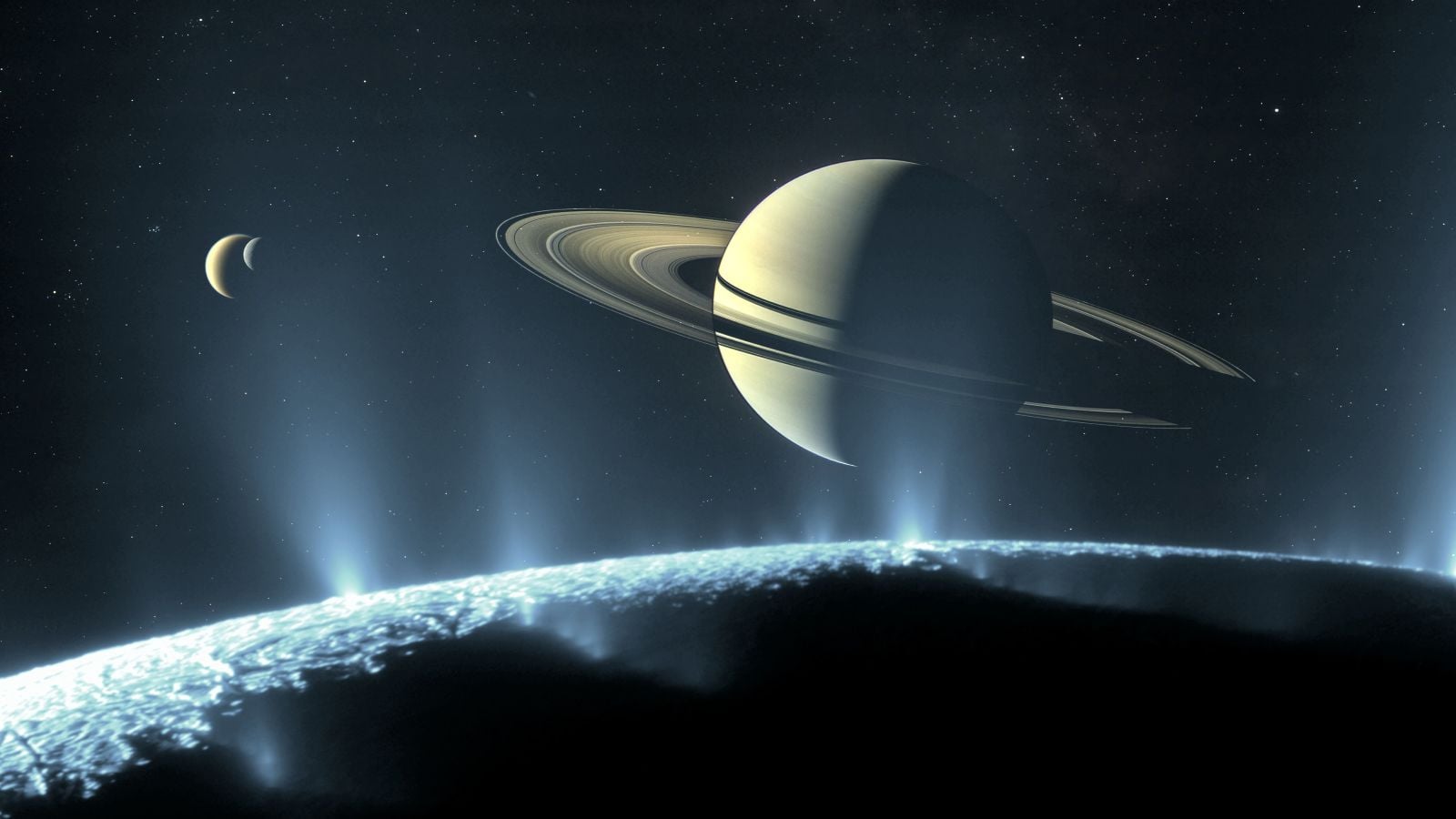
Illustration of icy jets erupting from Enceladus
Image credit: NASA's Goddard Space Flight Center
A methane-producing microbe from Earth's deep-sea vents has grown in a laboratory simulation of the ocean hidden beneath the ice of Enceladus, one of Saturn's moons, researchers report in Science Advances. The work comes from a team at LMU Munich, with collaborators at the Woods Hole Oceanographic Institution, the University of Regensburg, and Freie Universität Berlin.
Enceladus is among the harshest places scientists have seriously considered for life. Its ocean sits under a thick ice shell, is bitterly cold, and holds hardly any oxygen. That ocean water is believed to have a pH of 10 or 11, which LMU compares to the corrosiveness of pipe cleaner.
Yet the moon has drawn intense interest since NASA's Cassini spacecraft flew through the plumes of water and ice that erupt from cracks near its south pole. Cassini detected molecular hydrogen, methane, and dissolved minerals, which indicates strong evidence of hydrothermal activity on the seafloor.
On Earth, hydrothermal vents support ecosystems that live without sunlight. The microbe in this study, Methanothermococcus okinawensis, is a a single-celled organism from a branch of life separate from bacteria, called archaeon, that normally lives near these vents.
To build their stand-in for that distant seafloor, the researchers used an anoxic chamber, a sealed workspace that held oxygen at roughly 10,000 times below the level in Earth's atmosphere. Carbonate salts created a hypersaline liquid standing in for both the alkaline ocean and the rocky floor. Into that mixture went Methanothermococcus okinawensis, which gets its energy from hydrogen and carbon dioxide and gives off methane. LMU says this metabolism is among the most ancient still used by life on Earth.
The microbe grew and produced methane, running on hydrogen generated by reactions between the simulated seawater and rock. The ocean's high pH leaves very little dissolved carbon dioxide, which LMU calls one of the biggest challenges for life there, and the archaeon adapted by scavenging the tiny amounts available. Geomicrobiologist William Orsi, one of the study's authors, says the water-rock chemistry supplies hydrogen for energy and also keeps carbon within reach. His co-author, Nozair Khawaja of Freie Universität Berlin, said the team did not expect the experiment to succeed this well.
Orsi cautions that the study "doesn't prove that life exists on Enceladus," yet describes it as evidence that the moon's geochemistry can support one of life's original metabolisms.
A second Science Advances study, published the same day and led by planetary scientist Frank Postberg of Freie Universität Berlin, looked at how such life could be found. Using Cassini data, laboratory experiments, and modeling, the team concluded that droplets of ocean water launched into the plumes freeze slowly. As each droplet freezes, salts and organic compounds separate inside it. The droplets travel through the ice fractures at up to 1,000 km/h (about 620 mph) and shatter against the walls into fragments a few micrometers across, some carrying concentrated amounts of substances that were diluted in the ocean.
"That is great news in the search for life," Postberg says. A spacecraft would need to analyze many individual grains, but one containing microbial material could be identified with technology that already exists. His lab has previously shown that specialized instruments can detect microbial cell material in single particles resembling those in the plumes.
LMU notes that the European Space Agency has announced plans to retrieve samples from the plumes with its next flagship mission, L4, currently estimated to launch in 2042.

