

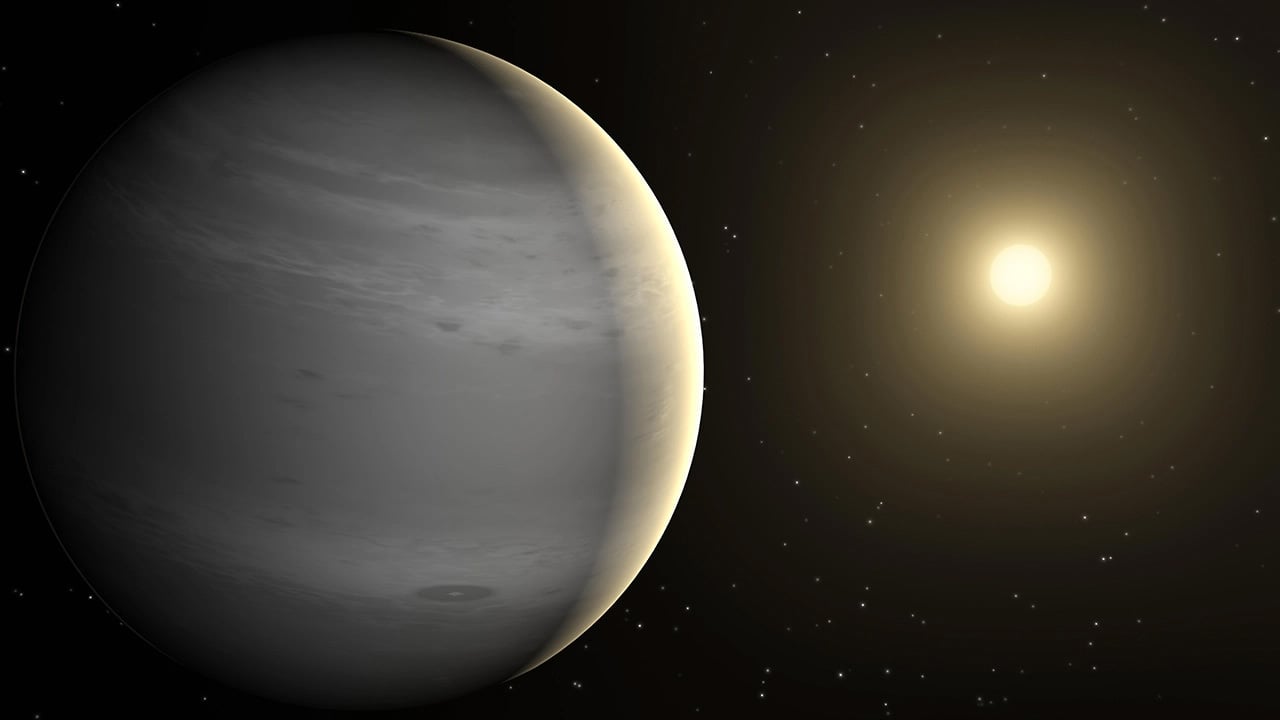
Artist concept of Beta Pictoris b
Image credit: NASA
For the first time, astronomers have pinned a repeating radio signal on a specific planet outside our solar system, according to a recent scientific paper. The source is Beta Pictoris b, a young gas giant about 12 times the mass of Jupiter and roughly 64 light-years from Earth. It is orbiting a star only about 23 million years old.
The scientific team, led by Kevin Ortiz Ceballos of the Center for Astrophysics | Harvard & Smithsonian, picked up the signal with MeerKAT, a radio telescope array in South Africa. The radio emission arrived as rapid, recurring bursts that were strongly circularly polarized, meaning the radio waves twist like a corkscrew as they travel.
Anyone hoping for an alien broadcast will be disappointed, though. The team attributes the bursts to planetary auroras, the same kind of physics that creates the northern lights. Electrons speeding along a planet's magnetic field lines give off radio waves in a process called electron cyclotron maser radiation. Earth and each of the four giant planets in our solar system produce auroral radio emissions of their own.
The bursts also gave the team the first direct measurement of an exoplanet's magnetic field, which influences how much atmosphere a planet loses to its star's wind and carries clues about the planet's interior. Using the frequency of the radio emissions, which range higher as the magnetic field increases, the scientists estimated Beta Pictoris b's field to be least 1.25 kilogauss. NASA's Juno spacecraft measured 7.766 gauss close to Jupiter, about 10 times the strongest field found on Earth, so Beta Pictoris b's magnetic field is more than 1600 times stronger than Earth's.
Seven other directly imaged giant planets in five other star systems within about 147 light-years sit far enough from their stars for the same radio signal estimation process to work. Detecting them will take radio telescopes five to seven times more sensitive than today's, which the team expects from next-generation observatories.

