

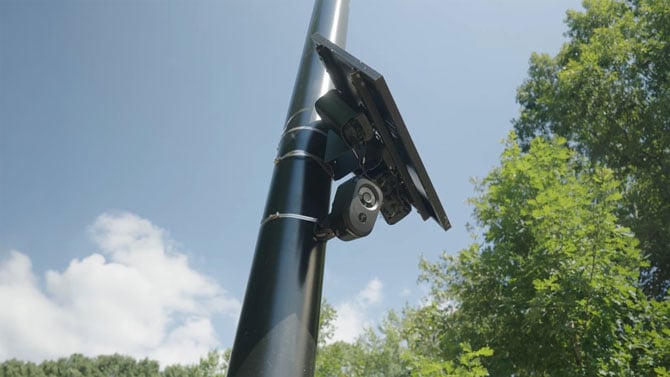
Image credit: Flock Safety
Flock Safety, the company behind a nationwide network of automated license plate reader cameras used by police departments, is requiring every law enforcement customer to adopt a set of accountability tools by the end of 2026. Flock announced the changes on August 13, the same week Georgia's Bibb County Sheriff's Office arrested three former deputies accused of using Flock cameras to track people they had personal relationships with. Bibb County's sheriff specifically credited Flock's newest safeguard, a tool called Audit Assistance, with uncovering the deputies' misuse.
Flock launched Audit Assistance in April 2026 to flag unusual search activity, such as an officer searching for the same plate under multiple different case numbers, for a supervisor to review. About a third of Flock's agency customers turned it on voluntarily before this week; now Flock is making it mandatory for every customer by the end of the year. Flock is also adding a "proactive lockout" that automatically suspends a flagged user's access until an administrator signs off.
The company is also cutting its recommended default data retention from 30 days to seven. By the end of the year, agencies must also attach a case number to every search, with emergencies exempted but automatically flagged for review. A new "offense filtering" option lets a city allow other police departments to search its camera data for, say, a stolen vehicle or a missing person while blocking searches tied to immigration enforcement.
Not everyone is convinced the changes add up to real accountability. ACLU senior policy counsel Chad Marlow wrote that Flock is pointing to recent officer arrests as proof Audit Assistance works, but that without knowing how many officers are misusing the system in total, "we cannot conclude if Flock and its auditing tools are catching 95% of violators or 5%." He's calling for an independent audit of the tool.
If you live somewhere with Flock cameras installed, none of this changes what the cameras capture: your plate, logged every time you drive past one, cross-referenced against a national database available to any agency your local police choose to share with. What changes is the paperwork trail behind each police search of that data and, in theory, a faster flag if an officer searches for reasons that have nothing to do with a case. Whether that flag reliably catches misuse instead of just documenting it after the fact remains to be seen.
Read next: Your car may have a secret dealer-installed, hackable alarm

