

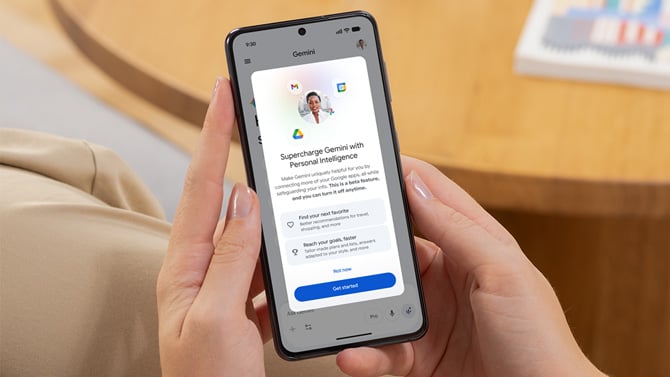
I use AI constantly throughout the day, but still in a fairly manual manner. When I want more than a basic web-based answer, I'll feed bots like ChatGPT, Claude, or Gemini specific info, such as emails or documents, to study and answer my questions. That method is looking as outdated as coding a web page by hand. We already have vast troves of info in our email, photos, and documents.
If the info is in Google's universe, its Gemini AI app is now gaining the ability to comb through its apps to gain insights. The goal is to better understand you and everything you do, in order to personalize responses to your queries. The feature, called Personal Intelligence, is rolling out in beta in the U.S. today to paid subscribers of Google AI Pro and AI Ultra plans on their personal accounts. Google says it will eventually come to business accounts and free personal accounts, too.
In a blog post today, Google's VP for the Gemini app, Josh Woodward, provided some examples from his own testing. In one case, he was buying new tires for his minivan. Gemini included suggestions for all-weather tires, based on pictures of family road trips in Google Photos. For some reason, he also needed his license plate number to buy tires, which Gemini retrieved from a picture of the minivan. This and other examples raise several questions for me about the usefulness and privacy of Personal Intelligence, which I'll get to in a moment. But first, let's look more closely at how it works.
At launch, Personal Intelligence provides users of Gemini on the web and in its Android and iOS apps the option to connect their Gmail, Photos, Search, and YouTube History to gain insights. Google says more apps are coming. Connecting apps is not entirely new; in 2023, Google allowed users to connect apps to Gemini's predecessor, Bard, but for simpler tasks, such as searching your Gmail for specific information. These Bard Extensions included Gmail, Docs, Drive, Google Maps, YouTube, and Google Flights and hotels, which may provide clues to what may be added to Personal Intelligence.
Read more:AI Chatbots 101: How to Get the Best Results from AI Assistants
I always try out new tools before I write about them, but I'm not doing that in this case. That’s because I still have questions about the usefulness of Personal Intelligence, its privacy measures, and the value of the trade-off between usefulness and privacy. To its credit, Google discusses both topics at length, but I've seen tech go wrong too many times for me to jump in.
Privacy with Personal Intelligence
I use Gmail only for less important things like newsletter subscriptions, and it's where most PR pitches land. I have other accounts for the important stuff. But I'm a rarity. Most people conduct their entire lives via Gmail. And even I now have a huge amount of information in Google Drive and Photos. Google emphasizes that personal information is encrypted on its servers and in transit to and from you. It also says that it doesn't train its AI models on information Personal Intelligence looks up in places like your inbox and Photos Library.
But Google says that it may train on your prompts, Gemini's responses, and how it formulates its answers – to help improve Gemini's performance. The distinction here is that Google says it doesn't retain your details, just learns how well the interaction worked and how to improve on it. That distinction is not so easy to get one's head around, nor is understanding how it might go wrong.
The first concern is privacy bugs. For instance, last November, Microsoft discovered a flaw in how all chatbots work that could allow attackers to glean information from their conversations. It's not the only bug to show up.
The next is deliberate violations. Google says that connecting apps to Personal Intelligence is off by default; users can enable it per app and turn it off at any time. (That was the same policy for the now-defunct Bard/ Extensions.)
But also in November, a class action lawsuit was filed against Google in California alleging that "Google secretly turned on Gemini for all its users’ Gmail, Chat, and Meet accounts, enabling AI to track its users’ private communications." It centers on Gemini Smart features, which can do things like generate Smart Replies, summarize threads in Gmail, or summarize conversations in Google Chat or Google Meet. The lawsuit alleges that Google switched these features from opt-in to opt-out last year without notice. Being sued isn't proof of guilt, but it's something to keep in mind.
Personal Intelligence's Usefulness
I'm not too impressed with Google's initial examples of how Personal Intelligence can help people. I owned a car when I lived in the mountains of North Carolina, and I knew where I drove without a reminder from Gemini (which didn't yet exist). There are four seasons in Asheville, so I bought all-weather tires.
I also think I know enough without AI personalization for most of Google's other examples, such as recommendations for restaurants I might like in my city. I could ask any chat app, "Recommend Indian restaurants in the Upper West Side." Same for documentaries or books I might like based on my interests. I know I like ancient history and science, for instance.
Read more: Alexa.com Is Here. Should You Use It Instead of ChatGPT?
What's more, Google admits to many weak points in Personal Intelligence that it needs to work on. They include "tunnel vision," in which it relies too much on what it knows about you, such as planning to focus a vacation itinerary on visiting coffee shops because it also knows that you like coffee. This feels like another version of the algorithmic feed in social media or music and video apps that keeps sending you more of the same.
People have a way of finding new and more innovative uses of technology than what the creators envisioned. (Just look at the explosion of mobile apps.) Also, public, regulatory, and legal pressure – often based on investigative journalism – may make it harder for companies to be lax on privacy issues.
It's possible I will someday find Personal Intelligence worthwhile. But not yet.
[Image credit: Screenshot via Google, phone mockup via Canva]