

Image credit: Josh Kirschner/Techlicious via ChatGPT
Nazi Germany's last reactor experiment would have needed about twice the uranium and more than twice the heavy water it contained to sustain a nuclear chain reaction, according to a new analysis in PNAS Nexus. That contradicts the account of its designer, physicist Werner Heisenberg, who said after the war that the reactor fell just short and lacked only a modest amount of uranium.
Whether Germany could have built a working reactor has been argued for eight decades, because a reactor is one route to producing the material for a bomb. Fear of a German lead drove much of the early American nuclear effort, yet the researchers found almost no technical evaluations of the German program. Much of its original data stayed classified until the 1970s, which left Heisenberg's postwar claims largely unchecked.
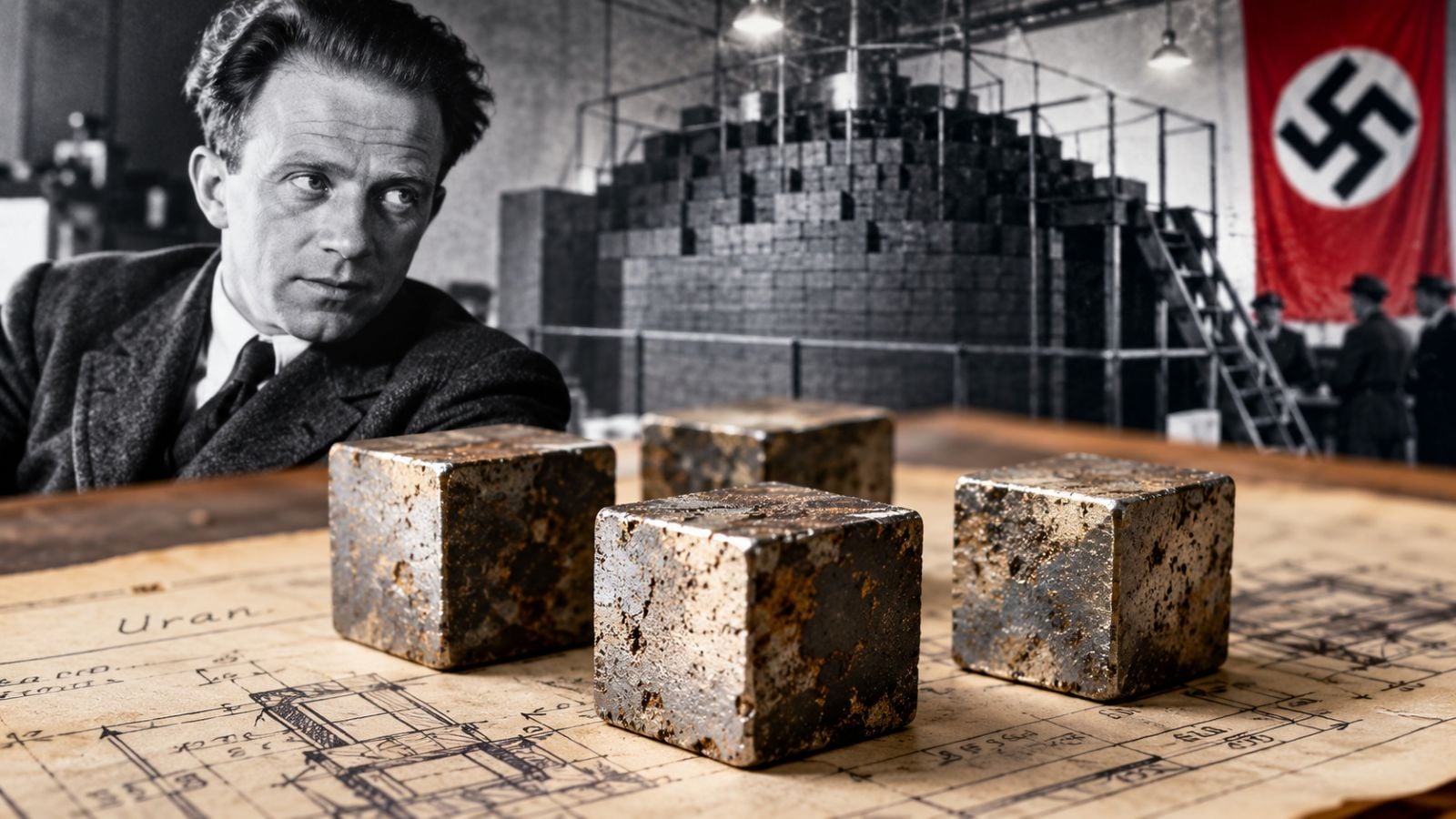
The Nazi experiment, called B8, was built in April 1945 in Haigerloch, a village in southwestern Germany where Heisenberg's team had moved after Allied bombing wrecked Berlin. It held 664 five-centimeter cubes of natural uranium, hung in chains inside a tank of 1,400 liters of heavy water. Heavy water is a form of water that slows neutrons so they are more likely to split uranium atoms. Layers of graphite and ordinary water surrounded the tank.
A reactor is "critical" when each round of fission releases enough neutrons to trigger the next, so the reaction feeds itself. Scientists express this as a number called k-effective, where 1.0 is the threshold. In a 1947 article in Nature, Heisenberg wrote that "a relatively small amount of uranium would in all probability have sufficed" to get B8 there.
The team, from institutions including the University of Maryland and Pacific Northwest National Laboratory, tested that claim by rebuilding B8 in a standard nuclear simulation code. Only 14 of the roughly 1,100 uranium cubes used by Germany's wartime program have known locations today, and the researchers examined two of them. One measured slightly less dense than pure uranium metal because of internal pores, and the other confirmed natural, unenriched uranium. For the heavy water, they used a 1947 measurement of samples recovered from B8 itself, which found it was 96.8 percent pure. Graphite impurities came from archival wartime lab analyses.
With those inputs, the model reproduced Heisenberg's own 1945 neutron measurements. It put B8's k-effective at 0.94, meaning each generation of neutrons was about 6 percent smaller than the last and the reaction died out. Even with perfectly pure heavy water, the figure rose only to 0.95.
Closing that gap took far more material than the small shortfall suggests. Depending on the layout, a critical version of B8 would have needed roughly 3,000 to 4,100 kilograms of uranium and 3,300 to 3,800 kilograms of heavy water, against the 1,538 and 1,549 kilograms actually used. Germany's total estimated inventory was 2,572 kilograms of uranium and 1,890 kilograms of heavy water. Pooling everything the country had would have brought B8 only to about 0.96.
Heavy water was the biggest constraint. The only source was the Norsk Hydro plant in Vemork, Norway, which the Germans controlled from April 1940 until Allied bombing destroyed it in November 1944. It produced 2,840 kilograms over the war. France seized 185 kilograms in 1940, another 140 kilograms were lost when an earlier Heisenberg experiment exploded in 1942, and Norwegian commandos sank 679 kilograms in 1944, leaving at most 1,836 kilograms in Germany by 1945. The researchers calculate a critical reactor would have needed about 1.8 times the heavy water Germany had available, and about 1.2 times its uranium.
Some historians have argued Germany should have switched to graphite, as the Americans did. The team modeled that too. German graphite was made from coke refined from coal in the Ruhr, which carries more boron, an element that absorbs neutrons. Graphite reused in B8 from the earlier B7 experiment contained an estimated 3.4 parts per million of boron-equivalent impurity, against 1.4 for the purified graphite used in the U.S. program. The Americans made theirs from petroleum coke, which Germany could no longer import after a British naval blockade began in January 1940. The simulations showed no critical graphite pile was possible with the uranium and graphite Germany had.
As a check on their numbers, the researchers compared B8 with Chicago Pile 3, a similar heavy-water reactor the U.S. Manhattan Project built in 1944. It reached criticality with about 2.5 metric tons of uranium and 3.8 tons of heavy water, close to what the model says B8 required. Most of B8's uranium cubes were likely shipped to the United States after the war and melted down for the American nuclear stockpile, the paper says.

