
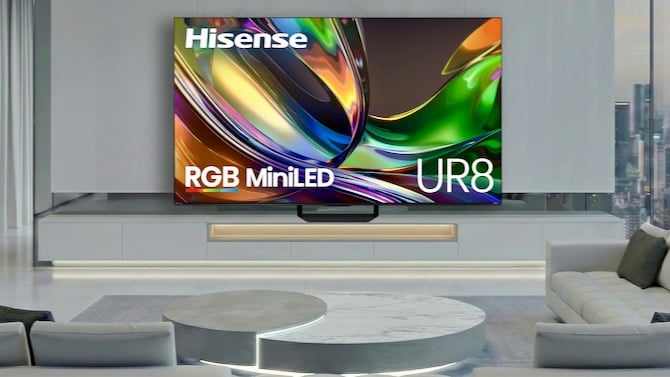
At CES 2026, TV makers were split in their ambitions to improve Mini LED TVs. Most companies, including Samsung, LG, and Hisense, are chasing the future with expensive, complex “Micro RGB” backlighting systems that replace traditional single-color backlights with clusters of microscopic red, green, and blue LEDs. The promise is higher brightness, better contrast, and improved color accuracy – full coverage of the very broad BT.2020 color space.
TCL, meanwhile, is doing something more pragmatic and arguably more important for most buyers. It’s pushing traditional Mini LED to a new level, also covering 100% of the BT.2020 color space, without jumping to an expensive new architecture.
The Mini LED Problem
Mini LED TVs have existed since 2019 as a middle ground between standard LED TVs and Micro LED TVs, which use an LED light for every pixel (like OLED TVs). They brought a big increase in brightness and higher dynamic range (more detail in the darkest and lightest areas of an image), but they lacked color accuracy at high brightness.
Traditional Mini LED TVs use blue or white LEDs paired with a color filter or Quantum Dot (QD) crystals to convert light into red, green, and blue. That works well, but it caps real-world color volume at about 90–95% of the BT.2020 color space. That matters because our eyes can see more colors, but TVs can’t reproduce them.
The Micro RGB Solution
backlight itself. In theory, that gives much finer color control and allows panels to hit 100% of BT.2020.
Hisense goes even further by adding a fourth color LED – cyan – to its backlight. That pushes color volume to a claimed 110% of BT.2020, which is, frankly, extraordinary and well beyond what OLED or standard Mini LED can achieve.
But there are two important caveats:
First, Micro RGB is not Micro LED. Micro RGB still uses an LCD panel with a backlight, just a more advanced one. The naming is confusing, and most consumers will understandably assume they’re getting something closer to Micro LED than they actually are.
Second, these systems are complex and expensive. They require multi-color LED manufacturing, advanced calibration, and more intricate power and thermal management.
They will be great TVs. They will also be expensive TVs.
Read more: Amazon’s $899 Art TV Pushes Picture-Frame TVs Into the Mainstream
The Super Quantum Dot Solution
TCL is taking a very different approach. Instead of replacing the backlight, TCL is refining it.
Its new X11L sticks with single-color Mini LED backlighting but pairs it with a new generation of Super Quantum Dots (SQD) that expand color reproduction. TCL claims full 100% BT.2020 coverage, matching Micro RGB without changing the underlying architecture.
That’s significant.
It means TCL gets the same depth of color that Micro RGB promises, without the cost and complexity of multi-color micro-LED backlights.
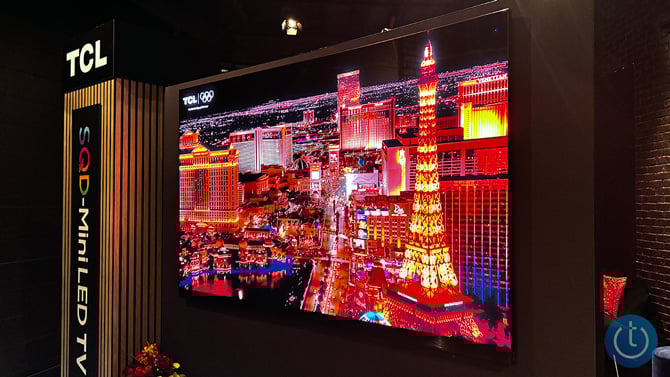
It also lets TCL push brightness to a frankly absurd 10,000 nits, well beyond even most premium Mini LED TVs. That kind of brightness makes HDR more impactful and makes TVs usable in rooms with lots of ambient light – something OLED still struggles with.
By sticking with single-color Mini LED instead of multi-color Micro RGB backlights, TCL can scale manufacturing more easily, control costs, and keep prices down. We fully expect TCL’s TVs to be cheaper than comparably sized Micro RGB models – even when the picture quality is very close.
Read more: This AI-Powered Portable Projector Casts a Sharp Image on Any Surface
With additional reporting by Suzanne Kantra
[Image credit: Techlicious, Hisense]