

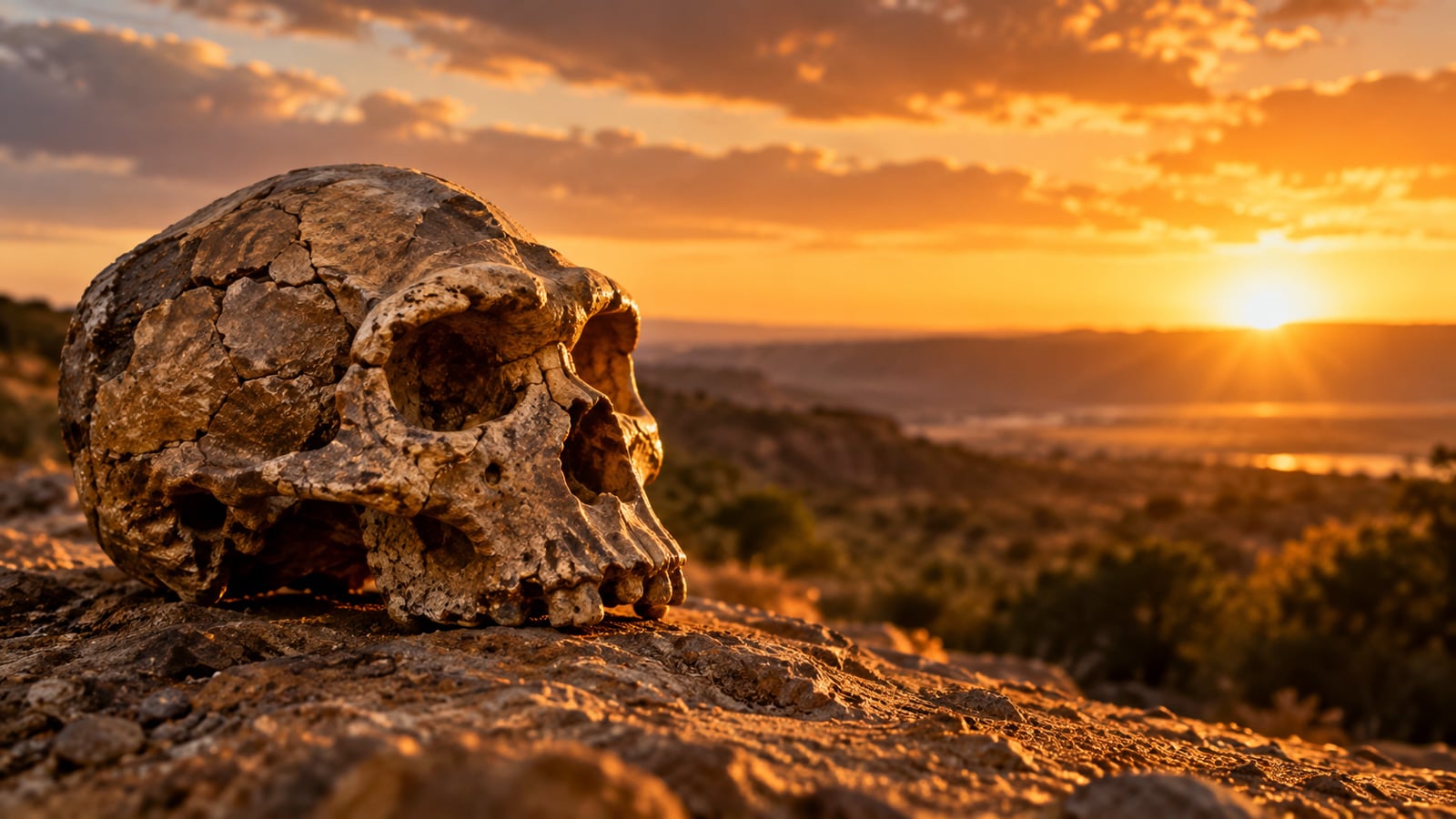
AI-generated illustration representing a Homo erectus fossil from roughly 2 million years ago.
Image credit: Josh Kirschner/Techlicious via ChatGPT
A skull fragment from a South African cave has been tentatively identified as an adult Homo erectus that lived about 2 million years ago, roughly 200,000 years before previously discovered adult fossils of the species found at Dmanisi in Georgia. The fragment, catalogued as DNH 127, is one of 18 hominin fossils described in a study in Annals of Human Biology by researchers from La Trobe University and partner institutions.
Hominins are the group that includes modern humans and our extinct ancestors and relatives. Homo erectus is the first species that researchers broadly agree belongs to our own genus, Homo, and it is likely a direct ancestor of ours.
The cave site, Drimolen, sits in South Africa's Cradle of Humankind. A 2020 paper in Science dated its fossil-bearing deposits to between about 2.04 and 1.95 million years ago and indentified a cranium from a child between 2 and 4 years old. The child skull resembled Homo erectus, but it left doubt without an adult sample, lead researcher Jesse Martin said. DNH 127 is the first adult fossil attributed to the species at Drimolen.
The fossils uncovered show how lopsided the neighborhood was. Across the site, Paranthropus robustus, a different hominin species with massive molars, outnumbered Homo erectus by more than 10 to 1. According to Martin, our ancestors were the ones who "looked like the outside long-odds chance to survive."
The new paper points to two features of DNH 127 that identify this fragment as belonging to Homo erectus. The seam where its temporal and parietal skull bones meet is straight, a trait of Homo erectus, and the bony bump behind the ear (the mastoid process) is too small for Paranthropus. Overall the fragment most closely resembles a Dmanisi skull known as D2700. The authors tentatively assigned it to Homo erectus and describe it as additional evidence for the species in South Africa at that time.
The two species were living in the same area, but diverging evolutionarily. Homo erectus was developing a larger brain and smaller molars, a shift possibly linked to eating meat, Martin says. Paranthropus robustus kept a brain only slightly larger than a chimpanzee's and grew massive molars for chewing tough, hard foods, working something like a mortar and pestle. Thankfully for those of us writing and reading this article, Homo erectus' evolutionary features carried the day.

