

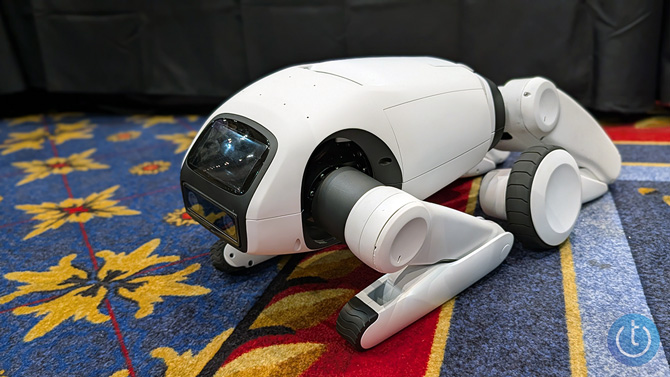
Plenty of robots at the show can walk, roll, lift, or “assist,” but most feel defined by a narrow purpose. The T1 approaches the idea of a household robot from the opposite direction. It’s built to exist alongside people – following you, adjusting its behavior to different environments, and shifting between roles as naturally as you move between tasks throughout the day.
In its humanoid mode, it stands with you, moves with you, and visually presents itself as a companion rather than a tool. When you’re walking around, it follows quietly. When you want a photo, it steps in as your camera operator. When you’re relaxing at home, it’s simply present. That alone makes it feel more natural than many robots I’ve tried over the years.
But Prime made a smart decision: not everyone wants a humanoid figure shadowing them. Tap a button and the T1 collapses into a four-legged form that behaves more like a dog than a robot. In this mode it climbs 18-centimeter steps, handles 35-degree slopes, and navigates uneven terrain you’d never expect a consumer robot to manage. Indoors or outdoors, it shifts into whichever form makes the most sense. A robot that can change how it moves, depending on the situation, feels far more realistic than one locked into a single form factor.
@techliciousmedia Checking out the Prime T1 humanoid companion robot at #CES2026
The T1 is clearly built with the assumption that today’s AI capabilities are just the starting point. It uses multimodal interaction, contextual awareness, and long-term memory to adapt to how you use it. Prime describes it as a “humanoid robot creation platform,” essentially encouraging owners to build customized behaviors, expressions, and camera movements on top of its core capabilities.
That approach makes sense. Instead of shipping a rigid device with a fixed purpose, T1 is meant to evolve – to take on more expressive, helpful roles as the underlying AI systems get smarter.
The T1 also operates as a camera crew on wheels (or legs). It includes more than 20 cinematic camera-movement templates, including effects like Hitchcock zooms and Inception-style rotations. At a family gathering or outdoor event, it can operate as a fully automated “life recorder,” tracking action and framing shots you’d never get from a stationary camera or a phone in your pocket.
Prime is also aiming the T1 at families. It can act as a personalized language tutor, answer kids’ endless “why” questions with an interactive encyclopedia, and weave emotional-intelligence prompts into its activities to support healthier character development.
There’s also a fun side to the robot. T1 supports remote control with a first-person video feed, letting you drive it around the house or yard. Its lighting effects sync with music, and the robot doubles as a portable power station when you’re outdoors. It can even act as a lightweight security companion, keeping an eye on the environment as it moves with you.
Across all these roles, what ties the experience together is that the robot doesn’t feel strictly “task-oriented.” It feels like something designed to be around you – sometimes helpful, sometimes entertaining, sometimes simply present.
A Glimpse at Where Consumer Robotics Is Headed
After spending time with the Prime T1 at CES, we walked away feeling like this is the direction consumer robotics need to go. A single-purpose device quickly becomes a novelty. A robot that can shift forms, evolve with software, and meet many different needs has a better chance of becoming something people will actually live with.
If nothing else, the T1 shows how a robot can be designed around people rather than expecting people to adapt to it. And in a year when AI is embedded into just about everything, that makes it one of the more memorable robotics demos at CES 2026.
Visit agibot.com to find out more.
[Image credit: Techlicious]

