

Image credit: Illustration by Suzanne Kantra/Techlicious via ChatGPT
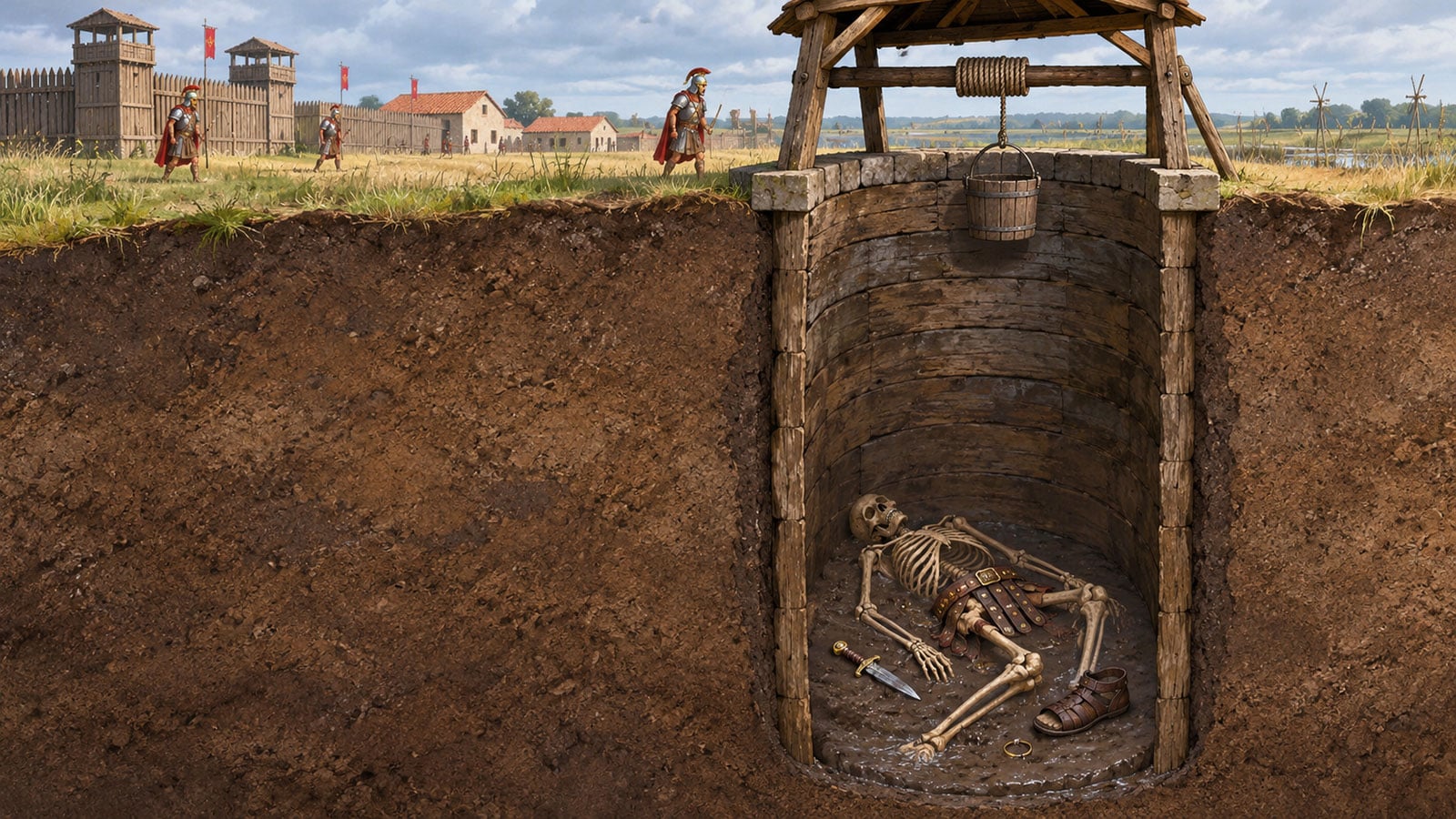
A man lay at the bottom of a Roman well in the Netherlands for 2,000 years with a dagger beside him, and Leiden University researchers now say he was murdered in a fit of vengence.
Who he was, who killed him, and why are the questions archaeologists Carol van Driel-Murray and Mark Driessen spent several years investigating with a team of specialists and students. They have a leading theory, which they describe the in their new book Victims of Violence from the Early Roman Fort Velsen.
It began in 1977, when amateur archaeologists digging at the site of the Roman fort of Velsen unearthed a well. At the bottom lay an almost complete skeleton, along with a military belt, a dagger, a ring, a brooch, and a soldier's sandal. Nothing identified the man or explained how he got there.
Historians had a ready answer. The Roman historian Tacitus wrote that the Frisians, who lived in the region, rose in revolt in A.D. 28 after the Romans demanded higher taxes, and the find was soon tied to that uprising.
Driessen and Van Driel-Murray wanted evidence before accepting that that story. So the team went back to investigate the skeleton, with forensic experts, 3D imaging, and chemical tests on his teeth.
Wounds on the skeleton gave them their first clue. The bones showed stab wounds, including some on the inside of the rib cage and numerous perforations in the pelvis. The team used 3D models to reconstruct how they were made and determined the cuts were probably inflicted with a Roman military dagger, presumably the one that lay with the man in the well.
The number of stabs is surprisingly high, Driessen says, and the team's forensic experts judged the killing as very brutal. He interprets that as the work of attackers who were extremely angry: "a furious and targeted act of revenge." In his estimation, a defensive fight at the fort over taxes becomes a much less likely cause of death.
The teeth provided the second clue. The man stood about 6 feet 3 inches tall, unusually tall for Romans of the time, and was very muscular, which led archaeologists in the early 1980s to suggest he might have been a Frisian. Local food and water leave chemical traces in tooth enamel that reveal where a person spent childhood. When the team tested his teeth, it showed he grew up in southern Europe – a very different conclusion from the one reached 40 years ago.
Finally, his gear supplied another piece to the puzzle. His dagger showed signs of wear and his belt was constructed from different pieces, while the dagger's sheath was richly decorated. The researchers read that as belonging to a regular soldier rather than an officer.
That left a Roman soldier from southern Europe, stabbed repeatedly in what looks like an act of revenge, and a list of possible suspects. Driessen says that unlike the natural sciences, where a single explanation is the norm, an archaeological mystery with human actors is better served by multiple scenarios.
The team's leading theory is that fellow soldiers killed him in retaliation for misconduct. The others include an attack by the Frisians during the tax revolt, the execution of a deserter by the military command, and killing by one or more members of the local population.
The rebellion that long defined this skeleton's story is now only one possibility in a murder mystery that will likely always remain unsolved.

