

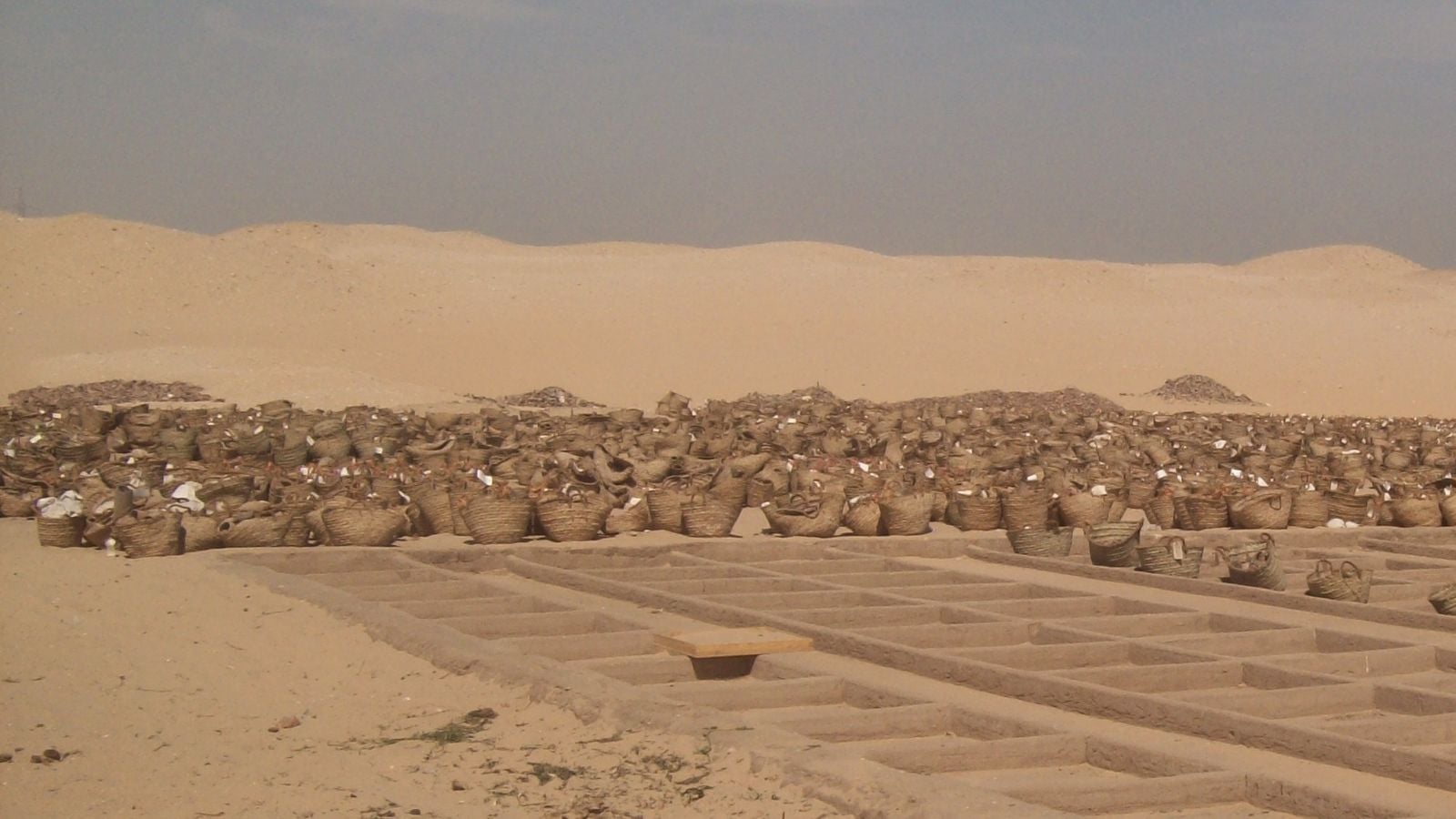
The ancient necropolis at Abydos, Egypt, where Egypt's earliest kings were buried alongside members of their households.
Image credit: isawnyu / Wikimedia Commons, CC BY 2.0; cropped
A new forensic analysis of 5,000-year-old skulls from Egypt's earliest royal burials has found potentially fatal head injuries in 18 of 46 skulls examined. The finding, published in Frontiers in Environmental Archaeology, supports a century-old suspicion that servants and officials were killed when their king died so they could keep serving him in the afterlife, a practice known as retainer sacrifice.
The skulls come from Abydos, in southern Egypt, where the kings of the First Dynasty were buried around 3000 BCE, roughly 500 years before the Great Pyramid was constructed. Around their tombs and ceremonial enclosures lie hundreds of smaller graves holding court officials, craftspeople, and other members of the royal household.
Many of those graves appear to have been filled at the same time, which led British archaeologist Flinders Petrie to suspect sacrifice. He found no wounds on the bones, though, and later scholars proposed a simpler explanation: the people died naturally and were buried near their ruler over time.
Petrie kept the skulls from his dig and shipped some to England, but he reburied most of the rest of the skeletons. Purdue University anthropologist Roselyn Campbell tracked down 46 of those skulls in the Duckworth Collection at Cambridge University and examined them for injuries that happened around the time of death. Bone that breaks at that point still bends before it cracks, which leaves edges that look different from damage done to dry, old bone. Eighteen of the skulls, or 39%, showed that kind of injury.
Most were linear fractures, single cracks running across the parietal bones on the upper sides of the skull. Campbell said that these would likely cause "rapid unconsciousness, internal bleeding, and death." The paper adds that without modern surgery, bleeding inside the skull from this kind of fracture would almost certainly have been fatal in the ancient world. A few skulls also had sharp-force wounds, including a penetrating injury to the side of the head and a chopping injury near an eye.
Petrie probably saw the cracks and misread them. He coated many of the skulls in paraffin wax to hold them together, often around the fractures, which suggests he mistook them for damage from their long-term burial, rather than injuries at the time of death.
He also speculated that some victims were stunned and buried alive, based on bodies with raised arms or knees. Campbell argues those poses fit bodies that were tossed into graves and shifted as they decayed.
The royal weapon or weapons of choice remain unknown. Egyptian art shows kings smashing enemies with maces, but experiments cited in the paper show that even small stone maces leave depressed fractures, or dents in the skull. Single linear cracks like these typically come from broad, flat objects made of wood, antler, or other light material.
Accidents are a poor fit as well. A fall hard enough to crack a skull would probably have broken other bones, and Petrie's photographs and notes show no such damage. A collapsing grave roof would likely have damaged the ribs and pelvis.
Plenty of questions remain. The surviving skulls represent only 5% to 15% of the people buried at each enclosure, and they come from graves around the enclosures of the kings Djer, Djet, and Merneith. Other people in the necropolis could have died naturally or been killed by a method such as suffocation that leaves no mark on the skull. The paper also notes that perimortem injuries can occur shortly after death, so the fractures cannot be conclusively proven to have caused it.
Campbell said she would like to locate the remaining bodies from Abydos and examine them. Her book on the subject, State-sanctioned Violence and Human Sacrifice in Early Dynastic Egypt, is forthcoming from Routledge.

