

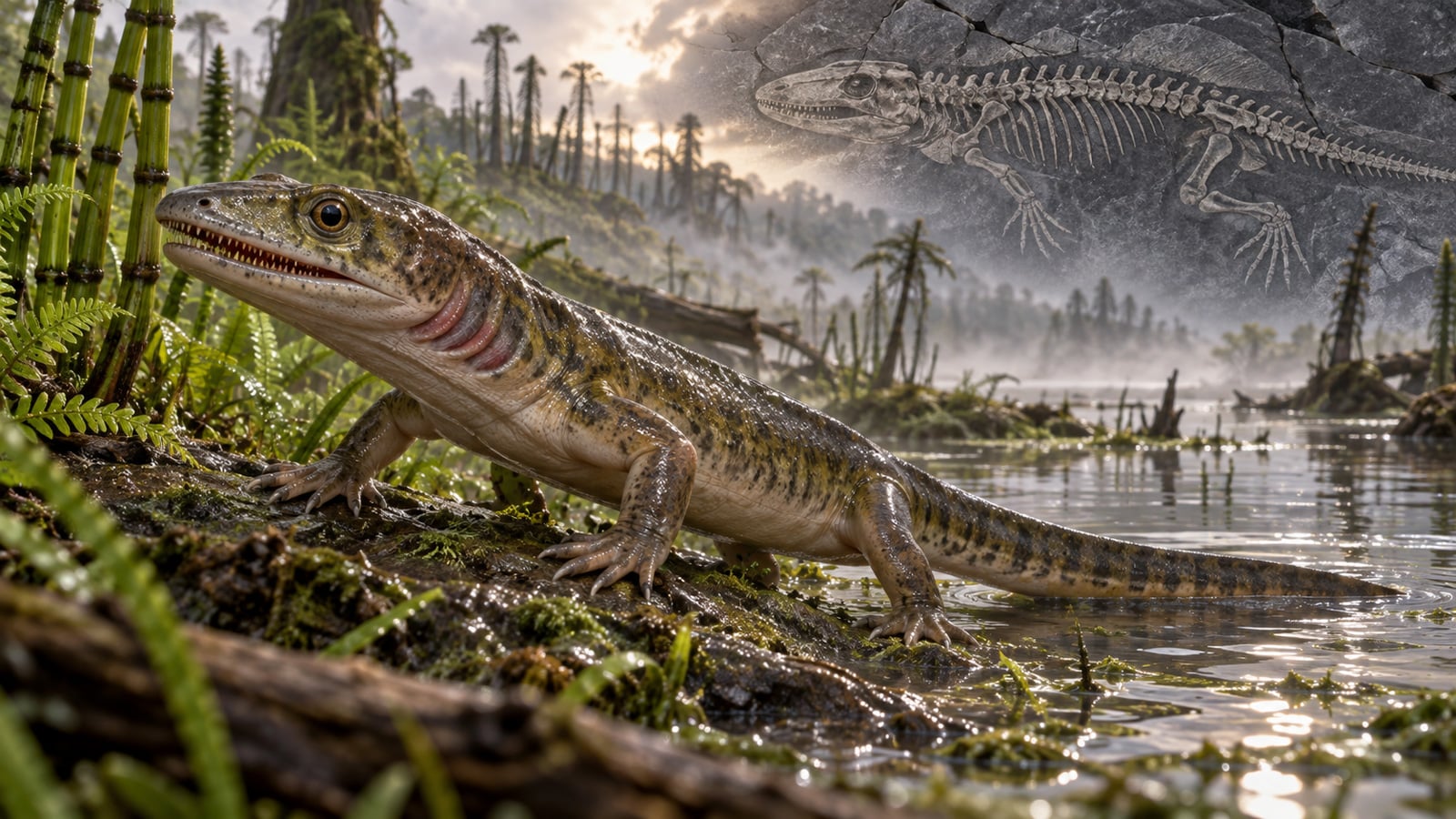
AI-generated illustration of Westlothiana lizziae
Image credit: Josh Kirschner/Techlicious via ChatGPT
A 345-million-year-old fossil from Scotland that scientists have cited for decades as one of the earliest known reptiles belongs to a much older lineage and had internal gills, according to a study published September 30 in Nature. X-ray scans of the fossil, nicknamed Lizzie, also revealed a fish-like mouth lined with thousands of tiny teeth, pointing to an animal that lived in water or moved between water and land.
Lizzie, formally Westlothiana lizziae, was discovered in 1984 and earned its nickname from its lizard-like look. The fossil sits in two crushed slabs of rock, but the nearly complete skeleton visible on the surface had four limbs with fingers and toes tipped by what looked like claws. Many of its contemporaries had fin-like limbs. Researchers formally named it in 1990 as the earliest known reptile, and it became a landmark specimen in debates over when vertebrates moved onto land.
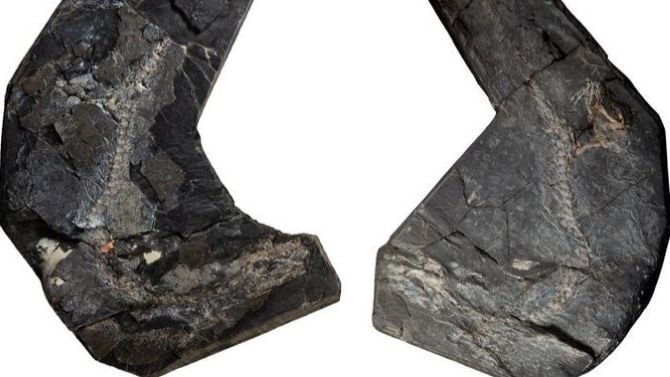
The two rock slabs of the Westlothiana fossil
Image credit: Roger Benson / American Museum of Natural History / National Museums Scotland
The fossil was widely cited as the earliest land-adapted amniote, the group of animals that includes reptiles, birds, and mammals. The new study, led by researchers at the American Museum of Natural History in New York, the University of Oxford , and the European Synchrotron Radiation Facility in Grenoble, France, changes that. The team used the facility's X-rays to reconstruct structures hidden inside the rock, a technique called synchrotron X-ray computed micro-tomography that builds a 3D model from many X-ray images, much like a hospital CT scan.
The scans showed a primitive skull, bony internal gill structures, and the toothy mouth, features that rule out Lizzie as an ancestor of reptiles. Co-lead author Xavier Jenkins said the animal that emerged from the scans "looked very different from what we expected." The skull places Lizzie in a far more ancient lineage, one the paper classifies as a stem tetrapod: an early branch of four-limbed animals that split off before the amphibian and reptile lines went their separate ways.
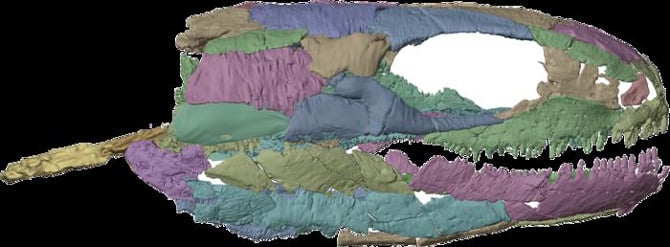
A reconstruction of Westlothiana based on x-ray scans of the fossil
Image credit: © American Museum of Natural History
Lizzie's feet and claws are part of a larger story. Traits once assumed to belong to land-dwelling reptiles, including five toes on each hand and foot and claw-like toe tips, had already evolved in more aquatic members of that older lineage. Jenkins said these land-suited features accumulated piecemeal in animals still living in and out of the water, showing that some reptile traits were already present in the common ancestor of amphibians and reptiles.
The finding also affects how scientists read ancient footprints. Fossil trackways showing an animal walking on four limbs with claw-like digits have recently been used to argue that amniotes originated during the Devonian Period, more than 359 million years ago, according to the museum. If relatives like Lizzie also had claws, clawed tracks alone can no longer establish that the animal that made them was an amniote, and some trackways attributed to early amniotes may have been left by amphibious members of the older lineage.
The authors also point to large gaps in what scientists know about early four-limbed animals, particularly small-bodied ones like Lizzie, that limit how well the origins of life on land can be reconstructed.

