

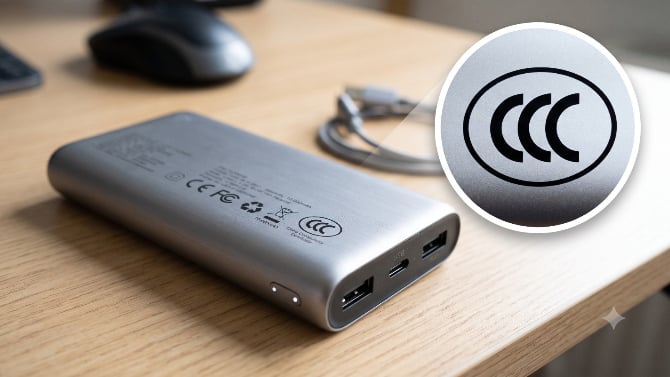
Image: Generated with Gemini
If you have a trip to China coming up and you plan to fly between cities once you're there, you should take a close look at your portable charger before you pack it. China's Civil Aviation Administration banned power banks that don't carry a printed 3C certification mark from domestic flights, and airport security has been enforcing it since June 28, 2025. And unless you purchased your current power bank in China, yours almost certainly doesn't have that mark on it.
If you carry one without the mark, you'll likely lose an expensive accessory on your trip. On a recent press trip we took to China, some of our media colleagues had their power banks confiscated at airport security in Shenzhen. They were none too happy to lose their critical devices in the middle of a business trip. To avoid suffering the same fate, here's what the rule covers and what you can carry instead.
What the rule bans
The CAAC notice covers three things: power banks with no CCC marking, power banks where the marking is unclear, and models or batches that have been recalled. The agency pointed to a run of lithium battery incidents as the reason, with 15 cases of power banks catching fire or smoking on Chinese flights in the first half of 2025. Around the same time, China's market regulator suspended or revoked the 3C certifications of several battery cell and power bank makers, and brands including Anker and Romoss recalled hundreds of thousands of units in the Chinese market.
Why your charger probably fails
3C stands for China Compulsory Certification, and the logo you're looking for on the device is the CCC mark, an oval containing three interlocking Cs. It's China's domestic safety approval, and it has been mandatory on power banks sold inside the country since August 2024. If the bank you own was built for an export market, you won't find the mark on it, even if the factory that made it sits in China. What you have instead is an FCC (United States) or CE (Europe) mark, which is useless to you at a Chinese security checkpoint.
You also need that mark printed or engraved on the body of the device itself. A peel-off sticker won't get you through, and if yours has faded or smudged over the years you should expect screeners to treat it as no mark at all. They want to see a legible watt-hour rating too. You don't get an appeals process at the checkpoint, and you generally don't get the bank back either, though you'll find short-term storage counters at a few of the larger airports.
Check the bank, not the box
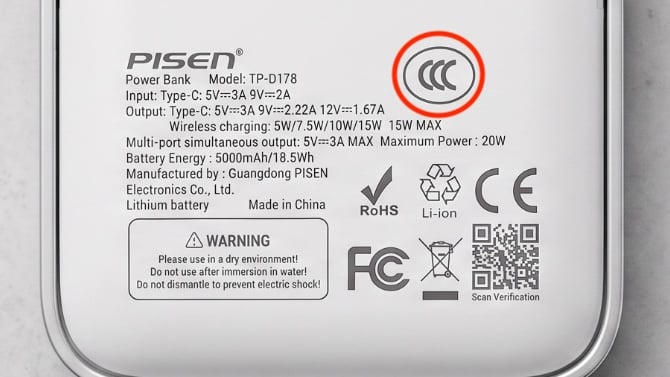
A PISEN power bank showing the CCC logo
Image: Palash Volvoikar/Techlicious, composited with Gemini
This is the part I'd pay the most attention to, because it's easy to think you're covered when you aren't. I went through six power banks I had sitting around, and exactly one of them had the CCC logo on the unit itself. Another one had the logo printed on the box with nothing at all on the bank, which does you no good once that box has gone into your home recycling.
So before you order anything, you should go through the listing photos and look for the oval logo on the body of the charger, not on the packaging and not just in the bullet points. If a seller only shows it on the box, you can assume it isn't on the device. When the bank arrives, check it in person and send it back if the logo isn't physically there, because you'll get a charger that's only certified on paper pulled at the checkpoint the same way you would an uncertified one.
Only flights are affected
You can use an uncertified power bank anywhere else in China without a problem. Hotels, taxis, high-speed rail, restaurants, and tourist sites are all unrestricted. The rule as written applies to domestic flights, though travelers have reported having banks pulled at international departure checkpoints in Beijing and Shanghai as well. Fortunately, we didn't experience that issue when we departed out of Shanghai on our trip. You'll usually see the issues arise at airports where domestic and international passengers go through the same security lanes.
You still have the usual airline battery limits to deal with on top of the 3C requirement. You can bring anything up to 100 watt-hours, which works out to roughly 27,000mAh, without asking the airline first. Between 100Wh and 160Wh you need permission from the airline, and you're usually limited to two. Anything above that, you can't bring at all. You also have to keep your power bank in your carry-on, not in checked luggage. Note that some airlines also limit charging a power bank on the plane, so pick one with enough capacity to get you through the flight.
Read More: Best Slim and Fast-Charging Portable Batteries
What power bank to use if you're traveling to China
You have three ways to deal with this China's CCC requirement, and which option you go with mostly depends on how much you want sorted out before you get on the plane.
Buy one with the mark before you go
You'll find a handful of sellers on Amazon in the US now marketing 3C-certified banks to travelers. PISEN has a 20,000mAh model ($26.99) and a 10,000mAh model (with 22.5W charging, two USB-A ports, a USB-C port and an LED display. LISEN sells a slim 10,000mAh aluminum bank ($24.99) with a built-in USB-C cable at half an inch thick, and you can look its CCC certification number up on China's certification database if you want to confirm it before you fly.
Buy one after you land
This is what I would do. You'll find certified banks everywhere in China, from convenience stores to electronics shops to JD.com, which does same-day delivery in the bigger cities. Xiaomi, Baseus, INIU, and UGREEN all sell 10,000mAh models in the ¥79 to ¥199 range, or roughly $11 to $28. You'll see them in airport shops too, usually at a markup, but that beats flying with a dead phone.
You're not downgrading by buying locally, either. Chinese brands make some of the best charging gear you can get (frankly, they make pretty much every portable battery charger out there), and the name brand power bank you pick up in Shanghai will usually be better built than a no-name Amazon listing you pick up in the US at the same price.
Or skip internal flights altogether
China's high-speed rail network covers most of the routes you'd actually take as a tourist, and you don't need any certification to bring a power bank on a train. Rail security may check that yours is under 100Wh and clearly labeled, but they leave the CCC mark out of it. And during our high-speed train trip between Hangzhou and Shanghai, we didn't experience any security checkpoints. So if your itinerary works on rail, you're probably fine bringing your regular power bank.
One last thing: you should check your power bank's model number against the recall list on the manufacturer's website. You'll get a recalled unit pulled in China whether or not it carries the 3C mark, and given how many power banks have been recalled in the past year, that's a check you should run regardless of where you're flying.

