

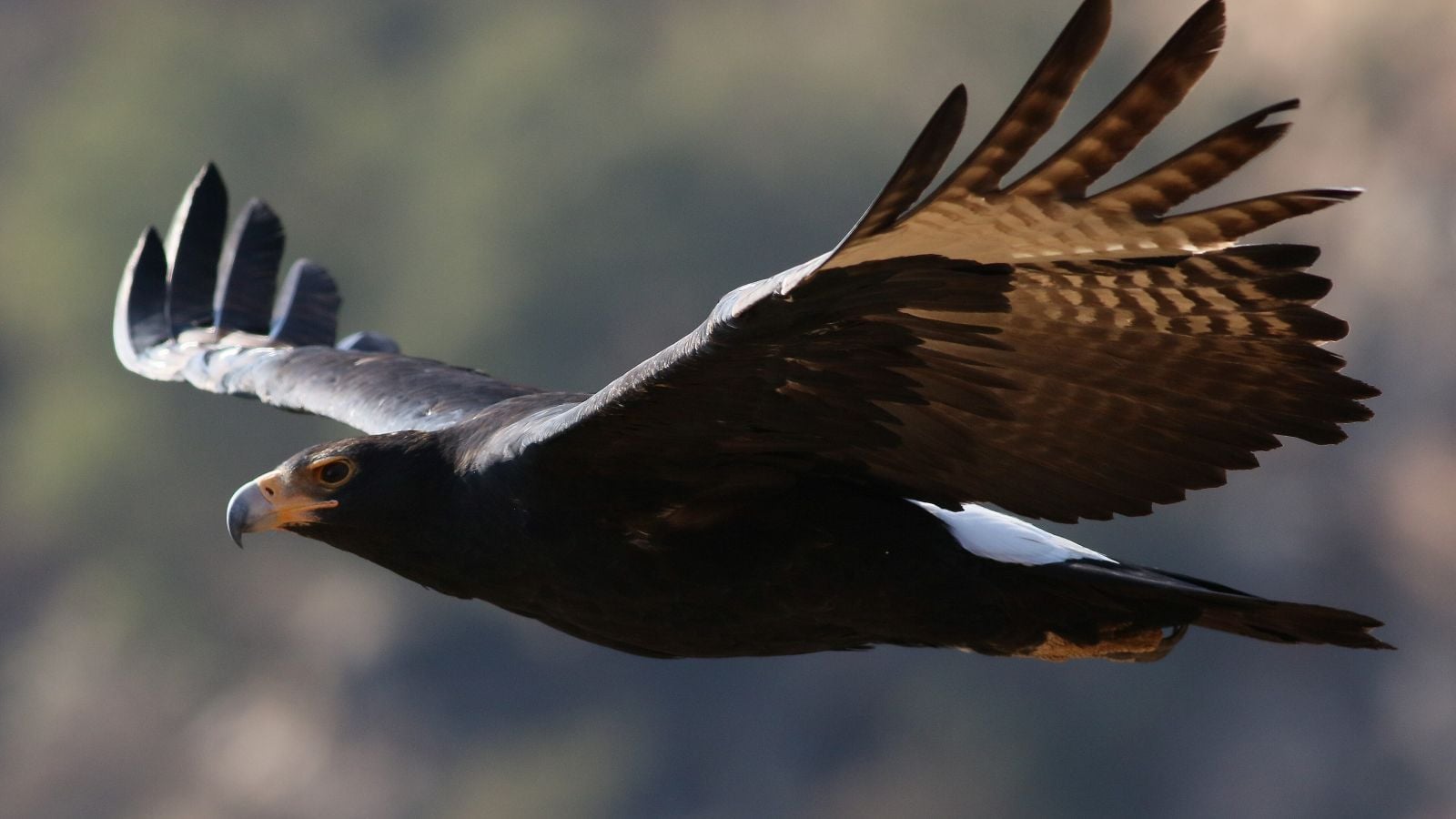
A Verreaux’s eagle in flight in South Africa.
Image credit: Derek Keats, CC BY 2.0, via Wikimedia Commons
Scientists working in the Sahara of northern Chad have found baboon skeletons with eye-socket punctures and shoulder damage consistent with eagle talons, including an adult male that weighed an estimated 58 pounds. That is roughly double the weight of the heaviest primate confirmed to have been killed by a bird of prey, according to a paper in the American Journal of Biological Anthropology published November 18.
The finding reopens an old question about our own ancestors. Some researchers have treated 44 pounds as the upper limit for primates that eagles will attack, a rule of thumb that also shaped how scientists think about early humans, known as hominins, of similar size. If the Chad evidence holds up, some of those ancestors may have had to watch the sky.
That 44-pound limit has roots in research on the Taung child, a young Australopithecus africanus whose remains were found alongside those of other animals. In 1995, researchers Lee Berger and Ron Clarke argued that eagles had accumulated many of the remains, which came from animals weighing up to 44 pounds. That helped shape assumptions about how large a primate an eagle could prey upon.
Catherine Hobaiter and her co-authors, from five institutions including St Andrews and Dartmouth College, surveyed the Ennedi Plateau, a sandstone landscape of cliffs and canyons, in early 2025. Hobaiter said in a University of St Andrews release that the team never imagined the eagles they saw as a threat until they found a skull with a puncture mark, then another, and another. Two adult male skulls had eye-socket punctures resembling those on the Taung child, and one also had a raked right shoulder blade, damage associated with crowned eagles. A return trip in June 2026 turned up a partial skeleton with similar injuries from a male the team estimates at 58 pounds (26.2 kilograms).
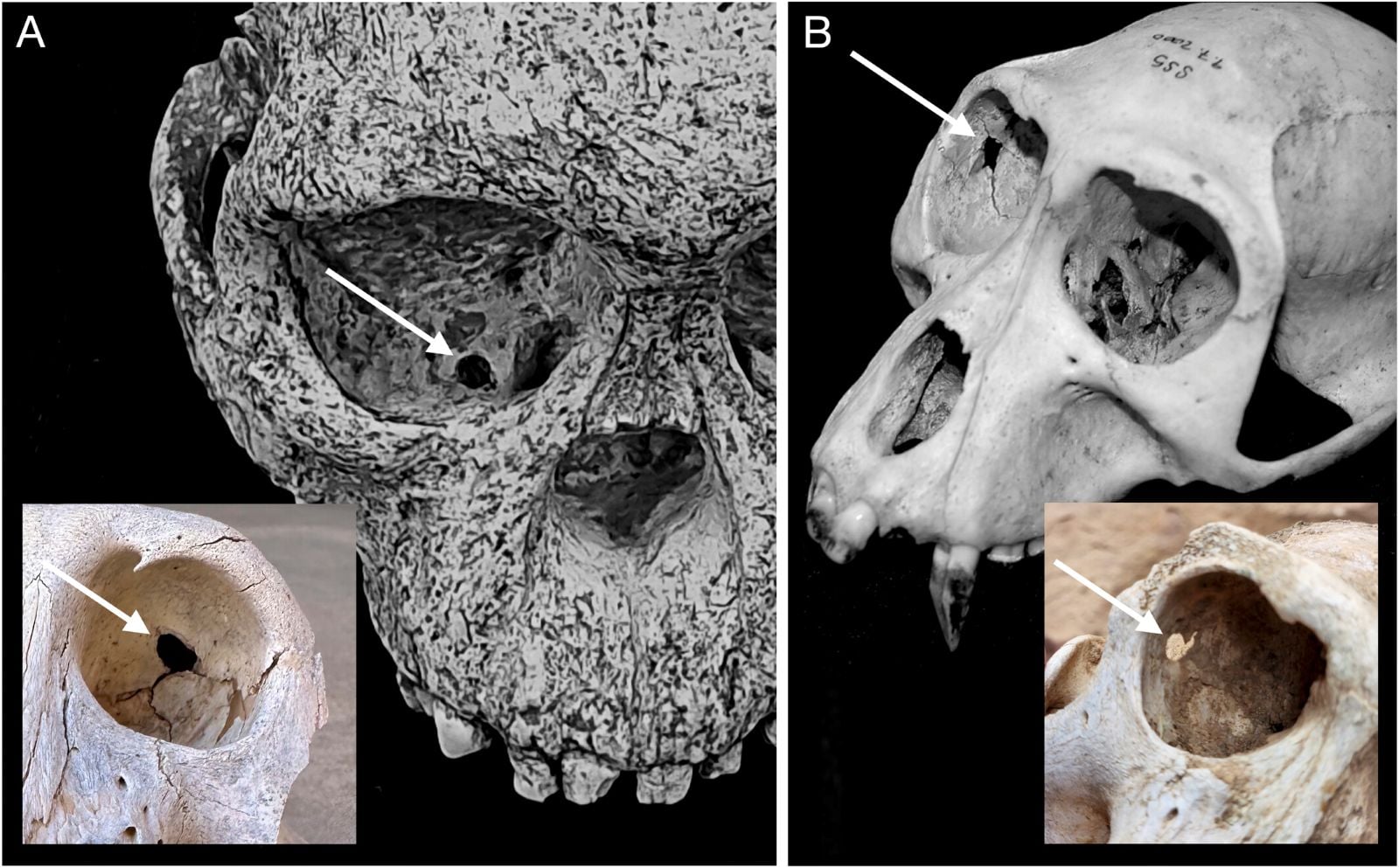
Talon punctures (arrows) in the eye sockets of the Taung child (A) and a monkey skull from a crowned eagle’s prey remains (B). The insets show similar punctures in baboon skulls from the Ennedi Plateau.
Image credit: Hobaiter et al., American Journal of Biological Anthropology, CC BY 4.0
The researchers found none of the broader skull damage a gunshot would leave or the crushing and tooth gouges typical of fights between male baboons. They acknowledge that scavenging cannot be ruled out, but argue that the severity of the punctures and the predominance of adult males among the remains favor predation, though no one has observed an eagle kill an adult baboon. Senior author Nathaniel Dominy of Dartmouth College said his team's skepticism "slowly gave way to acceptance" as the evidence accumulated.
An outside eagle specialist is not convinced. Jesús Bautista-Rodríguez, coordinator of the Desert Golden Eagles Project, told Live Science the marks are "compatible with eagle talons and feeding activity" but could have been made while eagles handled and fed on animals that were already dead, dying, or too weak to defend themselves.
Verreaux's eagles, the species the researchers suspect, sometimes hunt in pairs, with one bird startling prey while the other attacks. Their talons can span approximately 16 inches. When a pair swept overhead during the June trip, Hobaiter said, the baboons gave alarm calls and dropped to safety, though they had stayed relaxed around other large birds of prey.
Studies of predators that threatened early humans have largely focused on big cats, but the new findings suggest eagles deserve attention too. The Taung child provides evidence that eagles may have preyed on young hominins. If eagles could also kill adult baboons weighing nearly 60 pounds, early human ancestors of similar size, including Lucy, may have been vulnerable as well. The researchers suggest that aerial predators could have encouraged group defense and cooperation, although their influence on early human behavior remains speculative.
Read more: New fossils push a key human ancestor back 200,000 years

