

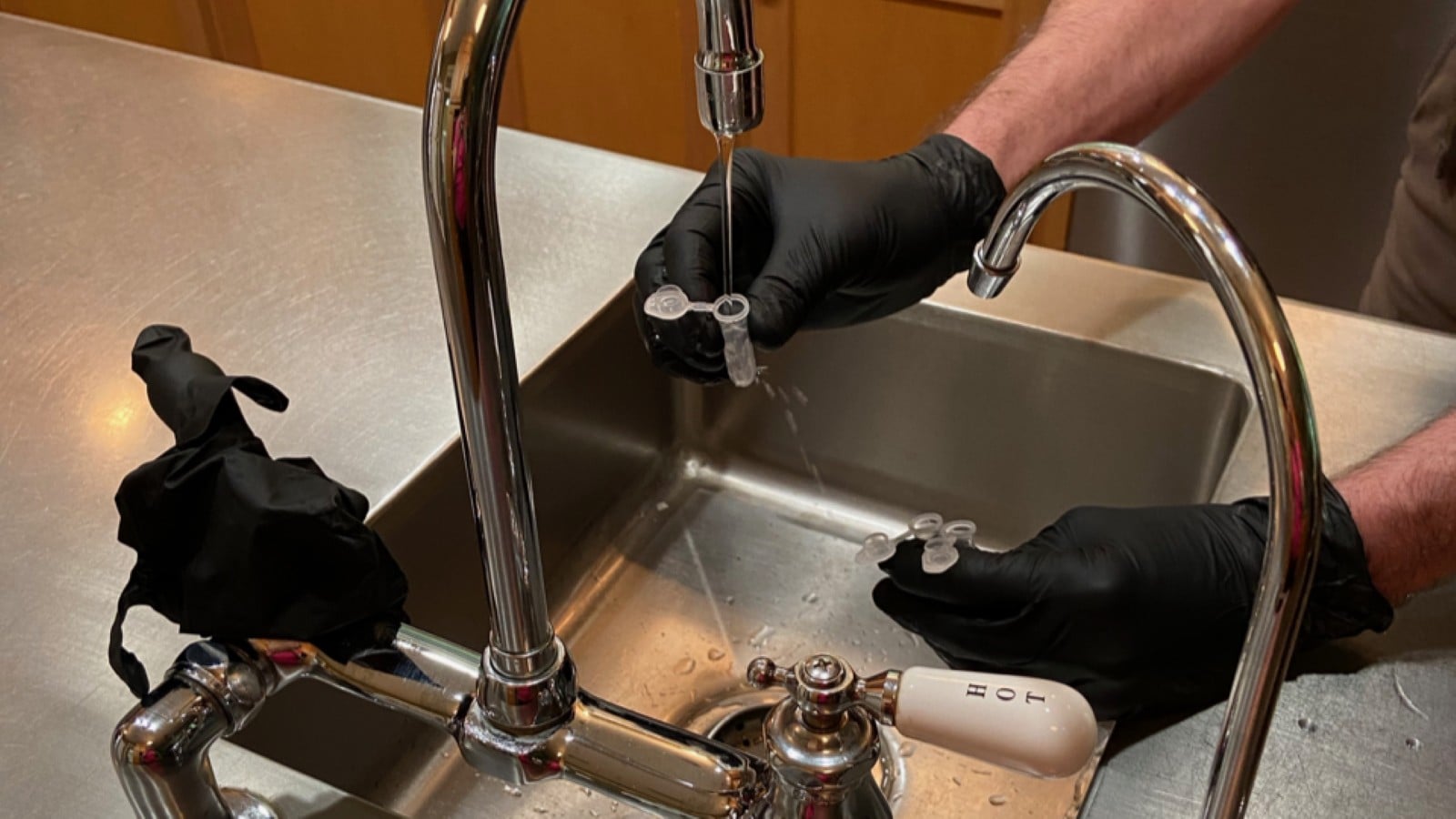
A USGS scientist collects tap-water samples for PFAS testing. A new study suggests conventional reporting methods may underestimate low-level forever chemicals in U.S. drinking water.
Image credit: Paul Bradley/U.S. Geological Survey
Americans may have more forever chemicals in their drinking water than testing reports suggest. A new study found that conventional reporting methods could underestimate average PFAS concentrations by more than half.
The problem isn't that laboratory testing is missing the chemicals entirely. It's what happens when concentrations are too low to measure reliably.
The Environmental Protection Agency's national monitoring program tests drinking water for 29 PFAS. For each chemical, the agency establishes a minimum reporting level – the smallest concentration that laboratories can reliably measure and report. These limits range from 2 to 20 parts per trillion. If a chemical is present below its reporting limit, it may go unreported even though it is still in the water.
In a study published October 23 in Cell Reports Sustainability, researchers analyzed more than 1.8 million PFAS testing records from the EPA's national drinking-water monitoring program.
They found that approximately 98% of individual results fell below the EPA's laboratory reporting limits and were treated as zero for the average contamination levels. Using statistical models to estimate the missing concentrations, the researchers calculated that conventional methods captured just 44% of the estimated average PFAS concentration across 9,991 community water systems.
For six PFAS covered by federal drinking-water regulations, the conventional calculation produced an average concentration of approximately 2.6 parts per trillion, compared with the newly modeled estimate of 5.2 parts per trillion.
What the PFAS findings mean for drinking water safety
PFAS, short for per- and polyfluoroalkyl substances, are synthetic chemicals used in products ranging from nonstick cookware to stain-resistant fabrics and firefighting foam. They're called forever chemicals because many break down extremely slowly in the environment. Exposure to certain PFAS has been linked to cancer, liver damage, and developmental problems in children.
The EPA's laboratory reporting limits are not equivalent to a safety limit. Reporting limits are based on laboratory measurement capabilities, while drinking-water standards are based on health risks and what can feasibly be measured and removed.
For example, the reporting limit for PFOA and PFOS is 4 parts per trillion, the same as the federal enforceable drinking-water limit. But the EPA's health-based goal for both chemicals is zero, reflecting its determination that no exposure level is considered risk-free.
The study doesn't establish that individual water systems are exceeding federal safety standards or determine whether the estimated additional contamination poses a health risk. But it suggests that current reporting methods may give an incomplete picture of PFAS exposure.
How to reduce PFAS in your drinking water
If you're concerned about PFAS, start by checking your local water utility's testing results. You can also search the EPA's national drinking-water monitoring database.
A home water filter can reduce certain PFAS, but not all filters are effective. The EPA recommends looking for products independently certified under NSF/ANSI 53 or NSF/ANSI 58 specifically for PFAS reduction.
For an affordable option that doesn't require installation, consider a water filter pitcher certified for PFAS reduction. Under-sink reverse osmosis systems certified for PFAS reduction generally cost more and require additional maintenance, but can reduce a broader range of contaminants.
Before buying, verify the exact model's PFAS-reduction claims in an independent certification directory. Certification for removing PFOA and PFOS doesn't guarantee that a filter removes every forever chemical, and filters must be replaced according to the manufacturer's instructions to remain effective.
The study doesn't mean everyone needs a water filter. But understanding what your water-testing results measure – and choosing a properly certified filter if needed – can help you make a more informed decision.

