

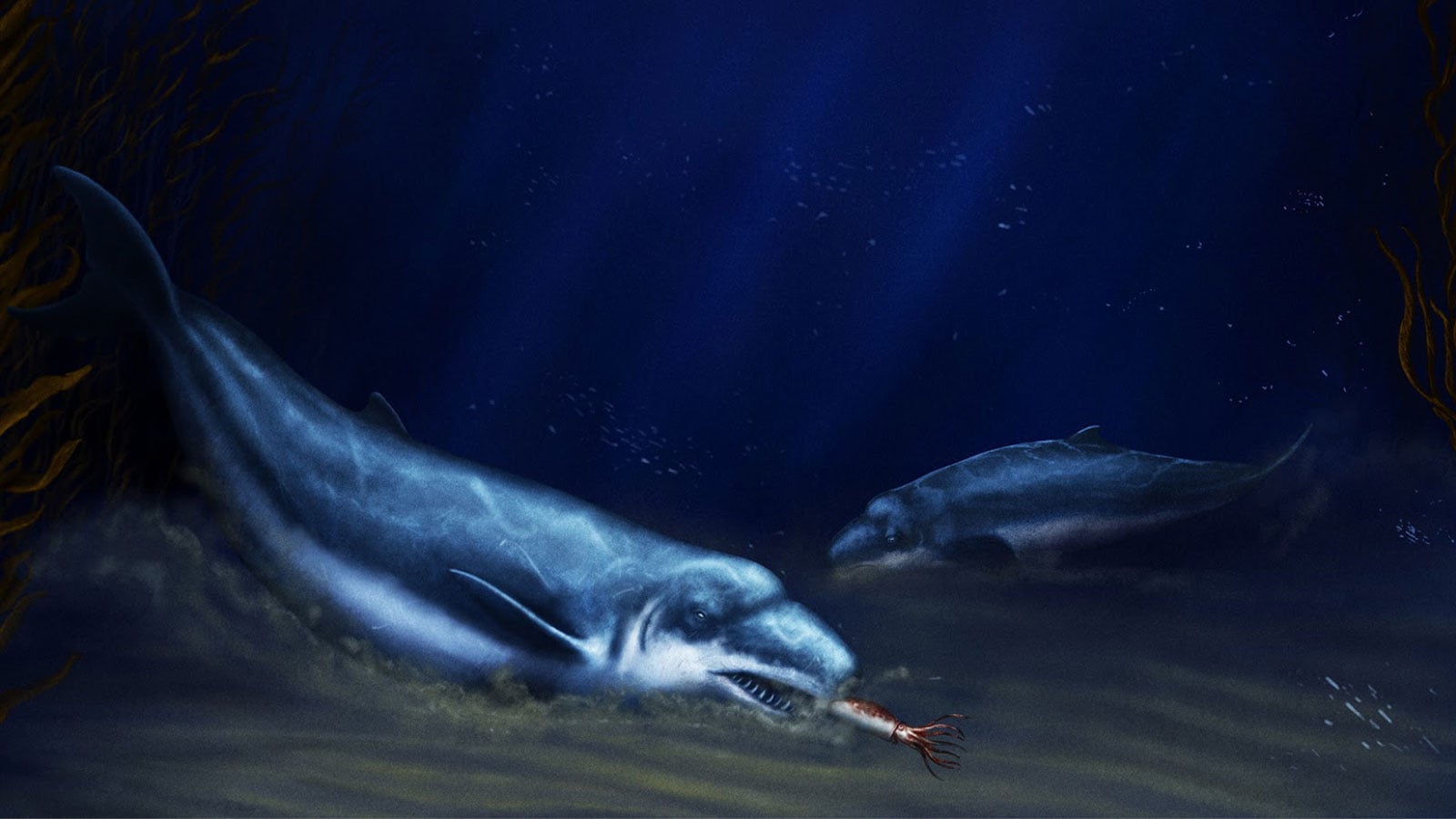
The extinct pygmy sperm whale Scaphokogia huachafo lived about 6 million years ago and had a downward-curving snout adapted for feeding near the seafloor.
Image credit: Jaime Bran Sarmiento / University of Zurich
Scientists have identified a new kind of prehistoric whale with what may be the most lopsided face of any mammal ever found. The roughly 9-foot-long whale, named Scaphokogia huachafo, lived off the coast of what is now Peru about 6 million years ago. Its skull is twisted to one side, and its snout points down toward the seafloor, a look with no direct match among living whales, according to a study published today in Communications Biology.
The skull was discovered in the mid-1990s in a desert in southern Peru that's famous for well-preserved fossils of sea creatures. It was sitting in a museum collection in Lima in 2015 when lead researcher Aldo Benites-Palomino, then a college student, came across it while working on his thesis. The team named it huachafo, a Peruvian word for anything bizarre, flashy, or over the top. "Its anatomy is so extravagant and odd that huachafo seemed the perfect name for it," Benites-Palomino said in a University of Zurich announcement.
A slightly crooked skull is normal for dolphins, sperm whales, and other toothed whales. Their foreheads hold specialized nasal structures they use to make clicking sounds, and they listen for the echoes to find food, a natural sonar called echolocation. Scientists link the lopsided shape of the skull to that sound-making equipment.
"Both bony nostrils are shifted entirely to the left side of the skull," Benites-Palomino said. "The skull looks completely crooked." The left nostril opening is much bigger than the right, and the bones around the nostrils don't match from side to side. After comparing its face with those of 30 other kinds of toothed whales, living and extinct, the researchers say this whale and its closest relatives have the most lopsided faces ever documented in whales, dolphins, and porpoises.
The team first had to make sure the skull hadn't simply been squashed out of shape during millions of years underground. The rest of the skull showed no signs of being bent or crushed, which suggested to the researchers that the crooked face was original. Its fully closed skull bones also show it was a full-grown adult.
Huachafo's snout was a thick, heavy tube of extra-dense bone and cartilage that had hardened into bone, angled 31 degrees toward the seafloor. The added weight worked like a scuba diver's weight belt, shifting the animal's center of gravity forward and down. Walruses and manatees also carry extra-heavy bones, which help bottom feeders hold their position underwater.
To understand how much the head could move, the researchers examined another fossil from the same group of whales, the only one with its first neck bone preserved. Their reconstruction suggests that even with its head raised as high as possible, the snout still pointed downward.
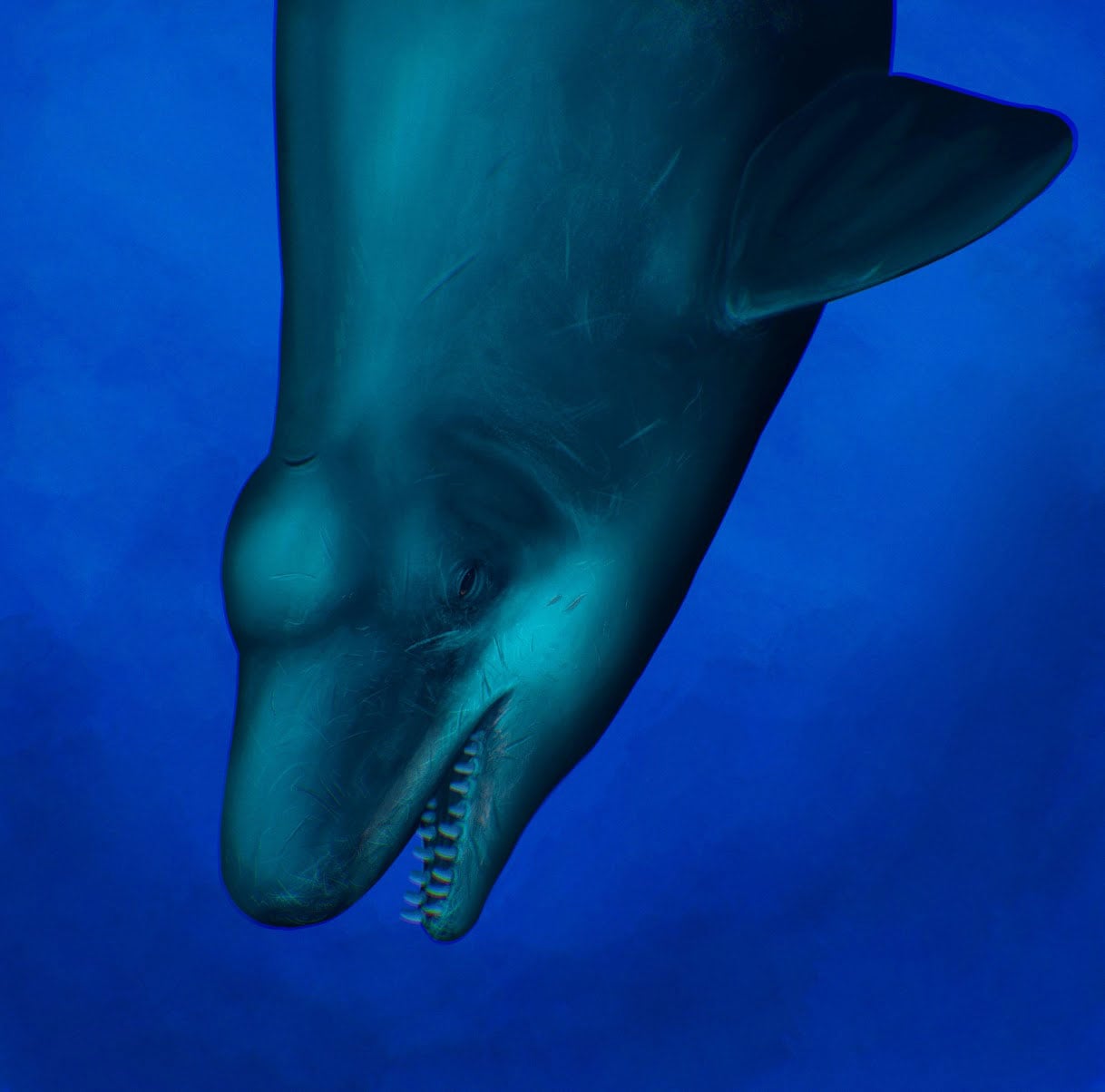
Scientists believe the whale's crooked skull and downward-curving snout helped it locate prey near the seafloor.
Image credit: Jaime Bran Sarmiento / University of Zurich
Today's sperm whales hunt squid deep in the ocean. The researchers think S. huachafo fed along the bottom of shallow coastal waters instead. Other bottom-feeding marine mammals often rely on sensitive whiskers or specialized vision to find food. Because the researchers found no skeletal evidence of similar adaptations in this whale, they suspect it used echolocation to search the soft seafloor for hidden prey.
Other unusual bottom feeders shared those waters, including a walrus-like dolphin that also had a downturned head. But as ocean conditions changed millions of years ago, this specialized way of life disappeared.
You can explore just how crooked huachafo's skull was yourself by rotating this 3D model of the fossil.
Read next: X-rays reveal what the 'oldest reptile' fossil was hiding

