

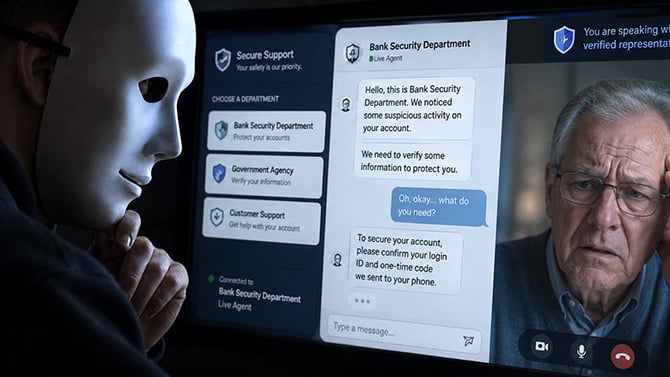
Americans reported losing $3.5 billion to imposter scams last year, according to Federal Trade Commission (FTC) data released today, June 15, 2026. Imposter scams are schemes where fraudsters pose as someone trustworthy (a government agency, your bank, a well-known company) to steal your money or personal information. Losses have nearly tripled since 2020, and the FTC says the $3.5 billion figure almost certainly understates the true scale of the problem since most victims never file a report.
Imposter scams topped every other fraud category the FTC tracks, accounting for nearly one in three fraud reports in 2025. The playbook varies, but the most expensive version follows the same script: a fake security alert, typically dressed up as a message from your bank, tells you your money is in danger and instructs you to move it somewhere "safe." By the time the victim realizes they've been manipulated, the money is gone.
Bank impersonators drove nearly $1 billion in reported losses alone. Government impersonators weren't far behind, at $920 million, up from $789 million in 2024. These scams arrive through every available channel: text messages, phone calls, email, social media, and, increasingly, search engine results that direct people to fraudulent websites designed to look like the real thing. A good security suite with web protection can flag those sites before you interact with them.
The imposter scam numbers sit inside a broader fraud picture. Total reported fraud losses reached $16 billion in 2025, a 25% jump over 2024 and the highest figure the agency has ever recorded.
To push back, the FTC joined a public-private coalition that includes the American Bankers Association, Google, Microsoft, and USTelecom for a "Never Ever" awareness campaign running through June 26. The message is deliberately blunt: the government will never tell you to move your money to protect it, will never threaten to cut off your benefits unless you pay immediately, and will never demand payment via gift card, wire transfer, cryptocurrency, or payment app. Anyone who does any of those things is a scammer.
The campaign alone won't fix this. The FTC finalized its Impersonation Rule in 2024, giving the agency authority to pursue federal court cases and seek direct financial relief for victims. Since then, it has brought a dozen enforcement actions and recovered more than $70 million in consumer redress. Recent targets include an April 2026 complaint against Innovative Partners, which the FTC alleges impersonated government agencies and major insurance carriers to sell consumers fake PPO health plans.
Seventy million dollars recovered against $3.5 billion lost is not a satisfying ratio. The FTC's enforcement tools are stronger than they were two years ago, but scam operations continue to outpace the response. If you've been targeted, report it at ReportFraud.ftc.gov.
[Image credit: Suzanne Kantra/Techlicious generated by ChatGPT]

