
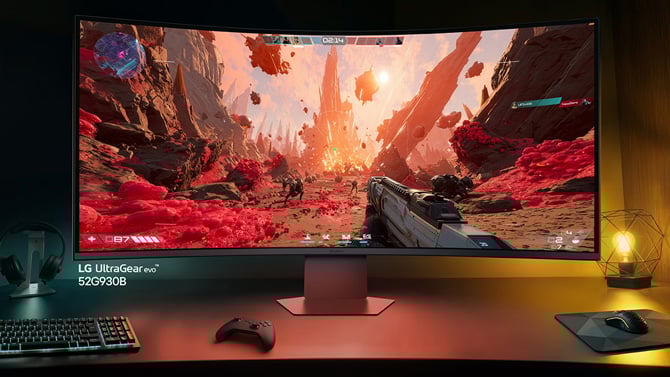
If you’re going to build a 5K gaming monitor, you should also solve the biggest problem with owning one – a lot of the content people actually use doesn’t come anywhere close to 5K. LG clearly gets that. With its new UltraGear evo monitors, the company is doing something that feels obvious: putting AI upscaling directly into the monitor itself.
Normally, monitors are brutally literal. They display whatever resolution they’re fed and let your GPU or console do the rest. Hook a Nintendo Switch or another Full HD source to a 4K or 5K display, and the monitor simply stretches those pixels to fill the screen. The result is predictable – softer images, blurrier edges, and fine details that look rough or jagged because they were never meant to be blown up to this size.
LG is borrowing a page from its TV playbook. Instead of relying on basic scaling, these new UltraGear evo monitors use an on-device processor to analyze the incoming image and intelligently rebuild it before it hits the panel. That’s the same idea behind LG’s TV upscaling, now adapted for monitors, and it’s why LG is calling these the world’s first AI-upscaled 5K monitors. Instead of just stretching pixels, the monitor attempts to preserve edges, textures, and detail, which should result in a cleaner, sharper image than traditional upscaling can manage.
Read more: Lenovo's All-in-One PC Brings an Immersive Experience to the Desktop
This also has practical benefits for gamers. Since LG’s AI upscaling runs on the monitor itself, not the GPU, you don’t need a monster graphics card to make high-resolution content look good. You can lower the output resolution from your PC to boost frame rates, then let the monitor upscale it back to its native resolution using LG’s AI Boost. It’s a clever workaround for anyone chasing smoother gameplay without sacrificing image quality.
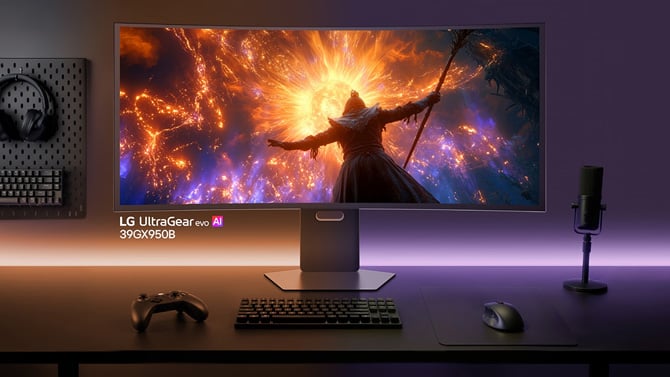
The 2026 UltraGear evo lineup includes the 39-Inch 5K2K OLED Gaming Monitor, 27-inch UltraGear evo GM9 5K Mini LED Gaming Monitor, and the 52-inch UltraGear evo G9 5K2K Mini LED. The OLED monitor uses a 4th Gen RGB Tandem OLED, which is capable of displaying 99.5% of the DCI-P3 color space, have a 0.03 ms response time and refresh rates of 240Hz at 5K resolution and 480Hz at Full HD resolution. The 52-inch G9 displays 95% of the DCI-PC color space, has a 1ms response time, and a refresh rate of 240Hz. The 27-inch Mini LED displays 99% of the DCI-P3 color space, has a 1 ms response time and refresh rates of 165Hz at 5K resolution and 330Hz at QHD resolution. The UltraGear evo line is set to ship sometime in May 2026. Pricing has yet to be announced.
Read next: CES 2026 Editor's Choice Award Winners
[Image credit: LG]