

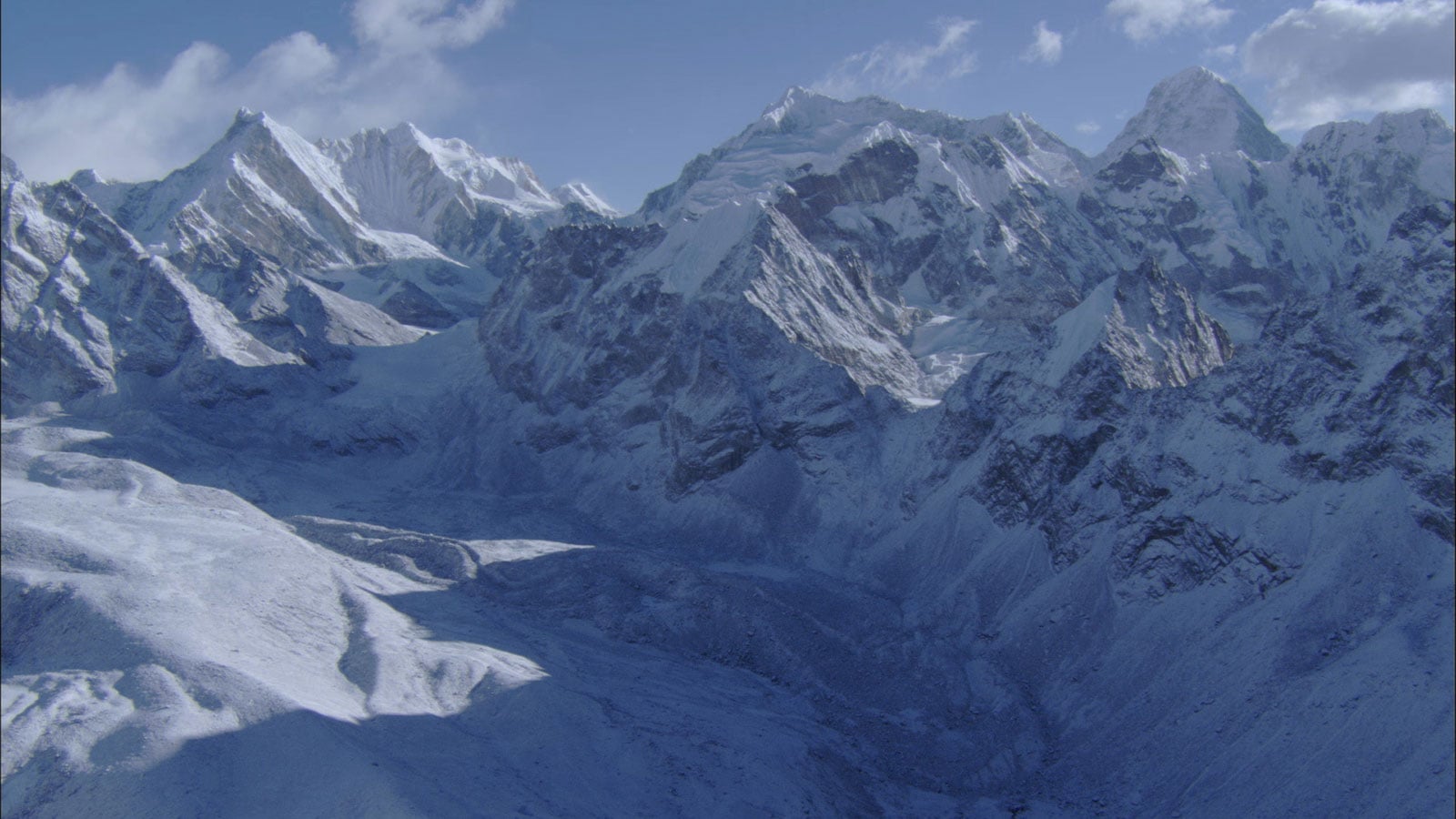
Himalayan mountain peaks
Image credit: NASA
Antarctica’s ice sheet hides the eroded roots of mountain ranges on the scale of the Himalayas, according to a study involving researchers from the Australian National University and the GFZ German Research Centre for Geosciences. The authors argue that erosion of these ranges flooded ancient oceans with nutrients and raised atmospheric oxygen, conditions that may have made the Cambrian explosion possible. That event was a dramatic burst of animal diversity that followed the appearance of the first shellfish.
The ranges formed between 650 million and 450 million years ago, as Gondwana, the supercontinent linking Antarctica with Africa, India, and Australia, came together. Antarctica’s collisions with India and Africa produced what co-author Ian Campbell, an emeritus professor at ANU, calls “by far the largest mountain-building events to have affected Antarctica.”
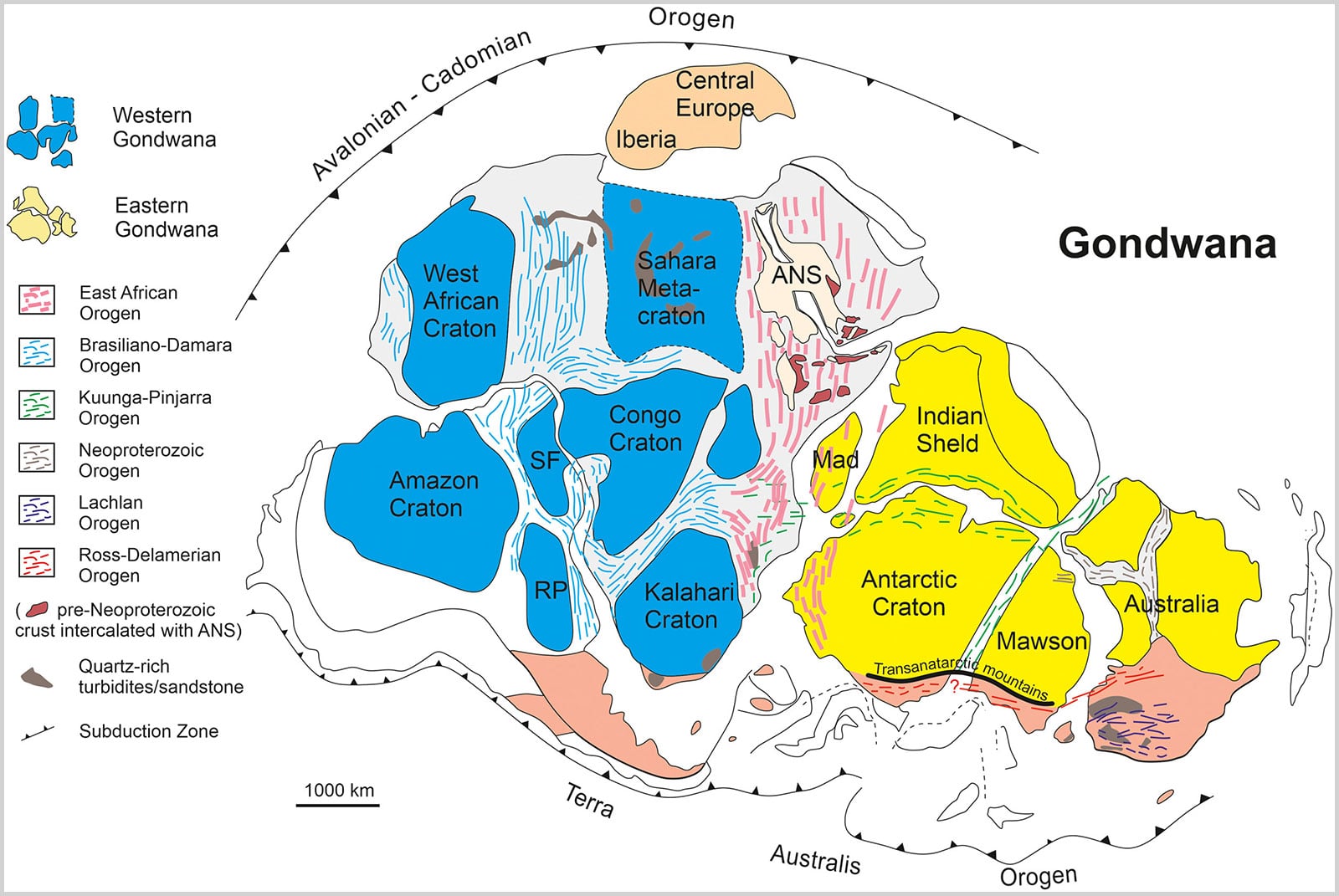
Reconstruction of Gondwana showing the ancient continental blocks and mountain-building regions that once connected Antarctica to other landmasses.
Image credit: Bei Chen and Ian H. Campbell / Earth and Planetary Science Letters (2026), adapted from Gray et al. (2008)
Ice covers nearly all of Antarctica, so the team studied zircon grains from ocean-drilling sediments around the continent’s margin. Zircon is a trace mineral found in many rocks, and each grain keeps a record of its age and the chemistry of the rock where it formed. Some carry a high-pressure signature from the deep roots of Himalayan-style mountains, and their ages cluster in the window when Gondwana came together.
When the researchers combined the Antarctic data with a global zircon database, Gondwana’s assembly came out as the largest mountain-building episode in the record, with more zircons traced to it than to the assembly of any other supercontinent. The paper also reports that, during the critical stretch leading up to the Cambrian explosion, nearly half the zircons came from Antarctica and southeastern Australia.
Wearing down big mountains washes nutrients such as phosphorus and iron into the sea, and the authors say those nutrients fed blooms of oxygen-producing algae and cyanobacteria. Fast-forming fans of sediment then buried the carbon those organisms made before it could decay and use up the oxygen again, which left more of it in the air. The Antarctic collisions came late in Gondwana’s assembly, according to ANU, which extended the nutrient supply into the Cambrian.
The authors say their oxygen calculation shows this scenario is feasible, but they stop short of calling the collisions a cause of the Cambrian explosion. What the data show is a match in timing: the planet’s most dramatic period of evolution coincides with its most important period of mountain building.
Read next: Earth microbes grow in simulated ocean of Saturn's moon

