

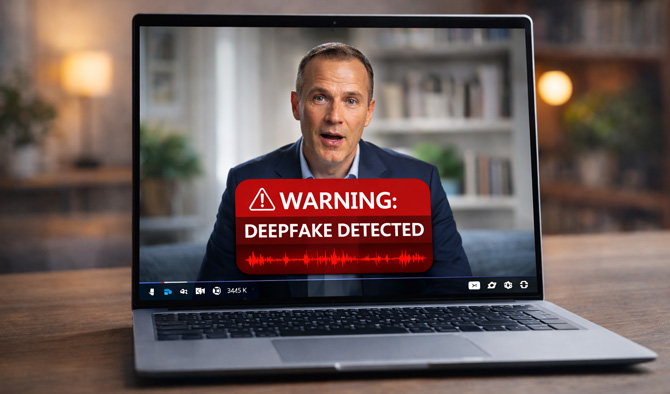
If you’ve spent any time on Instagram, TikTok, Facebook, or YouTube lately, you’ve probably had a moment where you paused mid-scroll and wondered, Is this real?
That used to be a rare reaction. Now it’s becoming routine.
There’s an important difference people need to understand. Some videos are clearly AI creations meant for entertainment – the trampoline-jumping bunnies, the fake movie trailers, the impossible stunts. You might be fooled for a second, but there’s no intent to deceive you into doing anything. Then there are deepfake scam videos. These use AI to impersonate a real person – a celebrity, politician, financial expert, or brand – with one purpose: to trick you into clicking, paying, or “investing.”
That second category is growing fast. And it’s getting good.
Even as someone who has spent years working around manipulated images and video, I’m finding it harder to tell what’s real and what’s not. For the average person, a video of a well-known public figure calmly explaining a “new opportunity” or endorsing a platform can be incredibly persuasive. When the voice, the facial expressions, and the timing all line up, your instincts don’t kick in the way they used to.
Read more: How AI Crypto Influencers on YouTube Are Stealing Real Money
According to new data from Avast, this isn’t happening at the edges of the internet. In Q4 2025, Gen Threat Labs detected 159,378 unique deepfake scam videos that combined manipulated media with clear scam intent. These weren’t suspicious downloads or shady attachments. They were woven directly into normal browsing on YouTube, Facebook, and X – right where people casually scroll every day.
That’s what makes this wave of scams different. They hide in plain sight.
Scammers don’t need the video to be perfect. They just need it to be convincing for 30 seconds – long enough for you to trust it and follow instructions. And the old tells we relied on, like awkward lip movement or robotic voices, are disappearing quickly as AI tools improve.
This is why Avast’s new Deepfake Guard feature for Windows PCs takes an unusual approach. Instead of trying to analyze what you’re seeing, it analyzes what you’re hearing. Deepfake Guard listens to the audio in videos in real time and looks for the subtle artifacts left behind when a voice has been synthetically generated or manipulated. If it detects those patterns, it warns you while you’re watching.
Because the detection runs locally on your PC, it works as you browse sites like Instagram, TikTok, YouTube, Facebook, Twitch, Vimeo, and others, without sending the video off to the cloud for analysis. Most importantly, it’s designed for the moment when people actually get fooled – not when they’re downloading files, but when they’re simply watching.
Deepfake Guard is part of Avast’s broader Scam Guardian protections and is included with Avast Premium Security (starting at $49.08 for one Windows PC and one mobile device for the first year). It runs on most Windows 11 PCs, with automated detection optimized for newer AI-ready machines from Intel and Qualcomm. On older systems, people can still opt in, though Avast notes there may be a small performance impact.
Read next: Instagram Launches TV App to Battle YouTube Shorts
[Image credit: Suzanne Kantra/Techlicious via ChatGPT]

