

The first week home with my first baby, I remember panicking about whether she was getting enough milk. She nursed constantly, seemed fussy, and I had no way of knowing if that was normal or a sign that something wasn’t working. I even bought formula, just in case. In hindsight, she was fine, but in that moment, I would have loved some reassurance.
By the time I had my second and third children, I knew what to expect. I trusted my body more, understood my babies’ feeding patterns, and didn’t feel the same anxiety. That’s why when I saw Coroflo’s Coro breastfeeding monitor at CES 2026, my reaction was mixed. It’s an elegant solution to a real problem, but it’s not a problem every mother needs solved for very long.
Where Coro becomes genuinely compelling is for women who are struggling with milk production, premature babies, latch issues, or situations where feeding isn’t going smoothly. In those cases, uncertainty isn’t just stressful; it can be the difference between continuing to breastfeed and giving up earlier than planned.
That uncertainty is surprisingly common. In the U.S., about 83% of mothers start breastfeeding, but by 6 months, only about 25% are still exclusively breastfeeding. In Europe, the rates are even lower. One of the main reasons women stop earlier than they intend to isn’t pain or inconvenience; it’s not knowing whether their baby is actually getting enough milk.
Coroflo was founded by parents who ran straight into that problem themselves. Two of the co-founders, Helen and Jamie, experienced the stress of trying to assess milk intake with their first child and found that the only available option was clinical weigh-ins before and after feeds, a process that’s inconvenient, inconsistent, and not especially precise. Along with a third co-founder, Rosanne, they set out to build something better.
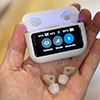
The result is Coro, a soft silicone nipple shield with a tiny, non-invasive sensor embedded inside it. As a baby feeds, Coro measures the amount of milk flowing through the shield in real time and sends that data to a phone app. There are no wires, no chargers, and no external hardware; it’s completely self-contained.
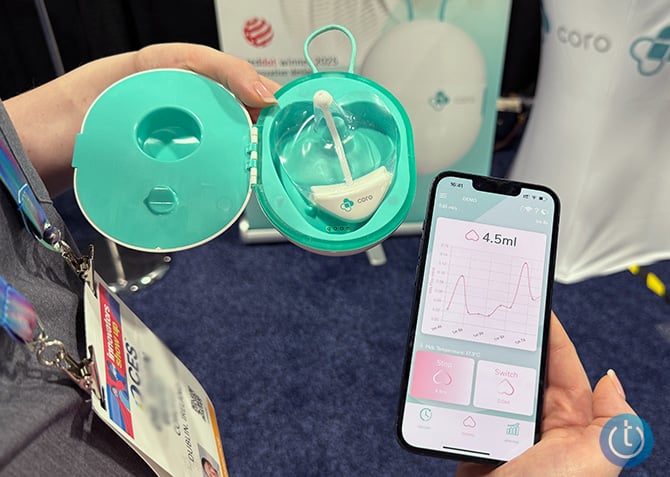
In practical terms, that means you can see exactly how much milk your baby consumed during a feed, track volume separately for each breast, and review patterns over days or weeks. You can see how long feeds last, how intake changes over time, and what a “typical” feed looks like for your baby.
That kind of data isn’t something most breastfeeding parents have ever had access to. And that’s both Coro’s strength and its risk.
On the positive side, it can be enormously reassuring and empowering, especially for parents dealing with low supply, slow weight gain, prematurity, or medical guidance to closely monitor intake. It can reduce guesswork, avoid unnecessary supplementation, and give parents concrete feedback instead of vague advice.
Read more: This Kid-Friendly Humidifier is Perfect for New Parents
But there’s a flip side. For parents whose breastfeeding is going well, constant measurement can become a new source of anxiety instead of reassurance. It’s easy to imagine someone fixating on numbers that naturally fluctuate or worrying when a feed looks “low,” even though their baby is thriving. Breastfeeding isn’t a factory process, and not everything benefits from being quantified.
That’s why I see Coro less as a universal must-have and more as a targeted tool. It’s most valuable when something isn’t working smoothly – when parents need answers, not just encouragement. For them, Coro can replace stress with clarity, and clarity with confidence.
For everyone else, it’s probably something you outgrow quickly, just as I outgrew my early worries once experience replaced uncertainty.
Coro doesn’t change what breastfeeding is. But in the moments when breastfeeding feels confusing, fragile, or at risk of falling apart, it offers something genuinely useful: real information in a situation that usually has very little of it.
Read next: Techlicious CES 2026 Spotlight Award Winners
[Image credit: Suzanne Kantra/Techlicious]