

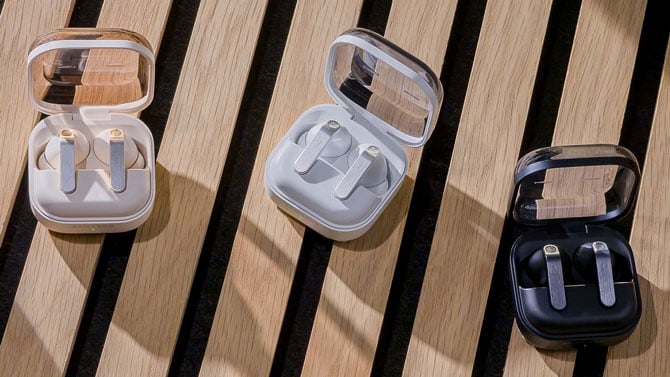
Image credit: Samsung
As the two of the biggest-selling Bluetooth earbud brands, Apple and Samsung will soon compete in a category in which neither company has any real expertise: hearing aids.
Samsung recently received FDA clearance to add over-the-counter (OTC) hearing aid functionality to its Galaxy Buds3 Pro and Galaxy Buds4 Pro buds, both of which sell for around $250, the same as Apple's hearing aid-enabled AirPods Pro. Samsung's hearing aid functions are due to become available sometime this fall for compatible Galaxy devices running One UI 8 or later.
On paper, Samsung appears to have checked all the OTC hearing aid boxes. Users can take a five-minute smartphone app hearing test that generates an audiogram for each ear. That audiogram is then fed into the earbuds to correct the wearer's unique hearing loss profile.
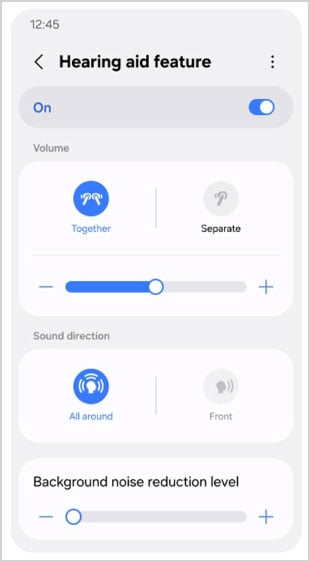
Image credit: Samsung
With its addition of hearing aid functions into the Galaxy Buds 3 Pro and Buds 3 Pro, Samsung seeks to address the growing demand for more accessible, reputable, and lower-priced hearing help. According to the World Health Organization, more than 1.5 billion people worldwide experience some degree of hearing loss, a number expected to grow to 2.5 billion by 2050. Yet many people who could benefit from hearing aids never obtain them because of cost, limited access to hearing-care professionals, prescription hearing aids costing in the thousands of dollars, or the stigma some still associate with wearing traditional hearing aids.
This isn't the first time Samsung has tried to address the need for hearing assistance. In 2023, they added the ability to amplify ambient sound through the Samsung Wearable app for the Galaxy Buds 2 Pro. In my testing, I found the feature to be useful for occasional use, not as a replacement for even a cheap pair of dedicated Personal Sound Amplification Devices. With OTC hearing aid FDA clearance, the Buds 3 Pro and Buds 4 Pro should be proper hearing aids.
Bluetooth bud and hearing aid paradoxes
Samsung’s hearing aid add-on, which follows Apple’s hearing aid-equipped AirPods Pro 2 and AirPods Pro 3 into the category, raises an intriguing question: What has Samsung learned from Apple and other makers of dual Bluetooth earbuds + hearing aids such as the HP Hearing Pro ($399) to solve the natural paradox between hearing aids and Bluetooth buds designed for music listening?
Traditional open-fit hearing aids allow ambient sounds to enter the ear canal naturally to mix with amplification to create a natural hearing experience. Conversely, closed Bluetooth earbuds are designed to seal your ear canal from outside sound to improve high (treble) and low (bass) frequency response as well as aid noise cancellation.
These paradoxical usage profiles have been addressed by dual Bluetooth bud/hearing-aid makers such as HP and Apple, which require compromises, usually at the expense of hearing aid performance.
Samsung, Apple, and other makers of dual Bluetooth bud/hearing aids face three problems, all produced by a Bluetooth buds’ inherent primary design as a music-listening device:
- Creating an open natural blend of ambient and amplified sounds through a sealed buds’ transparency or “ambient” mode.
- Eliminating the plugged-up sensation — and the unnatural sound of your own voice – that sealed earbuds produce.
- All-day battery life. Dedicated hearing aids are designed to operate “all day” on a single charge. But Bluetooth earbuds typically prioritize compact size, music playback, and phone calls over continuous hearing assistance, result in Bluetooth battery life rarely topping six hours on a single charge — hardly “all day” usage.
Read more: Elehear Delight review: The best budget OTC hearing aid
Can music-first buds be effective hearing aids?
This closed versus open bud conundrum doesn’t necessarily mean Bluetooth earbuds designed primarily for music listening can’t also dually serve as practical and effective hearing aids.
There are a few ways this could play out. Advanced processing could improve a closed buds’ transparency mode. Apple, Samsung, and others could bundle perforated silicone ear tips along with solid eartips to add a more “open” ambience. Or open-ear buds – currently the rage – could get FDA clearance as OTC hearing aids. Fast charging could overcome short Bluetooth bud battery life and allow quicker recharges during natural downtimes.
The Samsung-Apple hearing aid Bluetooth bud/hearing aid competition may intensify before year’s end. Industry rumors suggest Apple is preparing a next generation of premium AirPods, often referred to as AirPods Ultra, that will run on a new H3 chip which could include enhanced health/hearing capabilities, along with camera sensors to enhance gesture control. These rumors could be confirmed (or not) when Apple introduces its iPhone 18 next month.
If the AirPods Ultra rumors are true, the next battle between the world’s biggest Bluetooth bud makers may have less to do with music quality, noise cancellation, or battery life than which earbud can function most effectively as an open hearing aid and be worn comfortably all day.
Read next: The best open ear earbuds of 2026, tested

